Male entitlement has no place in the modern world
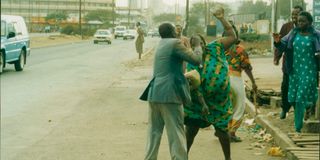
A woman struggles with a man.

What you need to know:
- The predicament Collins has created for himself is a result of patriarchal entitlement, a social and psychological disease that afflicts a huge number of men due to socialisation.
- A large number of men have a sense of entitlement to women’s time, labour, care and attention. This extends even to a belief that when they need sex, they must get it.
The viral post depicts a woman who returns home late at night to meet an infuriated husband demanding to know where she is coming from at that hour.
He dismisses as “rubbish” her attempts to calm him down to explain herself. He then asks whether she knows that there is no food in the house.
And with that, he slaps her so hard she collapses on the couch. Still in this state, he orders her to get his dinner ready and prepare to tell him why she switched off her phone.

As he walks towards the bedroom, he notices that she is not responding to the command. This annoys him even more. So he advances to administer more beating only to realise she is completely unresponsive.
In panic, he rushes her to hospital where the doctor informs him that she was there a few hours ago to take his mum for treatment.
“If she had been 10 minutes late,” he states, “your mum would have died.”
He is also told that she wanted to alert him but “her phone battery went flat.”
The doctor offered to call him but she said she would explain once at home. Mr Collins is then informed that while his mother is fine, the wife he just brought in did not make it. He breaks down in grief and disbelief.
The story concludes that it is now too late to correct his mistake. He should have controlled his anger, been patient and not brutalised her. It then appeals to the reader to *SAY NO TO DOMESTIC VIOLENCE! * and reminds us that the “difference between ANGER and DANGER is only D, which embodies “destruction, damage and death”.
The predicament Collins has created for himself is a result of patriarchal entitlement, a social and psychological disease that afflicts a huge number of men due to socialisation. In his Seven Ps theorisation about men’s violence, Michael Kaufman would classify Collins’ behaviour as “privilege”, the norm that many men consider certain things to be theirs by right.
A large number of men have a sense of entitlement to women’s time, labour, care and attention. This extends even to a belief that when they need sex, they must get it. It is so ingrained that in the 11th parliament, male parliamentarians dismissed marital rape as an imaginary concept when debating the Marriage Bill.
Entitlement also informs the belief that a woman who has appeared for a date has assented to intercourse. An excellent example of this psyche was in last week’s Sunday Nation in the story of Fatuma Kaingu who lost her sight from an acid attack by a man she had rejected.
“Why can’t some men understand that they can’t have every woman they desire?” lamented Fatuma’s mother.
“The Impossible Dream,” an animated video screened during a training for media and communications practitioners at the Aga Khan University last week, demonstrates men’s sense of entitlement.
In one scene, a man and his young son are banging plates with spoons as a way of demanding breakfast. They are incensed that the wife/mother has not yet served the meal while it is time to leave. One wonders whether the two are so mentally and physically incapacitated they cannot walk into the kitchen and serve themselves.
In other scenes, the man’s entitlement is shown in his expectation of the wife to pack his lunch bag, collect the clothes he has dropped on the floor on return from a drinking spree and pour beer into his glass as they watch television.
You wonder whether this man and his son can survive even for a day in the absence of the wife and daughter! Towards the end of the video, the woman dreams of a husband who assists and pays attention to her.
In the book Entitled: How Male Privilege Hurts Women, Kate Manne sees male entitlement as a manifestation of misogyny, which she defines as the “law enforcement” branch of patriarchy. She highlights the irony that while women are expected to provide feminine goods (sex, care and reproductive labour), they are denied the masculine equivalents (power, authority and claims to knowledge).
Essentially, entitlement generates men’s controlling behaviour over women, and what Manne refers to as “himpathy” – sympathy towards male perpetrators of violence rather than their female victims.
Like the Collins anecdote, which calls for an end to domestic violence, Manne notes that misogyny has no place in the modern world and must be eliminated.
And like the woman’s dream in the video, we must not only envisage an alternative world where women and men lead truly complementary lives devoid of entitlement, subordination, exploitation and violence. We must deliberately create it.
The writer lectures in Gender and Development Studies at South Eastern Kenya University ([email protected]).


