Mama Angel: Three times weekly, 200 souls find nourishment and dignity at her table
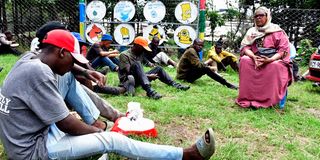
Hadija Shariff popularly known as Mama Angel (seated right) engages with some of the street boys who turned up for her free lunch at Kamukunji Grounds on May 8, 2025.

What you need to know:
- Hadija Shariff, known as "Mama Angel," has spent a decade feeding 200 street children and families three times weekly across Nairobi.
- Despite not being wealthy, this mother of seven was moved to action after seeing children scavenging from dustbins.
- She dreams of expanding her support to include education and helping parents establish small businesses.
The tantalising aroma of pilau rice wafts through the air as a long queue of eager faces forms. Young men and women, their clothes weathered by street life, stand patiently waiting for what might be their only proper meal of the day. Laughter occasionally breaks through the murmur of conversation, a moment of joy in lives often defined by hardship.
This isn't just another feeding program. For the past decade, it has been Hadija Shariff's personal mission to nourish those who call Nairobi's streets home.
"Whenever I passed around, I used to see street children feeding from dustbins and dumpsites, which really touched my heart," Hadija tells Nation, her eyes softening as she recalls what sparked her mission.


"I always told myself that they are just like my children, who I would not like seeing eating such food. I had to do something to help those I could."
What began as a modest endeavour with her small savings has blossomed into a lifeline for hundreds.
Starting with breakfast and lunch for a handful of street children once a week, Hadija has expanded her program to three days weekly, feeding approximately 200 people each day across Eastleigh, Kamukunji, and South B areas.
The single mother of seven doesn't come from extraordinary wealth. She's a businesswoman who simply feels compelled to share what she has.
"It is not that I have a lot of money or I am extremely rich," she explains, watching as her team serves steaming plates of pilau, beans, and vegetables.
"I am just touched by the plight of the street children and families. They deserve a better life than they live and better food than they eat. It is God who has given me the little money that I have, and I feel it's good to share with them. I will continue doing what I do until the day I die."
Each week, Hadija invests more than Sh200,000 from her business earnings to fund the feeding program. Her motivation stems partly from her faith.
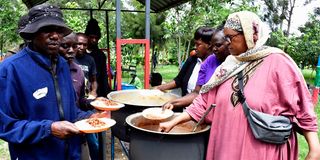
Hadija serves food to some of the young street boys who turned up for her free lunch at Kamukunji Grounds on May 8, 2025.
"I do all this by myself using savings from my businesses. Being a Muslim, my religion encourages those with more to share with those who have little or nothing," she says.
To the street families she serves, she is simply "Mama Angel" – a fitting name for someone whose kindness breaks through the harsh realities of street life. Her greatest joy comes from seeing happiness on the faces of those she feeds.
Hadija has observed that many street dwellers turn to alcohol and drugs to escape their sorrows. Yet her interactions with them reveal a different picture than what many might expect.
"From my interaction with the street families, they are very good people," she insists.
"They are peaceful, respectful, and friendly, contrary to what many people think. They love me so much, and I love them back. They always come, eat, and then go in peace."
Running such an initiative isn't without challenges, primarily financial ones. But Hadija has cultivated strong relationships with local chiefs, Nyumba Kumi leaders, and county government officials who support her work.
To ensure smooth operations, she employs three cooks, two casual workers, and seven young men who help transport food and provide security. Sometimes they prepare meals at her home before transporting them; other times, they cook at the feeding locations.
Mary Wanja, who recently lost her job as a casual worker at a club in Kamukunji, describes Hadija as "God-sent." Living on the streets with her two children, Mary depends on Hadija's program.
"I have no words to thank Mama Angel for what she has been to us. Were it not for her, I do not know what I would have eaten and given my children today. She gives us food for three days a week. All I can say is that God will bless her and give her long life," Mary says, gratitude evident in her voice.
Bernard Wambua's story echoes similar appreciation. After 21 years on the streets as an orphan, he knows hardship intimately.
"Street life is all I have known my entire life. Life is tough here, characterised by lack of food, shelter, and diseases. Today I had a meal courtesy of Mama Angel. Yesterday I slept hungry as I did not manage to get something to eat. May God bless her always," Wambua says.
Looking ahead, Hadija dreams of expanding her support to include education for street children and helping their parents establish small businesses for sustainable livelihoods.
"Many of these street children are very bright, and what they lack are the resources to see them through school. It's my hope that I will soon be able to bless some of them with education by paying their school fees. I am currently supporting a few who I can afford but would love to support more," she shares.
Her message to the privileged in society is simple: "It's always good to share what we have with those who do not have. That will not make us poor but richer through abundance of God's blessings. If I had many more resources, I would help uplift the lives of many more people."
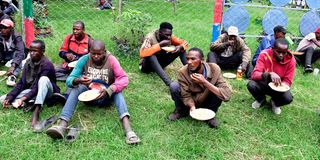
Some of the beneficiaries of Hadija's free lunch program at Kamukunji Grounds on May 8, 2025.
While Hadija has solely funded the initiative thus far, she welcomes well-wishers to help expand her work to other parts of Nairobi. She occasionally involves her children in the feeding programs as a form of mentorship.
"This is a very dear initiative to me that is close to my heart, and I would not like it to stop the day I leave this world. I would love my children to continue with it even when I am gone," she concludes.
Government statistics show that an estimated 60,000 children and young people live on Nairobi's streets, with this number growing. Most live in informal settlements such as Kibra, Kawangware, and Eastlands.
Many survive by scavenging, begging, and picking through rubbish. They face discrimination and marginalisation, making reintegration into society increasingly difficult. Abandonment, domestic conflict, and extreme poverty drive many to the streets, where substance abuse becomes a common coping mechanism for feelings of hopelessness and hunger.
For these vulnerable souls, Mama Angel's program offers more than just food—it provides dignity and a reminder that they haven't been forgotten.