Martha Karua’s early life of defiance to corporal punishment
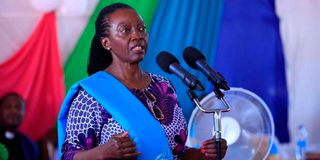
People's Liberation Party leader Martha Karua speaks at Ambassador Church in Ciagiini village, Kirinyaga County.

What you need to know:
- Long before national politics, Martha Karua’s childhood was defined by resistance, curiosity and a refusal to accept injustice.
- Inspired by bold women and guided by principle, a young girl from Kirinyaga forged her path against authority.
Martha Wangari Karua was born on September 22, 1957, at Kathande in the Kimunye/Njuku area of Kirinyaga. Her village was a lush, green setting that spread at the foot of Mt Kenya. It was surrounded by the Mt Kenya forest, the beautiful Karia stream and the clear, sparkling waters of the Kiringa River.
Martha grew up under the care of her parents, Josephine Wanjiru and Jackson Karua, but her boldness was shaped by two women: her paternal grandmother, Mwaa Njogu, and family friend, Margaret Muchira.
Margaret was a teacher who spoke with poise and confidence. She led conversations boldly and stated her opinions without apology. She wore trousers in a conservative village and took pride in her work, at a time when it was rare for women to work outside their homes.


Margaret was Martha's idea of success. Martha spent long hours in her kitchen, quietly studying her ways and hoping to be like her. Her grandmother, Mwaa Njogu, showed a different kind of boldness; she once turned away a suitor and sent back the goats brought as reverse dowry at a time when women were expected to accept arranged marriages between their families and potential husbands.
Martha's parents both taught at Baricho Primary School. By the time she was born as the second of what would become six children, her mother, Josephine, was running a shop at Kimunye Shopping Centre. Her father, Jackson, had moved to a teaching post at Mugumo Primary School, a short walk from their home. He instilled in Martha a spirit of generosity and community, in the spirit of the Kikuyu proverb: Kiara kimwe gitiuragaga ndaa (One finger cannot kill lice).
It was Jackson who sparked Martha's love of law. He took her to Kerugoya court to resolve a traffic matter, and the magistrate's command of the courtroom captivated her. From that day, she had a burning desire to become a lawyer.
To pay for their children's boarding school education, Jackson and Josephine started growing tea and selling their harvest to Kangaita Tea Factory. Martha enrolled at Kabare Primary School, eight kilometres from home, as a boarder at the age of 10. A year later, she moved to St Michael Boarding School in Kerugoya, before joining Kiburia Girls High School.
Schools at the time ran on a strict hierarchy. If a teacher was writing on the chalkboard and a student asked a question without being called on, it often ended in a beating. A teacher's word was final and beyond question. Students were expected to wait until the end of a lesson to raise any concerns.
Martha was curious and eager. She did not believe a student had to stay silent until the end of a lesson to ask a question. Corporal punishment, the use of physical force to cause pain, was not only allowed but widely practised and openly encouraged as a way to control children.
Black children's assault
It was a practice carried over from the colonial era, rooted in the racist belief that physically assaulting black children was an acceptable form of discipline. It was treated as normal, even necessary. Martha felt its harmful effects first-hand.
In her memoir, Against the Tide: My Journey on a Less Trodden Path, Martha describes many confrontations with teachers when she spoke out against corporal punishment. She challenged teachers who took pride in beating children and called it discipline.

Cover of Martha Karua's memoir, Against the Tide: My Journey on a Less Trodden Path.
She writes that it was "repugnant to my sense of what was proportionate and acceptable." She adds that, although teachers carried out the practice, it actually went against the teachers' Code of Regulations; beating children, in all its cruelty and humiliation, was not permitted under the rules.
In Form Two, a male teacher ordered her to bend down for a caning. Martha flatly refused. He treated her refusal as a bigger offence than the original one. She turned and ran out of the school. Her classmates threw bus fare over the fence in solidarity. Sadly, a classmate punished alongside her was severely caned and was left limping for weeks.
Martha's father then enrolled her in a different school. In her fourth year of high school, she was expelled for standing up to her headmistress over ongoing physical abuse and mistreatment. Rather than change schools again, Martha and her parents agreed she would spend the final five months before her O-Level exams studying at home and travelling to school each day.
During the three gruelling weeks of her O-Level exams, Martha travelled 25 kilometres daily to Karoti. Her father drove her halfway to Kutus each morning, and she used public transport for the rest of the journey. Every evening, he waited for her at Kutus when she returned.
She achieved the best grades in her school and affirmed her wish to complete her A-Levels in Nairobi. In 1975, at 17, Martha was admitted to Nairobi Girls' Secondary School, now State House Girls High School, and began finding her own path.
Nairobi Girls had a remarkable culture of openness that ran through all classes. Martha found the learning environment respectful and professional. Teachers and staff treated students with kindness and care. That environment allowed for open conversations and questions, and helped Martha grow academically as she moved closer to her goal of a career in law.
The writer is a novelist, Big Brother Africa 2 Kenyan representative and founder of Jeff's Fitness Centre (@jeffbigbrother).


