Meet the students whose disabilities became the foundation for extraordinary achievements
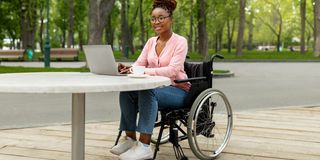
Disability is not inability. Three women transformed life-threatening illnesses and accidents into fuel for academic excellence and disability advocacy.

What you need to know:
- Caroline Muroki, Patricia Mativo, and Valary Olesia—each faced life-altering disabilities that forced them out of school and threatened to end their educational dreams forever.
- Despite losing their sight or mobility due to meningitis, road accidents, and brain surgery, they refused to give up and found alternative paths back to education.
The call comes at the worst possible moment. You're weeks away from sitting your Kenya Certificate of Secondary Education (KCSE) exams—the gateway to your future. Your bags are packed for the final stretch, dreams crystallising into plans. Then everything changes in a single night.
This is Caroline Muroki's story. But it's also Patricia Mativo's story. And Valary Olesia's story. Three women whose paths crossed with adversity at life's most crucial junctures, yet refused to let circumstances write the final chapter.
A homestead in Limuru: Caroline's journey back to light


Below the cold horizons of Limuru lies Caroline Muroki's family homestead, where the 19-year-old first-year Kenyatta University student welcomes visitors with a warmth that immediately puts everyone at ease. She's on a long holiday, and as introductions begin, something beautiful happens—we describe ourselves by mentioning the colours of our dresses and our hairstyles so that Caroline can paint a mental picture of who we are.
"This kind of introduction wasn't something I thought would become normal, but because I have a visual disability, I've embraced it," Caroline says softly as we shake hands and exchange smiles.
She moves freely around her home, settling into her favourite sofa seat without hesitation. "Welcome home. This is where we live," she says, explaining that she has mastered their home setup so completely that she doesn't need a white cane or anyone to guide her. This same confidence allows her to handle daily household chores independently.
But Caroline's journey to this moment of quiet confidence has been anything but linear.
In 2009, persistent headaches began plaguing the then-high school student just weeks before her KCSE exams. She was a registered candidate, ready to take the next step toward her dreams.
"We had broken for our last midterm in high school. We bid each other goodbye and hoped to see each other the following Tuesday after the short holiday for our KCSE. Unfortunately, it never happened. My classmates later saw me in an ICU bed," Caroline recalls.
That night, her condition worsened dramatically. She was rushed to Kijabe Hospital, where doctors diagnosed her with meningitis—a life-threatening inflammation of the brain and spinal cord membranes.
"I thank God I managed to come out of the ICU. After a few weeks, I came out of the ward, but on a wheelchair and in diapers because I was recovering from paralysis," Caroline tells Nation.Africa.
Each day following her discharge pushed her further away from writing KCSE exams with her classmates. Caroline was weak—she could neither sit nor do anything by herself. Her life had completely turned around. She hoped her former school, where she had registered for the national exams, would intervene so she could write her papers from her bed, but that intervention never came. When the 2009 KCSE candidates sat their last paper, Caroline chose to focus on recovering, remaining optimistic that she would one day write the exams herself.
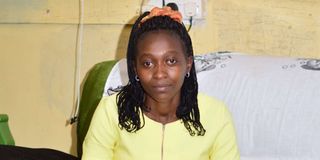
Caroline Muroki has been visually impaired since Form Four. Last year, she sat her KCSE examinations as a private candidate and scored a B minus. She is currently a student at KU.
The journey ahead proved longer and more challenging than she had imagined.
Caroline had hoped to return to her former school, perhaps repeating Form Three and continuing her education. Unfortunately, her visual disability meant acquiring an additional skill—learning to use Braille. Scholars at the Kenya Institute for Special Education advised her to undergo rehabilitation, and she agreed. During this period, she attended counselling sessions alongside mobility orientation and life skills courses.
"Meningitis affected me, so learning Braille didn't work for me, and that affected my learning. I went to different institutions, but they turned me away because I didn't understand Braille. They were like, 'No Braille, no schooling.' I got discouraged and felt that I had wasted my four years. I wished I had gotten married immediately after Class Eight," Caroline says of her initial struggles with visual disability.
Being out of school and struggling to accept a new lifestyle made her more vulnerable. The ambitious Caroline, who should have been planning to join university, was now at home, uncertain about her next steps. During this period, she conceived and gave birth to her daughter. She reveals that although becoming a single mother wasn't planned, caring for her baby with her parents' support kept her engaged and purposeful.
"My baby girl, now 10 years old, played a big role in my life for the three years before she started school, because I was at home instead of being in school. My baby kept my mind occupied," Caroline shares.
When her daughter started attending school, Caroline found the motivation to sit for her KCSE exams. This time, she chose not to attend a school but instead registered as a private candidate. Having already covered the four-year high school syllabus, she was confident about performing well in the examinations.
She hired tutors who came to her home to help with revision. The tutors would arrive with revision papers, work through them together, select topics they believed were likely to be examined, and take Caroline through them. The personal tuition, she says, favoured her since she was revising material she already knew.
During the examination period, she had a female invigilator trained to handle her specific needs. The two were in the same room but separate from other candidates. Her invigilator would read the questions aloud, Caroline would provide her answers, and the invigilator would write them on the answer sheet to be marked alongside those of other candidates.
Caroline's 14 years of resilience bore fruit when she scored a B-minus mean grade in the 2024 KCSE exams. This excellent performance secured her a place at Kenyatta University, where she is currently pursuing a bachelor's degree in Psychology.
"When you are blind, as much as you have to live a normal life, you are limited. When I was in school, I liked accounting and wanted to pursue an accounting course after high school. But unfortunately, with losing my sight, I had to change careers," she explains.
Her first year on campus has gone well, thanks to arrangements the university has made with drivers within the institution for all people with disabilities. This ensures students with special needs can get transportation whenever needed, as long as it's within the university compound. She also uses her phone's audio function to record lecturers during lessons and listens to them later for revision. Caroline is reaching out to well-wishers who can support her with a separate voice recorder so she doesn't need to delete recordings to create space for new lectures on her phone.
"When I have early classes, I wake up quite early because, with my challenge, I can't risk missing the one-on-one lectures. I cannot read by myself, unlike other students who would be fine with PDFs. For me, I have to attend physical classes so that when I read the PDF later, I'll remember what I was taught," Caroline shares about her current study challenges.
From accident to Oxford: Patricia's transcendent journey
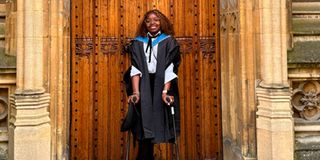
Patricia Mativo was involved in a road accident whilst in Form Two, forcing her out of school for two years.
The world truly is a global village. Although miles away from Kenya, Nation.Africa conducts a virtual interview with Patricia Mativo, who is in the UK where she has been a student for the past two years, pursuing a Master's degree in Environmental Change and Management at Oriel College, University of Oxford.
She's in the middle of a whirlwind of activities but spares a few minutes for our scheduled interview. Her journey to study overseas involved extensive applications to the university and the MasterCard Foundation Scholarship through the Africa Initiative in Oxford—a process she describes as energy-draining. Before qualifying, she had received several rejection letters, so settling in to study and experience a new culture is evidence that her efforts were worthwhile.
"The UK is wet almost every time of the year. I'm in a foreign country and a highly competitive university. I always question myself—how on earth did I make it here?" she says with warm laughter as we begin our virtual interview.
Like Caroline, Patricia also found herself forced out of school. The vehicle they were traveling in from Tanzania to Kenya was involved in a road accident. Seeking treatment took longer than expected, leaving her with a mobility disability that made it impossible to catch up with her former classmates. She was out of school for two years, nursing her injuries, and has used crutches to assist her mobility ever since.
"The university where I am has a structure called Disability Advisory Services. I introduced myself to them so they could understand my needs and communicate them to other departments I would be involved with, ensuring my stay in school is as comfortable and safe as possible, which helps me have smooth programs here," Patricia shares.
Patricia is among the top candidates in the country. After the accident, when she returned to high school, she passed the entry exam at her new school to join Form Three. When she sat her KCSE exams in 2016, she scored grade B with 66 points. This excellent performance secured her a slot at Multimedia University of Kenya, where she studied for a bachelor's degree in Analytical Chemistry and graduated with First Class Honours in 2021.
"I chose a humanity course, which isn't something I pursued for my degree, because I wanted to connect more with people. Chemistry is something I love, and it would have been much easier for me," she explains.
As she breaks glass ceilings, she remains equally keen on disability inclusion and gender matters, which is why her master's research focuses on people with disabilities in areas with poor sanitation in Nairobi's informal settlements. At Oriel College, University of Oxford, she has hosted an event for people with disabilities and a separate one for women of colour (Black, Asian, and Minority Ethnicities). She has also launched the Accountability Buddies Group, a platform that supports African students in accessing funded opportunities for their master's or PhD programs.
"When people see us graduate out here, it's not a small thing. It took a lot of work, emotions, and loads of so many things. Graduating isn't small for anyone. Many dynamics happen during a university student's years, and depending on whether you have the right support system, friends, and parents determines how you reach completion," Patricia notes.
Screen readers and second chances: Valary's digital revolution
Back in Kenya, we travel to Thika School for the Blind, where we meet Valary Olesia, another young woman whose story echoes familiar themes of resilience. The sound of a screen reader on her phone immediately captures our attention—it helps her use electronic gadgets because she cannot read without it. Valary first came here just after Form Four, worked for about a year, then left for university. She has now returned as the lead assistive technology computer instructor.
"When I was in Form Three, I started getting wrong answers even after using scientific calculators, and the teachers began realising there was a problem. I also had frequent headaches and convulsions because the pressure on my brain was too much," Valary recalls.
She was constantly at the school's sickbay, but the day the pain overwhelmed her, she called her uncle, who lived near the school. After getting permission from the principal, they went to Moi Teaching and Referral Hospital, where CT scan results showed a growth on her brain. She was then referred to Nyeri General Hospital, where surgery was performed.
"After the surgery, I was in the hospital for two weeks. I went back home, but I had been diagnosed with tuberculosis of the brain, so I took medicine for six months. The medicines were huge and difficult to take, and they were red in colour," she tells Nation.Africa.
Healing proved difficult, causing her to miss school for a year. Even when she was ready to return, going back wasn't easy—she had to transfer to a special school.
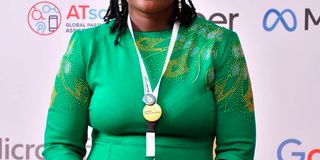
Valary Olesia became visually impaired at the age of 17 whilst she was in Form Three. She holds a degree in Gender and Development Studies and is currently the lead assistive technology computer instructor at Thika School for the Blind.
"I was mourning and crying every day. I thought I was the only blind person who could be healed by Jesus. I kept hoping He would come to touch my eyes and I would see again. I was almost falling into depression. I felt like the world was mine alone."
To adapt to her new life, she enrolled at Machakos Technical Institute for the Blind, where she interacted with other people with visual disabilities.
"That institute changed my life because I realised there's a mode of reading and writing when you're blind. I could proceed with my life—it wasn't the end."
With Braille skills acquired, she returned to school in Form Two and, in 2016, sat her KCSE exams, scoring C plus. She then enrolled at Kenyatta University and pursued a four-year bachelor's degree in Gender and Development Studies.
"I love advocacy focusing on disabilities, inclusion, and championing human rights, especially the rights of women and girls who are marginalised. I was particularly motivated to pursue this course because I'm outspoken, so I can champion the rights of girls and women with disabilities like myself."
Valary is part of the SRHR Alliance, which builds capacity on engaging stakeholders online with information about where girls in the community who lack sanitary pads can be referred to the alliance or request pads directly for distribution to girls who need them.
"Life after school is engaging. I'm a sexual reproductive health rights advocate—I do it out of zeal. You know, if you have a disability and you have a boyfriend and need to practice safe sex, you look for condoms and people question you. But disability doesn't define reproductive life. We need to enjoy conjugal rights like other people do, so it doesn't limit you from accessing any other right because of your disability," says the mother of two.
Valary graduated in 2021 with second-class upper honours, then completed an internship with the government at the Capital Markets Authority before landing employment at Thika School for the Blind. Her roles include mentoring staff, conducting assistive technology training, and reviewing curricula, among other responsibilities.
She emphasises that the digital transformation leading to assistive technology—where those with visual disabilities can access soft copy materials and let screen readers do the reading—represents a significant milestone.
Breaking digital barriers
Speaking during this year's Inclusive Africa Conference, Irine Mbari-Kirika, founder and executive director of inABLE, emphasised the need for digital developers and owners to make digital products and services accessible to everyone with disabilities.
Her sentiments are echoed by Dr Imaana Laibuta, who serves as a judge at the Court of Appeal. He acknowledges that technology is breaking barriers to information access for people with disabilities, particularly in the education sector.
"Our systems are quite supportive despite the fact that technologically, we are far behind. When I started studying law at university, all books were in print. We didn't have the kind of digital technology we have today where you can conduct research. Those of us who are blind and use Braille face storage challenges because Braille is very bulky. There's only so much you can record and store," Dr Laibuta, who has total visual loss, tells Nation.Africa.
Like Caroline, Patricia, and Valary, Dr Laibuta also lost his vision later in life. He was 22 years old when a medical accident left him with visual disability. He notes that disability impacts people differently—those who are resilient and set goals for themselves, working toward achieving them with or without disabilities, excel academically and in life despite numerous challenges, including discrimination against women with disabilities.
"Support mechanisms seem more robust when it comes to women with disabilities. You cannot ignore the fact that our society is highly prejudiced against women and disabilities, and disability itself. So when it's a woman, it's even worse. For most of them, society thinks they really shouldn't be looking for reproductive health services," Dr Laibuta says.


