Menstrual poverty: 'I stay away from school because I don't want the embarrassment'
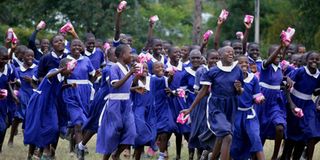
Pupils of Ombeyi Primary School in Kisumu County excited after receiving sanitary towels from a donor. A report by the National Gender and Equality Commission has exposed severe educational disparities and barriers facing girls across 19 marginalised and arid and semi-arid land counties.

What you need to know:
- Poor sanitation, menstrual poverty and harmful cultural practices continue to disrupt education for girls across Kenya.
- A new report reveals alarming barriers preventing girls from accessing safe, inclusive and quality education.
Rose Naserian*, 16, from Maralal in Samburu County, always dreads that time of the month when she has her menstrual period. She says she is often forced to miss school because she cannot afford sanitary towels.
“Many times when I get my period, getting sanitary pads is a challenge because my mother often does not have the money to buy them for me. This usually forces me to stay away from school because I do not want the embarrassment that comes with it,” says Rose, who comes from a family of two.
Her mother is a single parent who works as a domestic worker. Most of the time, Rose relies on assistance from Kirta Touch the Needy, a non-governmental organisation that provides sanitary towels to vulnerable girls. “Missing school almost every month because of my period affects my studies and performance. I just wish my mother could always provide sanitary towels for me,” she adds.


Rose’s experience mirrors that of millions of other girls who struggle to manage their periods and miss school as a result. The plight of such girls is highlighted in a report by the National Gender and Equality Commission (NGEC), which exposes severe educational disparities and barriers facing girls across 19 marginalised and arid and semi-arid land counties.
The report shows that girls in marginalised counties are twice as likely to miss school because of menstruation. In schools where more than 40 girls share a toilet, menstrual-related absenteeism stands at 15.8 per cent. In contrast, schools that meet basic sanitation standards record absenteeism of only 7.3 per cent.
According to the report, 77 per cent of schools had functional handwashing facilities, while just 26 per cent had toilets accessible to learners with disabilities. It concludes that many girls miss school every month because they lack safe and private sanitation facilities.
The report, Evidence on School-Level Factors Affecting Girls' Access to Quality Education in Marginalised Communities in Kenya, highlights systemic failures that continue to push girls out of school. It notes that about 20 per cent of public primary schools in these counties still report cases of child marriage.
At least 30 per cent of schools reported teenage pregnancies, while 16.9 per cent of girls were affected by child marriage compared to less than one per cent of boys. Cases of female genital mutilation (FGM) were reported in Garissa (27 per cent), Baringo (27 per cent) and Narok (21 per cent). FGM is a harmful practice that often precedes child marriage.
On digital inequality, the report indicates that only 20 per cent of rural schools have basic technology infrastructure, leaving many girls behind in science, technology, engineering and mathematics education and digital literacy. Nationally, only 33 per cent of teachers had received digital literacy training, while Wajir recorded none.
Disability-friendly toilets
Only a quarter (25 per cent) of the schools surveyed had disability-friendly toilets, disproportionately affecting girls with disabilities. The average pupil-toilet ratio for girls is 32:1, far above the national standard of 20:1. Mandera recorded severe shortages, with 97 boys and 45 girls sharing a single toilet.
Across the 19 counties surveyed, 76 per cent of headteachers were male, while only 24 per cent were female. In Wajir and Mandera, all the headteachers sampled were men. However, Nairobi's informal settlements recorded stronger female leadership representation, with 89 per cent of headteachers being women. Women chair only 25 per cent of parent-teacher associations (PTAs) and just 20 per cent of boards of management. In Garissa, Wajir and Mandera, no female PTA chairpersons were recorded.
Female teachers are also significantly underrepresented in some counties, including Wajir (14.9 per cent) and Mandera (14.6 per cent), limiting the availability of female role models in schools.
Read: 'Blood may overflow and stain my skirt': Schoolgirl's struggle with period poverty during holidays
Dr Elyas Jillaow, director-general in the Ministry of Education, says they, in collaboration with the Ministry of Health, will prioritise investments in sanitation facilities, provide sustainable menstrual hygiene support, and conduct regular school health compliance reviews.
He notes that harmful social and cultural practices, including child marriage, school-related gender-based violence and limited adolescent sexual and reproductive health education, remain significant barriers to girls' education.
“These measures will feed into sector-wide planning and NGEC reporting, ensuring that learner wellbeing, safety and dignity are recognised as fundamental obligations rather than optional components of school management,” Dr Jillaow says.
He also emphasises the need to strengthen leadership and governance in education, adding that the ministry is committed to working with county education boards to roll out structured gender-responsive leadership training, enforce gender representation standards in PTAs and boards of management, and integrate gender indicators into school improvement plans.
NGEC warns that without urgent and targeted interventions, Kenya risks falling short of its Vision 2030 goals and Sustainable Development Goal 4 on inclusive and equitable education.
The commission has recommended several measures to address the challenges, including prioritising the distribution of sanitary towels, establishing gender-segregated and disability-friendly facilities, enforcing gender quotas in school leadership and deploying more teachers. The report also calls for gender-inclusive digital literacy programmes and mentorship initiatives to protect and empower girls in digital spaces.
*Name changed to protect her identity.