Milking success: One cow, one dream, endless possibilities
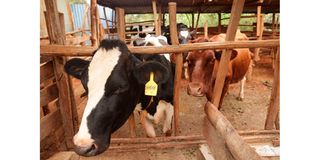
Dairy cows at Agnes Wangari Wanyaga's Giachumi home in Githunguri, Kiambu County, on August 4, 2026.


What you need to know:
- Across Kenya, women are turning dairy farming into a source of income, education and economic empowerment despite mounting challenges.
- From Kiambu to Homa Bay and Kitui, women farmers are building livelihoods through dairy while confronting finance and climate challenges.
Agnes Wanyaga gently wipes the udder of one of her Friesian cows before settling onto a low stool inside a clean milking parlour at her farm in Giachumi, Githunguri, Kiambu County. Dressed in gumboots and a green cap bearing the colours of the dairy cooperative where she delivers her milk, she is beginning the afternoon milking.
Before every milking session, she washes the udders and ensures each animal has enough water and fodder. Afterwards, she delivers the milk to a local cooperative collection centre about 500 metres from her home.
Her day starts long before sunrise. “By 4am, I am already in the cowshed preparing for the first milking. After milking, I clean the shed, feed the cows, provide water and then attend to my farm crops before returning for the second milking in the afternoon,” she says.


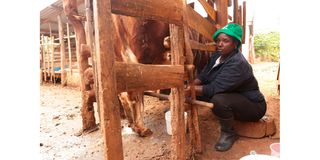
Dairy farmer Agnes Wanyaga milks her cow at Giachumi in Githunguri, Kiambu County, on August 4, 2026.
Today, Agnes keeps four dairy cows, producing between 40 and 50 litres of milk daily despite the rising cost of animal feed. Each cow produces an average of 15 litres a day. “A decade since I ventured into dairy farming, milk has given me a voice,” she says with a smile.
Before discovering dairy farming, Agnes relied on growing vegetables, including traditional ones. She still grows the vegetables, but dairy farming has become the backbone of her household economy. She ventured into dairy farming after watching farmers in her community whose lives had changed through milk production. “I saw women educating their children, paying school fees and improving their homes through dairy farming. I wanted that life too,” she recalls.
With savings from a women's merry-go-round, she bought her first heifer for Sh20,000. At the time, she had no cowshed and temporarily kept the animal in her late mother's shelter. She later joined GDC Sacco Ltd, affiliated with the Githunguri-Fresha Cooperative where she delivers her milk. Regular savings enabled her to qualify for her first loan of Sh50,000, and the affordable financing allowed her to expand her herd one cow at a time.
Today, although she owns four dairy cows, her cowshed can accommodate up to 45 animals, a number she plans to hit over time. Dairy farming has educated all four of her children through college and university, and they are now employed. “It is the cows that educated my children,” she says.
Her story echoes that of thousands of women who have made dairy farming a pathway to economic empowerment. The industry remains Kenya's leading agricultural subsector, contributing about 14 per cent of agricultural GDP and supporting more than 1.8 million smallholder households.
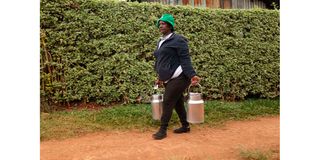
Dairy farmer Agnes Wanyaga carries cans of milk to a collection point at Giachumi in Githunguri, Kiambu County, on August 4, 2026.
Data from the Ministry of Agriculture and Livestock Development shows that the country produced a record 5.5 million tonnes of fresh milk in 2025, ranking second in Africa after Egypt. Smallholder farmers account for about 80 per cent of national milk production, while the industry contributes approximately 4.5 per cent to GDP, 44 per cent of livestock GDP, and supports more than 700,000 direct jobs.
Women provide up to 70 per cent of on-farm dairy labour, taking charge of feeding, milking, animal health management, fodder preparation and household nutrition. Yet their contribution has not always translated into ownership and control of dairy resources.
A report commissioned by the Kenya National Farmers' Federation (Kenaff) and implemented by AfriCCLAN found that although women play a major role in dairy production, they continue to face barriers in land ownership, access to finance, leadership and decision-making.
The assessment, conducted among dairy farmers in Nakuru, Meru, Nyandarua, Uasin Gishu and Kiambu counties, found that 86 per cent of women farmers belong to cooperatives and 82 per cent reported control over dairy income. However, only 23 per cent own titled land, while 19 per cent have documented ownership of cattle.
According to Agnes, cooperative support has bridged some of these gaps. She attributes much of her success to GDC Sacco and the local cooperative she has supplied since she began farming. Besides providing a guaranteed market, the cooperative trains farmers on disease control, mastitis management, feeding, breeding, vaccination and animal health. Through the Sacco, she has also acquired water storage tanks of 3,000, 1,500 and 1,000 litres to harvest rainwater for use during dry seasons.
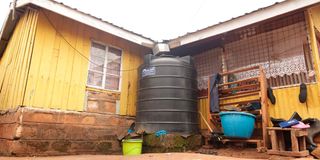
A water tank at Agnes Wangari Wanyaga's Giachumi home in Githunguri, Kiambu County, on August 4, 2026.
Technology has further transformed her farm. She installed a biogas system that now provides all the cooking energy for her household, while the slurry is used as organic fertiliser on her vegetables, eliminating the need to buy chemical fertiliser. “I do not incur any cost on cooking for my family,” she tells the Nation during an interview at her Githunguri farm.
Production costs, however, remain a major concern. Although a well-fed cow can produce between 25 and 30 litres of milk daily, rising feed prices and prolonged dry spells have reduced yields to as low as 10 litres for some cows. Electricity is another challenge: filling her 3,000-litre water tank costs about Sh200 every time, while running a chaff cutter adds to her monthly power bill. “My next dream is solar power. It would reduce production costs and help me invest more in the cows,” she says.
She also hopes to venture into value addition by producing yoghurt, mala and other dairy products. The Kenaff report notes that improving women's control of dairy enterprises is critical, since milk income contributes significantly to household welfare.
Dairy income was associated with improved food security, dietary diversity and child nutrition, reported by 78 per cent, 70 per cent and 61 per cent of women respectively. Yet financial access remains a major obstacle, with 65 per cent of women citing lack of collateral as a key barrier to obtaining credit.
For Anne Mwihaki, a 39-year-old mother of two from Kiambu, dairy farming has also become a source of livelihood and resilience. She started with one cow costing Sh20,000 after previously surviving on the sale of avocados, bananas, roasted maize and vegetables. A foot-and-mouth disease outbreak later killed one calf and severely affected another cow, forcing her to sell it at a throwaway price.
Instead of quitting, she returned to selling vegetables and fruits, and raised enough money to buy another cow. “Within six months, I was back in dairy farming,” she shares.
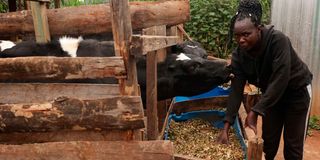
Dairy farmer Anne Mwihaki feeds her cows at her Giachumi home in Githunguri, Kiambu County, on August 4, 2026.
Today, she supplies milk to a local cooperative, with the income helping her first-born child join college while the younger one is in Grade Seven. She also grows fodder and vegetables.
Her financial turning point came through a Sacco, where she saved before qualifying for loans. When she struggled with repayment, the Sacco gave her time to reorganise and repay gradually. She now qualifies for loans of up to Sh100,000, which she reinvests in the farm. She has also employed one worker and belongs to a women's self-help group.
“My dream is not only to succeed but to become a leader who inspires and uplifts other women,” she tells the Nation.
Another Kiambu farmer, Veronica Wanjiru, turned to dairy farming after a road accident in 2009 disrupted her small business in Nairobi. Encouraged by another woman during her recovery, she returned to Githunguri and bought her first dairy calf for Sh15,000.
Feed shortages later forced her to sell cattle, but she rebuilt her enterprise gradually. She now keeps four cows and supplies milk to a local cooperative, producing between 13 and 15 litres daily per cow, depending on weather and feed availability. Dairy income has enabled her to buy land, and she has invested about Sh103,000 in a water pipeline and borehole.
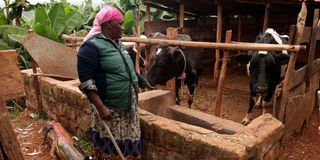
Dairy farmer Veronica Wanjiru stands next to her Giachumi home cattle shed in Githunguri, Kiambu County, on August 4, 2026
A 50-kilogramme bag of dairy meal now costs about Sh3,200, squeezing her margins, so she grows fodder and other crops to reduce her dependence on purchased feed. “Whenever I see the cows and hear them mooing, I feel so happy. If I did not have them, I think I would go mad,” she says.
Veronica believes dairy farming has given her dignity and enabled her to support others by sharing milk or food with neighbours. The story moves to Nyanza and Western Kenya. At 6am in Alara Korayo Village in Kochia, Homa Bay County, most people are still asleep. But one home is different. It belongs to Phoebe Atieno, a retired teacher who ventured into dairy farming after growing tired of being supplied with adulterated milk.
As her neighbours sleep on, she and two of her workers are already busy milking cows by hand. By 7am, neighbours with containers in hand start knocking at her gate for milk, some returning in the evening when the cows are milked for the second time. Phoebe also takes some milk to Olare and Nyangweso market, where she operates a milk dispenser.
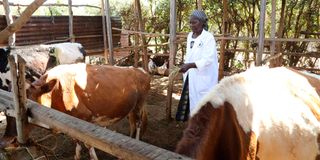
Phoebe Atieno in the cattle shed at her Alara Korayo farm in Kochia, Homa Bay County, on August 11, 2026.
Besides milking, she takes part in other farm activities to keep her nine dairy cows, one dairy bull and four dairy goats well cared for, including feeding the animals and collecting their waste to make manure.
This was not her daily routine before 2016. “I had my first cow in 2016. Before then I used to buy milk from other farmers or from the shop,” she says.
Her decision to start the dairy farm came when her mother-in-law fell sick and doctors advised her to take a lot of milk. “She was instructed to take milk that is not processed. We mostly used to buy packed milk from the shop but this was not supposed to be used,” she notes.
At first, she would source milk from Eldoret every morning, with a farmer she had engaged sending it to her in a container by public service vehicle. Phoebe also bought milk from local farmers in her village. “The main challenge I faced was that milk supply was not constant. Farmers would only get milk when their animals are lactating,” she says.
She also discovered that some farmers added water to their milk to get more litres and earn more money. That was when Phoebe decided to own cows herself, before starting her own farmer group called Rhock Field, where she is chairperson. “I wanted to have surety that whatever my family consumes is not adulterated. I also considered the availability of market since a lot of people in my village do not own dairy animals but are in need of milk every day,” she says.
From a single animal, the farmer now owns ten dairy cattle, plus a bull that serves the other cows. During peak seasons, when feed is plentiful and the animals are lactating, she gets up to 70 litres of milk. Most is sold at the local market, with some bought directly at the farm. “I used to supply 10 litres of milk every two days to a bank in Homa Bay town. The contract ended when a new management came in. Milk from goats is mostly bought for patients,” she says.
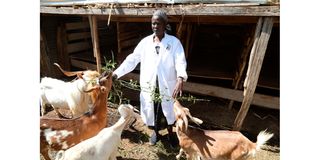
Phoebe Atieno feeds her dairy goats at her Alara Korayo farm in Kochia, Homa Bay County, on August 11, 2026.
Phoebe prefers selling milk herself rather than taking it to her group, the Kochia Dairy Cooperative Society, to save on transport costs, since the group's collection point is elsewhere. She still keeps in touch with members, who sometimes ask her to help sell their milk through her dispenser when they have surplus production.
Using proceeds from her business, she supports her grandchildren through education. “Though their parents pay their school fees, I also help my grandchildren take care of some of their needs. I also pay fees for two children who I live with,” she says.
The venture also enables her to employ four people: two men permanently stationed at the farm and women who help her sell milk. Climate change threatens her farming. Intense sunshine makes fodder wither and die, and during dry seasons she sources fodder from as far as Narok County, a move that eats into her proceeds.
Even so, she practises conservation, using biogas to supplement other cooking methods at home. Animal waste from the farm is also turned into farmyard manure, which she sells at Sh1,500 for a 50-kilogramme bag.
“Some of the manure is used at the farm to support propagation of African vegetables which cannot do well when farmers use synthetic fertiliser,” she says.
Her success has inspired other residents of Alara Korayo Village, including women, to venture into dairy production. “Some members of my group produce fodder. It is a symbiotic relationship where they provide feed to individuals who own animals,” she says.
She advises women intending to venture into dairy production to start small, noting that owning a single cow can make a big difference. “Being able to get milk for nutrition is one of the most important elements in the dairy business. A single cow can make the farm expand when the milk is sold and proceeds used to make the farm grow,” she says.
Henry Nzinga, the National Agricultural Value Chain Development Project coordinator in Homa Bay, says the dairy sector contributes significantly to the county's economy, with areas such as Rachuonyo South and Rachuonyo East heavily dependent on milk sales.
In these two areas, farmers have easy access to extension services and other forms of support. He notes, however, that most dairy farms in the region are owned by men, with women having less voice in decision-making, and cites lack of empowerment as a major hindrance to women owning farms.
“Financial muscle is a major problem. Traditionally, men are the ones who owned farms and it is still being practised today,” he says, pointing also to gender barriers that affect women's ability to own dairy farms.
Some families, he explains, have given men more power, and women cannot engage in any business without their husbands' approval; where a man does not approve an idea, it becomes difficult for a woman to start it.
“My advice to women who want to venture in dairy farming is that they should know that the venture requires patience. One has to wait before they start getting profits,” he says, adding that animal upkeep is not a small cost. “Some get stuck along the way because of the high cost of animal upkeep. But a patient farmer can recover the money spent by selling milk.”
Leadership hitch
The Kenaff study highlights leadership as another area where women continue to lag behind. Although women dominate many dairy activities, cooperative boards remain largely male-controlled, with some having only two women out of eight members. The report recommends increasing women's representation in cooperative leadership, strengthening gender-responsive policies and ensuring women take part in decisions affecting milk pricing and markets.
For Phoebe, the hope is to acquire more animals, though she worries about the high cost of feed. For now, she is focused on selling fresh milk at the market while using some of it to make mala and ghee. “I have not thought of exporting the produce. Perhaps some of my children who will pick up the business will introduce new business models,” she says.
The story of women using dairy farming to build income repeats itself in the arid and semi-arid parts of eastern Kenya, where farmers are finding ways to keep the enterprise going, despite climate and feed challenges. At 45, Rita Wanza is among the youngest dairy farmers in the area. The mother of three runs a vibrant dairy enterprise in Kyetheni village on the margins of Masii township.
The trained schoolteacher owns 12 dairy cows, making her one of the biggest dairy farmers in the county. “Every day, we deliver at least 60 litres of milk to Masii Dairy Farmers Cooperative Society,” she tells the Nation.
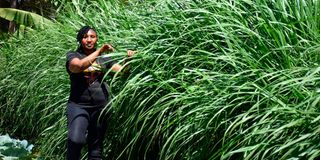
Rita Wanza Mutua shows a Nappier grass plot in Kyethei village, Machakos County, on August 12, 2026. She quit a teaching job to venture into dairy farming.
She is among 607 members of the cooperative, which sells its milk through numerous outlets across Kitui, Machakos and Makueni counties. Wanza's dairy enterprise started four years ago with a single Friesian heifer. “I bought one cow in 2022 just to keep myself busy. It has spawned a big enterprise,” she says.
She resigned from teaching once the dairy enterprise began earning her more than the teaching job. “The money we get from the sale of milk caters for all our basic needs at home,” she says.
The proceeds have gone into expanding her herd, including phasing out Friesian cows for Guernsey, which she says produces more milk. Access to animal feed has been a challenge, as the region grapples with climate change and shrinking land sizes, with Machakos County seeing a spike in the cost of a bale of fodder. To get around this, Wanza planted Napier grass. She feeds her animals vegetable waste, significantly cutting her feed costs.
Her dairy venture has created employment for one woman. “Some women avoid dairy farming, terming it a dirty venture. They should create an interest in dairy farming. They should start even with a single cow. Beyond selling milk, a dairy venture provides income from the sale of young calves. Manure from dairy cows is also another revenue stream,” she says.
For Ruth Chelimo, dairy farming started as a livelihood activity but has grown into a full-time enterprise that has transformed her family's fortunes. The farmer from Kosirai, Nandi County, quit her marketing job to concentrate on dairy farming, a decision she says has increasingly paid off.
Chelimo recalls a time when dairy farmers depended heavily on milk hawkers, who offered poor and unreliable prices. “A milk hawker pays you for the day, and their market is not sustainable,” she says.
Today, she supplies her milk through an organised marketing system that guarantees a more reliable market and better returns, allowing her to provide for her family, pay school fees and undertake development projects.
She says the changing role of women in dairy has kept her in the sector. “Women have really benefited through dairy farming. Initially, their representation was below 10 per cent. Now, over 50 per cent of active participants in dairy are women,” she states. “Women are the support system of every household.”
According to Chelimo, dairy farming requires commitment, particularly because feed costs and production challenges can affect earnings. But with better markets and access to support services, she has continued expanding her enterprise.
The Kenaff report notes that women's empowerment outcomes differ across counties. Kiambu emerged as the highest-scoring county overall, with a score of 3.33 out of nine, largely due to strong income control and market opportunities linked to its proximity to Nairobi.
However, the report warns that low land ownership remains a vulnerability, since many women's empowerment gains are based on income rather than ownership of productive assets.
It recommends accelerating joint land titling, supporting women's inheritance rights and developing dairy-specific financial products that recognise livestock, milk delivery records and group guarantees as alternative forms of collateral. It further proposes establishing a National Women in Dairy Credit Guarantee Fund with about Sh2 billion in capitalisation to guarantee up to 70 per cent of women's dairy loans.
Other recommendations include expanding extension services targeting women farmers, increasing the number of female extension officers, supporting value addition through equipment such as milk coolers and pasteurisers, promoting digital payments directly to women, and strengthening collective marketing groups.


