Nairobi 1985: How UN Women’s Conference sparked global feminism in Africa
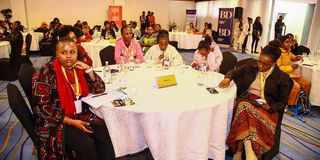
Participants during the NXT HER Summit at Mövenpick Hotel, Nairobi, on August 21, 2025, themed “Breaking Barriers – 30 Years On.” The summit drew its inspiration from the Beijing Declaration and Platform for Action of 1995.
What you need to know:
- From Mexico City to Beijing, the UN conferences built momentum for women’s rights, embedding gender equality into the global development agenda.
- African feminists and institutions played a decisive role in shaping this history, which anchors today’s struggles and inspires future generations to fight for justice and equality.
- Nairobi’s legacy endures through strong feminist networks, Global South leadership, and youth activism in Kenya and beyond.
At the NGO Forum of the Third World Conference on Women in Nairobi in 1985, I turned 18. It was a spectacular coming of age.
The conference brought the global women’s movement to Africa, and African girls and women into the movement. I was part of a secondary school delegation of Kenyan girls who wanted more for ourselves and our sisters and somewhere to demand that. The NGO Forum of the Conference, hosted at the University of Nairobi, provided that space.
My mother, a teacher, advocated stronger policy on girls’ education. My sister, a delegate among students from women’s colleges, advocated women’s rights. My aunties in Nairobi were in leadership roles at the conference and the NGO Forum.


Frene Ginwala and Baleka Kgositsile of the African National Congress delegation and with whom I spent time, went on to serve as speakers of independent South Africa’s parliament. They taught me why the UN was important to a liberation struggle.
Egyptian feminist author Nawal al Sadawi’s joy and energy inspired me, despite the devastating stories she told about the violence that girls and women face, and because of the power of those stories. I made friends that I still have today. Mostly, I saw the world of women come to my country, Kenya, and tell me that I mattered, we mattered, and we weren’t going to be silent about it.
The Nairobi conference marked the end of the UN Decade for Women, which had been declared at the first UN Conference on Women in 1975. It wasn’t just my coming of age; it was the coming of age of the global women’s movement. Our Movement Elder Charlotte Bunch says, “Nairobi was the birthplace of global feminism.”
Decades later, looking back, my colleagues and I agreed that the story of the UN World Conferences on Women is a story worth telling. We realised that we were at risk of losing our history, and that advocacy for gender equality often feels ahistorical and disconnected from the achievements of the past, which offer lessons that can guide us today. We spent more than a year reflecting on the conferences, scouring through archives, interviewing movement elders and youth activists, and pursuing new research and novel sources to document and tell the story.
The UN World Conferences on Women, beginning in Mexico City in 1975, followed by Copenhagen in 1980 and Nairobi in 1985, culminated in the landmark Fourth World Conference on Women in Beijing – the one that everyone talks about, the one for which we will celebrate the 30th anniversary this month. But Beijing was not just one moment. The series of women’s conferences – along with other UN conferences in the 1990s on the environment, human rights, population and development, and social development – created a decades-long journey of movement building and layered gender equality gains.
The UN provided a unique container that brought together women’s rights advocates and governments, creating opportunities for strategic advocacy, the generation of ideas across nations and sectors, the creation of standards and commitments, and increased accountability.
By Beijing, just 20 years after Mexico City, gender equality was integrated into the global development agenda; violence against women was recognised as a human rights violation; the representation of women at all levels of leadership was recognised as critical; population frameworks were transformed into health and rights frameworks; the rights of adolescent girls were recognised; and women’s role as stewards of the environment was confirmed.
Our Movement Elder Peggy Antrobus noted that “[w]ithout the UN, there would be no global women’s movement.” And she was right. Each conference secured particular wins and provided new opportunities to grow and strengthen the movement, a movement that was shaped by strong leadership and activism by women from the African continent.
African girls and women
Africa hosted two key global conferences to advance gender equality – the Nairobi conference on women and the Cairo conference on population and development. As a result, they increased the participation, representation, and leadership of African girls and women in critical intergovernmental processes and the global advocacy that surrounded them.
Three out of four of the women’s conference secretaries general were from the Global South, and East Africa’s own Gertrude Mongella was secretary general of the Beijing conference. Notably, advocacy on girls’ rights was seeded on the continent of Africa, through joint advocacy by feminist networks such as Femnet, governments, and UN agencies such as Unicef and Unesco. The “girl child” became one of the 12 critical areas of action featured in the African Platform for Action in 1994 before its subsequent adoption in Beijing in the global Platform for Action.
Each conference further built our feminist ecosystem. The creation of powerful African feminist institutions strengthened our movement on the continent and globally. The Global South network Dawn emerged from a meeting to prepare for the Nairobi Conference. The African Women’s Development Fund emerged out of a preparatory conference for Beijing.
Regional networks like Femnet and national organisations like Tamwa generated both transformative and commonsense ideas, shaped a global and inclusive feminism, strategically advanced advocacy, and contributed directly to national policy and global standards and norms. These institutions, and many others, today continue to lead the way for girls and women on the continent.
Our history matters. It is the foundation of our movement today and provides lessons to navigate emerging and reemerging challenges, in this moment when so many of the values we hold dear are under attack.
Today, decades after I turned 18 surrounded by a growing global women’s movement, a new wave of young women and men is leading the call for social justice and rights in Kenya. They know the value of our history. Throughout the troubled years of the Moi regime, including during the 1990 Saba Saba protests, young people courageously defied the repressive one-party regime and demanded multiparty democracy.
Today, young people are once again holding us to account, honouring the movement and our movement elders, while courageously charting a new way forward. Our hope lies in them, the backbone of civil society, and in the movement they are leading, like the ones that came before, to create a better Kenya, a better world, for us all.
The writer is Associate Vice President, Girls & Women Strategy, UN Foundation.