Nairobi Summit on gender off to a transformative start
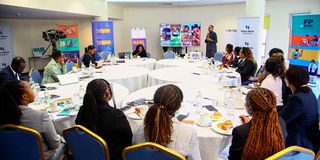
Nation Media Group Chief Corporate Affairs, Marketing and Partnerships Officer, Monicah Waceke Ndung’u, during her presentation at the Nation Media Foundation and FP2030 Health Roundtable at Movenpick Hotel, Nairobi, on August 20, 2025.

The Nation Media Foundation, in partnership with FP2030, has convened the NXT HER Summit which opens on Thursday in Nairobi.
The two-day summit will reflect on the 30-year legacy of the Beijing Declaration and interrogate African women’s representation and leadership in health, education, media, and the economy.
As the social impact arm of the Nation Media Group (NMG), the foundation is committed to going beyond amplification to ensure African women’s voices not only feature in stories but actively shape solutions for the continent.


NMG's Chief Corporate Affairs, Marketing and Partnerships Officer Monica Ndung’u said the summit, whose theme is Building the Future, the Next 30 is designed to bring intergenerational dialogue to the forefront.
“This summit is about moving from amplification to accountability. For too long, the media has been seen as a platform that only amplifies voices. We believe our role goes beyond that—we want women’s voices not only to be heard, but to drive solutions across sectors that directly affect their lives,” she said.
Ms Ndung’u noted that discussions will revolve around four cross-cutting pillars: women in health, women in media, women in education, and women in the economy and leadership.
On women in health, she said the summit will spotlight often overlooked issues.
“When we talk about women in health, we are not only thinking about access to healthcare. We are shining a light on mental health, reproductive justice, and innovations that can transform healthcare delivery for women. Too often, women’s health challenges are dismissed or underfunded, yet they are at the heart of community wellbeing,” she added.
The pillar on women in media will interrogate biases that have shaped coverage for decades, with newsrooms worldwide historically built on patriarchal systems that either silenced women’s voices or distorted their narratives.
Read: How Phoebe Asiyo's 'ridiculous' 33 pc women quota became the bedrock of Kenyan gender equality
On education and training, Ms Ndung’u warned that without deliberate action, the digital gender gap will widen.
“Technology is rewriting the rules of access, opportunity, and participation, but we must acknowledge the digital gender gap. When artificial intelligence itself is reproducing the same biases that have held women back for generations, we must be vigilant. Education and training for women is not just about getting more girls into classrooms, it is about preparing them to compete and lead in a rapidly changing technological landscape,” she said.
The final pillar, women in the economy and decision-making, will advocate for stronger inclusion of women in leadership roles.
Speaking during the discussions, Dr Samukeliso Dube, Executive Director of FP2030 said her organisation— a global partnership focused solely on family planning— is committed to accelerating access to contraception.
“We can only achieve this through partnerships, which is why we launched the Made Possible by Family Planning campaign. It seeks to raise resources, normalise the narrative on family planning, and break beyond the echo chambers of our community so that everyone understands its importance,” Dr. Dube said.
She clarified that the discussed $1 billion target is not a single fund but a fundraising goal, stressing that local voices must remain central to the movement.
“We know overseas development assistance is shrinking, yet the unmet need for family planning is enormous. If we can encourage more financing—whether to countries, programmes, or service delivery—we can ensure universal access. Family planning is about women deciding if, when, and how many children they want to have. That’s as personal as it gets. Through our partnership with Nation Media Group, we are making sure people can speak for themselves and their stories reach the mainstream,” she added.