Offside, handball, VAR: Five women break down the beautiful game
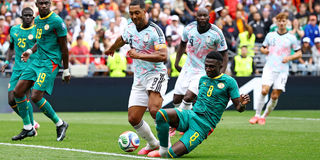
Senegal's Lamine Camara tackles Belgium's Youri Tielemans in the penalty area, prompting a VAR review, during their Fifa World Cup Round of 32 match on July 1, 2026, at Seattle Stadium, Washington. Moments like this are exactly what our five contributors help fans understand.

What you need to know:
- As the 2026 Fifa World Cup reaches its final between Argentina and Spain, five Kenyan women explain football's most common rules and terms in their own words.
- Their explanations span offside, handball, penalties and VAR, alongside a wider glossary of football language.
The 2026 Fifa World Cup ends today (Sunday), as defending champions Argentina face Spain in a historic final at 10pm (Kenyan time) at MetLife Stadium in New Jersey, US, the second World Cup meeting between the two nations in 60 years.
Earlier today, England will battle 2018 champions France in the third-place playoff at Hard Rock Stadium in Miami at 12am.
Beyond the action on the pitch, this year's tournament has also drawn a growing number of female fans. Some have followed football for years, while others have developed an interest after watching matches with family, friends or partners.


Although many casual supporters simply celebrate whenever the ball hits the back of the net, football is governed by a complex set of laws that determine every decision made on the field. From offsides, fouls, goal kicks and throw-ins to corners, free kicks, penalties, handball decisions, and the distinction between direct and indirect free kicks, understanding the rules and terminology often enhances the viewing experience.
Traditionally regarded as a male sport, football is increasingly attracting women who are taking the time to learn and appreciate its finer details. As the World Cup reaches its climax, five female football enthusiasts share how they understand some of the game's most common rules and terms, and why knowing them has deepened their love for the sport.
Moraa Times (Sports Content Creator)
Free kick: This is a reward given to the team that has been fouled.
Offside: As an attacking player, why are you running like Murife when the ball hasn't been passed? Be like Mary Moraa or Ferdinand Omanyala: don't sprint before the race starts. Time your run, or you'll be trapped offside.
Handball: Now this is where the referee is the judge, and a player's intention and hand are the evidence. The referee looks at whether the player intentionally moved or stretched their hand towards the ball, that's hand to ball. Ball to hand is when the ball naturally strikes a player's hand. The final decision depends on the player's hand position and the referee's final call.
Penalty: This is one of the sweetest rewards in football, but it can also be heart-breaking. A penalty is awarded when a player is fouled inside the penalty area. If an opponent commits a foul inside the box, the referee may point to the spot. Stay with me, it's one thing to win a penalty, and another to convert it.
Throw-in: Harambee Stars defender Marcelo Ouma always does it so well. A throw-in occurs when the ball completely crosses the field of play, and the team that didn't touch it last restarts play with a throw-in.
Ruth Viona (Sports Analyst)
Offside: A player is supposed to be in line with the second-last opponent in the opponent's half, so as not to gain an unfair advantage.
Ball to hand: This is when the ball unintentionally moves directly onto the arm of a player, and the arm is not outstretched, in line with the player's body, or in a natural position.
Handball: If any part of the arm below the shoulder touches the ball, whether intentionally or accidentally, and the arm is not in its natural position, it results in a handball offence. Sanction: a free kick if it's outside the penalty area, or a penalty if it's inside the 18-yard box.
Penalty: A spot kick is awarded in the 18-yard box after an infringement has been committed by the defending team, and is taken from the 12-yard spot.
Throw-in: This is awarded to the opposing team when the ball crosses out of bounds, last touched by a player. A goal cannot be scored directly from a throw-in. To execute one, hold and deliver the ball with both hands from behind and over the head, ensuring part of each foot remains on or behind the touchline at the spot where the ball left the field.
A goalkeeper can only throw the ball if they claimed it, either by collecting a cross or catching a shot while the ball is still in play. If the ball goes out of play, the restart is a goal kick instead, which can either be short or long.
Tabitha Njoroge (Fifa Referee Assessor)
Free kick: A free kick is given when an infringement occurs on the field of play while the ball is in play. The infringement is always caused by an opponent.
Goal kick: This is awarded when the ball goes out of play over the goal line, last touched by the attacking team. The goalkeeper restarts play by kicking the ball from the goal area. A goal kick can also result from the goalkeeper handling the ball inside the penalty area.
Indirect and direct free kick (signalled by the referee): An indirect free kick is awarded for offences such as offside, or when a goalkeeper handles a ball passed to them by a teammate inside the penalty area. The referee signals an indirect free kick by raising an arm straight above the head, keeping it in that position until the ball touches a second player.
Ball touching the referee: If the ball hits the referee while the match is ongoing and inside the field of play, play usually continues, as the referee is considered part of the field. However, play stops and restarts with a dropped ball if the touch interrupts a promising attack, sends the ball directly into the goal, or causes a change in possession. Under Law 8, on the Start and Restart of Play, the referee must drop the ball for a player from the team that last touched it, at the exact spot where it was last touched.
Neddy Atieno (Former Harambee Starlets captain)
Free kick: A free kick is given when a player breaks the rules, for example: a reckless tackle, handball, pushing or holding an opponent, or tripping or kicking an opponent. Meaning, you broke the rule, so the other team gets a free kick.
Offside: A player can only be offside in the opponent's half. They are offside if they are ahead of both the ball and the second-last opponent when a teammate passes the ball. The hands and arms do not count. Meaning, don't run ahead and wait for the ball. Stay with the game.
Handball: Handball happens when a player deliberately touches the ball with their hand or arm, or makes their body bigger with their arm. If the ball accidentally hits the hand, it is not always handball. It means don't use your hands to play the ball.
Penalty: A penalty is given when a player from the defending team commits a direct free kick offence inside their own penalty area, such as handball, tripping, pushing, holding or a reckless tackle. You broke the rule inside your own penalty box, so the other team gets one shot at the goal.
Throw-in: This is used to restart play after the ball entirely crosses the side-line. It is awarded to the opponent of the team that last touched the ball. The thrower must face the pitch, hold the ball with both hands, throw it from behind and over the head, and keep both feet on or behind the side-line.
Goal kick: The goalkeeper can use their hands only inside their own penalty area. They can catch, throw, roll or kick the ball. After releasing it, they cannot pick it up again until another player touches it. Using their hands outside their own box can result in a penalty.
VAR (Video Assistant Referee): VAR, located just behind the bench or the fourth official, helps the referee check important decisions like goals, penalties, red cards and mistaken identity. The referee always makes the final decision. If the referee is not sure, they watch the video and decide again.
Hariet Fakhir (Coach, Zetech Sparks)
Free kick: This is a restart given after an infringement.
Offside: This is when an opponent player is in an advantageous position over the second-last player.
Ball to hand: This is when the ball hits the hand accidentally, without the player intending to play the ball.
Handball: This is when a player deliberately touches the ball with an arm or hand.
Penalty: A free kick given to a team when a direct foul is committed inside the opponent's 18-yard box.
Throw-in: This is a restart of play when the ball goes out over the touchline, taken by hand.
Other football terms every fan should know
Besides offside, penalties and free kicks, several other football terms and laws help fans better understand the game.
Corner kick: A corner is awarded when the ball completely crosses the goal line after last touching a defending player, without a goal being scored. The attacking team then takes the corner from the nearest corner arc.
Penalty kick: Once the taker completes the run-up and strikes the ball, they cannot stop and move backwards. Feints during the run-up are allowed, but illegal movement can result in the penalty being retaken or an indirect free kick being awarded instead. Goalkeepers must keep at least part of one foot on or in line with the goal line until the ball is kicked.
Formations: A formation shows how a team's ten outfield players are arranged on the pitch. The numbers are read from defence to attack, excluding the goalkeeper. For example, a 4-3-3 formation means four defenders, three midfielders and three attackers. It offers width in attack and balance in midfield, making it one of the most popular formations used by clubs such as Manchester City and Real Madrid.
Tackle: An attempt to win the ball from an opponent, either by standing or using a slide tackle. Poorly timed or dangerous tackles often result in fouls or cards.
Cross: A long pass delivered from either wing into the penalty area, usually aimed at creating a scoring opportunity.
Clean sheet: When a goalkeeper and defenders prevent the opposition from scoring throughout the match.
Concede: When a team allows the opposition to score a goal.
Foul: Any illegal challenge or action, including tripping, pushing, holding, dangerous tackles, or deliberate handball, that results in a free kick or penalty, depending on where the offence occurs.
Rebound: The ball remains live if a shot hits the wall or the goalkeeper and returns to the field, and play continues. Any player, even the one who took the shot, can score off the rebound.
In the case of a rebound during a penalty kick, if the goalkeeper saves the penalty and the ball bounces back to the player who took it, that player is allowed to take it again and score. However, if a penalty kick hits only the goalpost and returns to the taker without touching the goalkeeper or any other player, the goal will not be allowed.
Deflection: A deflection occurs when the ball strikes a player and changes direction without that player intentionally trying to play or control it. Deflections are common in football and can make it difficult for goalkeepers to react. In many cases, a defender may unintentionally deflect the ball into their own net under pressure, resulting in an own goal.
Own goal: An own goal happens when a player directs the ball into their own team's net, resulting in a score for the opposing team. The goal is credited to the player who committed the own goal, not to an opposing striker, and the point is awarded to the opposing team.
Kick-off: Starting the match at the centre of the field.


