Period Man: How James Atito is changing menstrual health conversations in Kenya
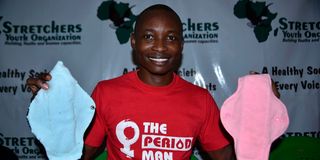
James Atito, aka 'Period Man', displays reusable pads for free distribution to vulnerable girls to promote menstrual hygiene in Mombasa.

What you need to know:
- Menstrual health advocate James Atito says reusable sanitary products are transforming conversations around period poverty in Kenya.
- New national campaign encourages Kenyan households to contribute monthly towards supporting girls’ menstrual hygiene and dignity.
When James Atito began speaking openly about menstruation six years ago, many people found it unusual for a man to champion menstrual health. Today, the anti-period poverty advocate, widely known as “The Period Man”, says the conversation is slowly changing, with more young people embracing reusable menstrual products and communities becoming increasingly open to menstrual health discussions.
On this World Menstrual Hygiene Day, May 28, James says one of the biggest shifts he has witnessed is the growing acceptance of reusable sanitary products among girls and women struggling with the rising cost of living. “We’ve been doing the same thing for years, but now we are seeing more young people adopting reusable products,” he says. “We are also seeing people becoming more receptive to training on reusable products.”
He says the high cost of disposable sanitary pads has pushed many girls towards cheaper alternatives that are often ineffective. “Those cheaper pads that retail at Sh50 or Sh60 are very thin, so they do not work well for those with a heavy flow,” he says.


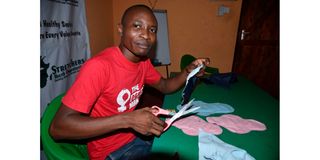
James Atito, aka 'Period Man', prepares reusable pads for free distribution to vulnerable girls to promote menstrual hygiene in Mombasa.
To bridge the gap, James and his team have shifted from relying on commercially produced reusable pads to locally manufacturing them through trained community groups. “What we’ve mainly been doing is training women and men on how to make reusable products locally,” he says. “We then buy the raw materials in bulk, make the products and distribute them to girls.”
According to him, commercially produced reusable pads still remain unaffordable for many vulnerable girls. He cites prices ranging from Sh600 to Sh850 per packet, depending on the number of pads included. Beyond access to products, James says the menstrual health sector still faces a major challenge in monitoring the effectiveness of interventions.
“The greatest challenge we’ve been facing in the sector is monitoring and evaluation,” he says. “When we distribute pads in schools, we do not follow up to know what has changed. Are girls still absent? Are girls still missing classes? Are teachers changing their attitudes?”
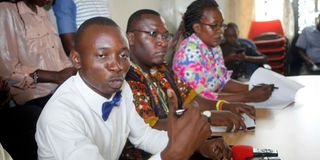
James Atito from the Stretcher Youth organisation in Mombasa, accompanied by civil society members, addresses a press conference at Kenya National Commission on Human Rights offices.
He says his organisation is now focusing on tracking the long-term impact of menstrual health programmes instead of simply distributing products. He also highlights that menstrual health disorders among young girls are becoming a major emerging issue in the sector. “We’ve had cases of girls as young as 12 or 14 experiencing endometriosis, fibroids, ovarian cysts and cervical cancer,” he says. “Our focus has also shifted towards addressing menstrual health challenges such as these.”
His work has now evolved into a larger movement under Period Man Community Trust, a charitable public trust focused on ending period poverty through local resource mobilisation.
This year, the organisation launched the Men4Periods365 campaign, a 10-year initiative encouraging Kenyans to contribute Sh365 every month towards supporting a girl’s menstrual needs. “We are encouraging men, women and households to participate in local resource mobilisation,” he says.
Under the campaign, a Sh365 monthly contribution, or Sh4,380 annually, supports one girl for an entire year with sanitary pads, panties, soap and body oil. The initiative, he says, is targeting one million girls across the country and plans to work with 1,000 schools by installing sanitary pad dispensers, incinerators and establishing pad banks.
In boys’ schools, the programme is promoting male engagement in menstrual health conversations and using the schools as collection points for menstrual products. So far, about 600 people have joined the campaign since its launch in January. “For us, that is slowly picking up, but considering we have attracted 600 contributors in four months, we have tried our best,” James says. “We are still continuing to reach out to as many people as possible.”