Pope Francis: The male-dominated funeral scene told its own story
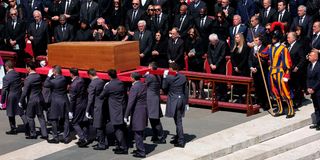
Pallbearers carry the coffin of Pope Francis, on the day of his funeral Mass, at the Vatican, April 26, 2025. His funeral's male dominance exposed the gender transformation yet to come.

What you need to know:
- Pope Francis's legacy on women's rights reveals a pontiff who made unprecedented strides by appointing around 20 women to senior Vatican positions, yet maintained conservative positions on female priesthood and reproductive rights.
- Despite breaking male strangleholds on power by granting women voting rights and leadership roles, his male-dominated funeral highlighted how far the Church still has to go.
When the funeral of Pope Francis was held on April 26, the optics were clear. It was largely a male affair – from the pall bearers and leadership of the service to the political leaders in attendance. This stood out as a strong reminder that the world is still heavily male dominated.
Be that as it may, the event marked the end of a pontiff universally eulogised as a quiet revolutionary who embodied the spirit of Christianity through his humble life and service to the needy. He unequivocally stated his love for the downtrodden and envisioned a world of justice. It is in this regard that it is important to examine his legacy with regard to women’s rights.
Stories about his legacy highlight that Pope Francis took steps to include more women in the leadership of the Roman Catholic Church. An article titled “Breaking barriers as women take the lead in the Vatican”, by Anbu Selvam of Radio Veritas Asia, catalogues the various women Pope Francis appointed to senior positions in the church.


In 2020, he appointed Sister Nathalie Becquart as undersecretary of the Synod of Bishops, making her the first woman in such a position and granting her voting rights in the policy making body. This was fortified in 2024 when he granted 57 women voting rights, breaking the stranglehold that previously limited these to bishops and cardinals, all men.
Read: The Pope who loved women
In the same year, he appointed Dr Francesca Di Giovanni as undersecretary for multilateral affairs in the Vatican's Secretariat of State, paving way for a woman in the church’s diplomatic relations and affairs.
This was followed in 2021 by appointment of Sis Alessandra Smerilli as secretary of the Vatican's Dicastery for Promoting Integral Human Development, through which she could “influence policies related to social justice, environmental sustainability and development”.
The same year saw Sis Raffaella Petrini appointed President of the Pontifical Commission and of the Governorate of Vatican City State, making her the senior-most woman in Vatican’s administrative structure with oversight and management mandates straddling security, infrastructure and cultural heritage. It was a good year for women as Sis Nuria Calduch-Benages was appointed Spanish biblical scholar. Other appointments were of Sis Barbara Jatta to head the Vatican Museums in 2016, Dr Gabriella Gambino and Dr Linda Ghisoni as undersecretaries of the Dicastery for Laity, Family and Life and Paloma García Ovejero as deputy director of the Vatican's Press Office.
Traditional Church
Perhaps the last woman appointed to a senior position before the Pope died was of Sis Simona Brambilla as Prefect of the Dicastery for Institutes of Consecrated Life and Societies of Apostolic Life in January 2025.
Previously, the prefecture was reserved for cardinals and archbishops, all men in the traditional church system. He also positioned six women in the Vatican’s financial governance structures, placed three to the office that selects bishops, and included them in canonical discussions including on the possibility of women serving as deacons.
That virtually all the women were the first ever of their kind to hold the offices is a veritable demonstration that Pope Francis wanted to see an inclusive and transformed church in which women were not just laity but also high level leaders. Observers note that Pope Francis appointed the highest number of women, around 20, to senior positions.
In debates about the Marian or Petrine theological model, he projected the church as feminine, symbolically signaling that he considered women integral to its identity and operations. But cynics contend that this was a tokenistic honour to women, stereotyping them as symbols of purity without acknowledging their agency.
He was also criticised for informal remarks that portrayed him as essentially a conservative who used progressive language. These “mixed” messages suggest a personality who was in constant debate about not only the church’s position about contemporary issues but also seeking to clarify his own ideological standpoint as he carefully navigated the terrain so as not to create a tumult but still initiate a progressive journey of change.
Yet despite his remarkable steps, Pope Francis still maintained conservative stands on ordaining women to priesthood and on sexual and reproductive health issues, especially abortion. But if he was ambivalent on some of these issues, he was categorical about others, such as gender based violence, human trafficking, the gender wage gap, marginalisation of women from leadership and sexual abuse by the clergy. Could he be called a feminist at crossroads?
Gender equality advocates would be keen to track the actual influence the women he appointed make on policy matters and practices of the Roman Catholic Church. They will also monitor whether the successor continues the trajectory set by Pope Francis or reverts to the default patriarchal settings.
The writer is a lecturer in Gender and Development Studies at South Eastern Kenya ([email protected]).