Reading without borders: Why both fiction and nonfiction books matter
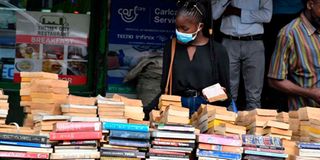
A book lover selects novels on Tom Mboya Street in Nairobi.

What you need to know:
- A debate over fiction versus non-fiction reveals false binaries, overlooking how both genres sharpen critical thinking and deepen understanding differently.
- While some dismiss novels as entertainment, literature has historically shaped political, cultural and moral consciousness across Africa and beyond.
Someone I was having a conversation with last weekend took me back to an old argument whose basis I have never understood. He felt that there is a dearth of people who read in this country, which is a risk to critical thinking. According to him, the problem is worse because many of the people who read consume fiction books, which provide little value beyond entertainment.
The debate between readers of fiction and readers of non-fiction books is unlikely to ever end. On one side, we have people whose lives are devoted to fiction books. They know the Harry Potter series by heart. They admire Margaret Ogola’s vision for women leadership. They have read all the novels by Bessie Head and Alexander McCall Smith, and to a good extent, they feel familiar with the communities in Southern Africa, all thanks to the books they read.
Then there is the second category of readers who swear by non-fiction books. I once interviewed a leading cardiologist in Nairobi. I was doing a profile feature for a youth-facing magazine I was assigned to at the time. Our conversation was brilliant. Towards the end, I asked him what genre of books he reads.


“I read solid books. I do not have time for stories,” the stoic, tall man said to me. The answer felt rehearsed. I was definitely not the first person he had said that to. He was proud of the fact that he did not have time for stories. His response was unexpected but unsurprising. As I grow older both chronologically and professionally, I meet more people who have a similar view of fiction books, as the good doctor.
That conversation stayed with me, especially as I thought about what was on my bedside table. My two current reads are a fiction and non-fiction book. The State of Africa by Martin Meredith is an encyclopedia-like history book that traces the different disasters that many African countries have been stumbling into right from independence. It’s a depressing reminder that while it is good to think of the problems of Africa as being written by our checkered history that includes slavery and colonialism, as a continent, we are not completely blameless of the sorry state that Africa finds itself in today.
For my fiction dose, I am re-reading Kosiya Kifefe, an old book (good luck finding it in a bookshop) by Arthur Gakwandi. The novel follows the protagonist’s life from pre-independence Uganda all the way to post-independence. Basically, we live these periods through the life of the main character. The fear, embarrassment, doubt, ineptness, greed, and corruption of a nation are embodied in this character. The novel is culturally, historically and anthropologically important in understanding the story of Uganda.
“I think the challenge that we have is we are constantly under pressure to see things in binaries. Why do we feel the pressure to immediately compare?” I asked him. He seemed quite surprised that the same brain that reads fiction also reads non-fiction. Fiction builds critical thinking; non-fiction helps in factual understanding. I believe both these skills are important.
He was not immediately convinced by my argument because he said I am lucky I am reading a useful fiction book. He said many fiction books have little value to add to life’s most pressing issues. We were quiet for a while. I do not know why he was silent; but I know I was imagining how the world would be today if Chinua Achebe did not write Things Fall Apart; if Mariama Ba did not write So Long a Letter; if Nawal el Saadawi did not write Woman at Point Zero; if Ama Ata Aidoo did not write Our sister killjoy and if Tsisti Tsitsi Dangarembga did not write Nervous Conditions. To mention less than a few.
Since I couldn’t crystallise all these thoughts into a sentence in that instance, when I finally spoke, it was to pursue his line of argument. “You are aware that we equally have some baseless non-fiction books that mislead the reader?” I asked, trying to sound as diplomatic as possible.
He paused. He partly agreed but insisted that fiction books are more notorious for that kind of mistake. We both laughed. My position was reading fiction and non-fiction doesn’t have to be an either or situation because that kind of thinking severely limits intellectual growth. What is your take on the debate?
The writer is the Research & Impact Editor, NMG ([email protected]).


