Real lives, real worries: What 2025 meant for women
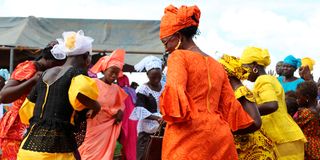
In 2025, Kenya marked 15 years since adopting a new Constitution, which promises fairness, equality, and an end to discrimination in all sectors.

What you need to know:
- Fifteen years after adopting its progressive Constitution, Kenyan women still face contraceptive shortages, hospital detentions for unpaid maternity bills, and underfunded gender programmes.
- USAid funding cuts left clinics empty and rescue centres struggling to feed girls fleeing FGM and child marriage.
In 2025, Kenya marked 15 years since adopting a new Constitution—one that former Chief Justice Dr Willy Mutunga once described as "the most progressive in the world". It promised fairness, equality, and an end to discrimination in all sectors. Yet, as the year unfolded, Kenyan women witnessed the inverse of those principles play out in their lives.
The contraceptive crisis
The cracks appeared early. When USAID froze its funding in January—despite the agency supplying nearly a quarter of Kenya's family planning commodities—the country's ambition of achieving universal access to sexual and reproductive healthcare slipped further from reach. Contraceptives became scarce, choices narrowed, and the fear of unplanned pregnancy intensified.


Nearly half (46 per cent) of Kenyan women aged 15 to 49 either do not want more children or would prefer sterilisation, according to the Ministry of Health. Yet their ability to exercise that choice became uncertain.
Alice Achieng', a mother of three from Kakamega County, had previously accessed her three-month injection easily from her sub-county hospital. That access suddenly turned into a demoralising routine after the funding freeze.
With her husband working far from home, she hoped to receive the injection to avoid an unplanned pregnancy. But after visiting three public health facilities—each out of stock—she gave up, exhausted and anxious.
Such experiences were replicated across counties. A joint analysis by the Council of Governors, UN Women, and the United Nations Capital Development Fund found that in Kajiado, although the number of health facilities has increased, many dispensaries remain understaffed and chronically understocked, with frequent shortages of family planning commodities.
The 2022 Kenya Demographic and Health Survey revealed that arid and semi-arid counties—where food insecurity is already high—also bear the highest unmet need for family planning: Marsabit (38 per cent), Tana River (34 per cent), and West Pokot (30 per cent). These same counties record the country's highest fertility rates, deepening cycles of poverty.
A fragile safety net
The year also exposed the fragility of Kenya's gender-based violence response systems. "I'm afraid; I have no food to feed the 98 girls," said Sister Teresa Nduku, director of Mary Immaculate Girl Child Rescue Centre in Suguta Mar-Mar, Samburu County, when speaking to the Gender Desk in June.
Her voice carried the weight of caring for girls at risk of female genital mutilation and early marriage. For years, Sister Teresa has rescued girls fleeing child marriage, FGM, and gender-based violence. But when US-funded support—which had ensured a steady food supply—was cut, the girls under her care became unintended casualties of geopolitics.
"I cannot send them away," she said. "Even though our dormitory was built for 50 girls, we are now hosting 98. I know it's overwhelming. But what do you do when a nine-year-old girl runs to you bleeding after being cut and told she's someone's wife?"
Detained for giving birth
The year also exposed the vulnerabilities women face in a health system detached from their economic realities. Although the government replaced the National Health Insurance Fund with the Social Health Authority in October 2024—insisting that Linda Mama benefits had been strengthened—the lived reality for many mothers was harsh in 2025.
From Kakamega to Eldoret, Thika, Kiambu, and Nairobi, women were detained in hospitals for failing to pay maternity fees.
Yet on 23 September 2025, President William Ruto's Women's Rights Advisor, Harriette Chiggai, tweeted from New York: "Kenya is making great progress in reducing maternal mortality... The introduction of the Universal Health Care policy, coupled with progressive legal frameworks, is ensuring that women at the grassroots have access to quality, life-saving healthcare. Together, we will continue working towards a future where every mother has the right to a safe childbirth, and every family can thrive in dignity.
The disconnect between policy pronouncements and hospital wards could not have been starker.
Forgotten at the margins
Beyond healthcare, the economic landscape for women remained stubbornly unchanged. Lilian Nyariki, a vegetable vendor in Kawangware, said nothing has changed for her.
"I started selling vegetables along Salim Road in 2021 and the road is in a poor state. There is no drainage," she said. "When it rains, it floods, and neither you nor the customer can reach your stall. That's income lost, and we depend on daily earnings."
Her hope that the county government would tarmac the road in 2025 faded. "It feels like they have forgotten us. Life goes on as usual," she said.
What must change
For meaningful change in 2026, stakeholders say there must be a fundamental shift in how women's needs are funded and prioritised.
"We have policies, and policies without budgets behind them are mere pamphlets," said Dorise Ng'ong'a, the acting gender, disability, social inclusion, and education advisor at World Vision Kenya.
"Getting resources to fund the policies we already have and women's programmes would really help—so that we don't have shelters closing down when funding goes down. Because shelters, when they close down, are really a problem for survivors."
Ng'ong'a noted that gender funding has become the government's fallback resource for unrelated emergencies—an indication of how low women's needs rank on the priority list.
Read: The stark reality of gender inequality separating Kenyan girls from the world's most equal nation
"Priorities on women's issues have gone down," she said. "The State Department for Gender receives minimal funding. And when there is an issue in another directorate, it is their funding that gets picked."
This lack of commitment is dangerous, she warned, especially as gendered crises deepen.
"Issues affecting women are changing," she said. "This year, we've really been looking at homicide and intimate partner violence. There is need for us to become creative and find lasting solutions for women."
As Kenya enters 2026, the question remains: Will constitutional promises finally translate into lived reality for women—or will they remain, as Ng'ong'a put it, mere pamphlets?


