Rights groups issue 40-day ultimatum over rising femicide and GBV crisis in Kenya
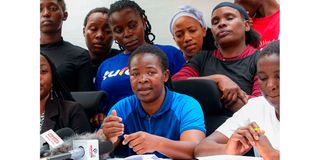
Unicon official Jackline Anyango and other human rights activists address journalists on the alarming rise in femicide cases in Kenya, at Vocal Africa offices in Nairobi on May 6, 2026. They called for urgent government action, improved police investigations and stronger judicial measures to curb gender-based violence and ensure justice for victims.

What you need to know:
- Rights groups demand urgent government action as femicide and gender-based violence cases continue rising nationwide.
- Kenya faces growing pressure to implement anti-femicide recommendations amid increasing killings of women and girls.
In April 2025, Sylvia Kemunto, a first-year student at Multimedia University, was found dead in a water tank. She had been strangled and showed no signs of attempting to defend herself. Her boyfriend later surrendered to the police.
In April 2026, Anita was fatally stabbed by her husband, a senior Kenya Defence Forces officer, in front of their four-year-old daughter and house help. In the same month, 21-year-old Rose Apondi, a student at Ramogi Institute of Advanced Technology, was murdered by her ex-boyfriend in a planned revenge attack.
Last week, gospel musician Rachel Wandeto was attacked, doused with petrol and set on fire by unknown assailants. She later succumbed to her injuries at Kenyatta National Hospital.


These are just a few of the many cases of femicide and gender-based violence recorded in Kenya in the recent past. Data from Fida-Kenya shows that 35 out of 70 weekly cases reported in 2026 across the organisation’s three offices are directly linked to physical and sexual violence among intimate partners.
April data from Amnesty International Kenya shows that at least eight femicide cases are reported each week. This means that about one woman or girl is killed every day in Kenya. Women aged 18–35 account for 59 per cent of all femicide cases nationally, with most victims being students in universities and colleges.
The increase in femicide cases in recent years led to the formation of the Presidential Technical Working Group on Gender-Based Violence (GBV), Including Femicide. The taskforce handed over its report to President William Ruto in January, with a raft of recommendations aimed at ending GBV.
However, despite the group submitting its report and recommendations, no action has been taken to date. As the report remains unimplemented, femicide continues to rise, with the latest statistics indicating that at least one woman is murdered every day. It is for this reason that a group of rights organisations today issued a joint statement giving the government a 40-day ultimatum to implement the recommendations of the taskforce or face protests and litigation.
Led by the Law Society of Kenya and Fida-Kenya, the rights organisations have given the government 40 days to report on the implementation of the taskforce recommendations. “The Cabinet Secretary for Gender and Culture, together with her Interior counterpart and relevant government agencies, should immediately share reports on what they have done to put the Technical Working Group’s recommendations into action, especially those focused on ending GBV and femicide,” they said in the statement.
The rights organisations also want the President to declare femicide a national crisis and ensure it receives urgent attention. Their demands include the immediate activation of the GBV Fund to support survivors and finance prevention, response and survivor support initiatives.
Rights advocates are demanding that femicide be classified as a distinct, actionable crime to combat the normalisation of killings and improve data tracking. “We are calling on the government to urgently establish a rapid response team to assist in reporting GBV and femicide cases, provide legal aid and psychosocial support, and offer referrals for survivors and victims’ families. The President should also launch a national campaign to raise awareness and mobilise action against GBV and femicide,” they added.
The campaign, they noted, should address the root causes of violence, challenge myths and stereotypes that fuel violence against women, and encourage people to report such cases. They are also pushing for a nationwide GBV survey to collect data on trends and prevalence and guide evidence-based policy decisions.
Ultimatum
If their demands are not met within the next 40 days, the organisations say this will demonstrate a lack of commitment and accountability by duty bearers, forcing them to organise peaceful protests across the country led by grassroots women, male champions, civil society groups and Kenyans committed to eradicating GBV and femicide.
“We will also file a Strategic Interest Litigation to secure justice and push the government to properly fulfil its legal duty to prevent and respond to violence against women and girls,” the organisations said.
Esther Passaris said these painful deaths must force the country to confront the harsh reality of rising violence against women and girls. She noted that families are grieving, communities are living in fear, and women and girls increasingly feel unsafe in spaces where they should be protected.
“If we are truly serious about ending femicide and violence against women, then the murder cases involving these women must be expedited, and strong investigations must lead to successful prosecutions. We need faster investigations and trials, protection of evidence and witnesses, stronger prevention systems, survivor support and trauma healing, safe spaces and emergency response systems, and accountability at every level,” Esther said.
The Presidential Taskforce on Gender-Based Violence and Femicide called for the recognition of femicide as a distinct criminal offence in the Penal Code to address the gender-based motivation behind the killings. It also called for the formal classification of femicide and GBV as a national emergency or disaster to ensure prioritised funding and urgent intervention. The report further recommends stricter bail and bond rules for offenders and harsher minimum sentences for aggravated sexual offences.
The taskforce also proposed the introduction of mandatory chemical castration for perpetrators of defilement involving children and persons with disabilities, and making it a punishable offence to use out-of-court settlements to silence victims of GBV and femicide. The rights organisations that issued the joint statement included Kenya Human Rights Commission, Kewopa, Save a Girl, Usikimye, Siasa Place, Creaw, and Social Justice Centre Working Group.


