The App helping survivors of sexual violence get justice
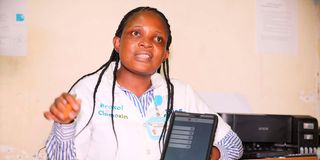
Loice Otieno, a clinical officer at Lumumba Sub-County Hospital in Kisumu, showcases the MediCapt Mobile App on May 28, 2026. By digitising the Rape Post Care Form, the app ensures that vital forensic data and survivor details are accurately recorded and preserved immediately following medical examinations, streamlining the chain of evidence.

What you need to know:
- MediCapt, developed by Physicians for Human Rights, is changing how forensic evidence is collected, stored and transmitted in sexual violence cases.
- The app enables clinicians to securely document, store and share court-admissible forensic evidence of sexual and gender-based violence (SGBV), addressing a problem that has long dogged SGBV prosecutions: lost, damaged or mishandled paper forensic records.
In 2024, a teenage girl from Kangema, Murang'a County who is living with HIV and battling mental illness, found a lifeline in her pursuit of justice after the National Gender and Equality Commission (NGEC) stepped in to recover crucial medical documents that police officers had allegedly withheld.
The survivor, who had endured repeated defilement, was left in limbo after her Post-Rape Care (PRC) and P3 medical forms, vital evidence in prosecuting sexual offences, were reportedly held back at a local police station. The alleged withholding of evidence risked derailing the case, raising questions about accountability and sensitivity in handling cases of sexual violence.
NGEC's Rapid Response Team, acting on a referral from St John's Community Centre, worked with the Medical Superintendent and social worker of Kangema Sub-County Hospital to secure the survivor's documents. The team obtained copies of the PRC and P3 forms, as well as the police Occurrence Book (OB) number, safeguarding key evidence for the ongoing investigation.


"The immediate retrieval of the survivor's medical forms was crucial. Delays or obstruction in evidence handling can compromise justice and deepen trauma for survivors, especially those facing additional vulnerabilities such as illness or mental health challenges," says Desire Njamwea, assistant director,
Legal, Complaints, Investigations and Redress at NGEC.
Also read: From boda rider to human rights defender: One man's fight against sexual violence in Mt Elgon
Many survivors of sexual violence, like the teen girl, grapple with a host of challenges in their bid for justice, among them missing evidence and gaps in what police present in court. But survivors could now have reason to smile if a mobile application built to seal these loopholes is anything to go by.
MediCapt, developed by Physicians for Human Rights (PHR), is changing how forensic evidence is collected, stored and transmitted in sexual violence cases.
The app enables clinicians to securely document, store and share court-admissible forensic evidence of sexual and gender-based violence (SGBV), addressing a problem that has long dogged SGBV prosecutions: lost, damaged or mishandled paper forensic records.
It has digitised the Rape Post-Care Form, where details of survivors, some of which serve as vital forensic evidence, are normally entered after a medical examination. Used in hospitals, it guides clinicians through conducting and documenting physical examinations and capturing forensic photographs of injuries, storing everything using sophisticated encryption and tamper-proof metadata that protect the survivor's privacy and preserve the chain of custody.
Loise Otieno, a clinical officer at Lumumba Sub-County Hospital in Kisumu, has used MediCapt since February 2025, and describes it as God-sent. She says that once survivors are brought to hospital and consent obtained, either from the survivor or their guardian in the case of minors, their bio data, including photo evidence, medication and examination details, is entered into the app.
Filling in survivors' details on the paper PRC form, she says, used to be tedious and prone to errors.
"The PRC form was prone to improper documentation, which led to a lot of cases being dismissed. Data alteration also used to happen. Most appeals of sentences in Kisumu before were based on how this form was filled, which is now not the case. We had cases being dismissed based on the handwriting in the
Post Rape Form, as it was not legible," Loise explains.
Once the details are in the app, mobile clinicians send them to the police via email, then print a hard copy, which they also hand over to police.
"The system we use has specific login credentials. One cannot alter details already submitted therein, but can only add an addendum to it. The security and credibility of the data put into the system are assured. The system captures all data needed in real time," she adds.
Since February last year, Loise has handled nine cases of sexual violence through the app, all submitted to police. A total of 16 cases of defilement and rape have been recorded via the app in the same period.
The platform allows doctors to securely transmit medical evidence directly to law enforcement and justice sector officials, including police, lawyers and judges, to aid investigations and prosecution.
MediCapt is currently used at five sites in Kenya: Naivasha County Referral Hospital, Nakuru County Teaching and Referral Hospital, Mukuru Health Centre, Lumumba Sub-County Hospital in Kisumu, and Molo Sub-County Hospital.
According to PHR data from May 2026, 1,854 cases have been documented on MediCapt in Kenya.
Loise and other medics are among the project’s beneficiaries. It is spearheaded by the UN Women. She says the training that came with the project has given her confidence in managing survivors of sexual violence.
“At least we are now sure of what we are doing, and we know we are doing it right. We are also training other clinicians on how to use the app to ensure there is continuity upon transfers," she adds.
MediCapt is part of the UN Women initiative dubbed "Let It Not Happen Again," launched in 2019 with support from the Italian Agency for Development Cooperation, in partnership with the Office of the High Commissioner for Human Rights. It is being implemented in collaboration with PHR, the Centre for Rights Education and Awareness (Creaw), and CSO Networks.
Between January 2024 and December 2025, 681 cases were documented using MediCapt, and 382 MediCapt forms entered the justice system during this period, representing 56 per cent of the forms captured in the app.
An evaluation also reviewed 350 closed sexual offence cases from Nakuru and Naivasha Law Courts between 2022 and 2024. Of these, 21 cases, or six per cent, included MediCapt-generated PRC forms.
Cases documented on the app achieved stronger judicial outcomes, with a 67 per cent conviction rate compared to 28 per cent for cases not documented. None of the acquitted cases were due to evidence flaws, and courts consistently cited MediCapt-generated evidence as clearer, more reliable, and sufficient; reducing delays caused by incomplete or illegible forms.
Kidenda says the initiative’s objective is to build the capacity of duty bearers, such as nurses and clinical officers, in collecting and storing forensic evidence in a survivor-centred way.
“Through the training we have conducted on the MediCapt application, we have helped medics understand how to properly collect, package, and store medical forensic evidence in cases of sexual violence. Many cases collapse due to lack of evidence, often because it was collected, packaged, or stored incorrectly,” she says.
Close to 800 people across professions, including police, clinicians, nurses and magistrates, have been trained.
"The impact has been phenomenal. Those involved in the criminal justice system, including clinical officers, police and magistrates, are now more knowledgeable on the collection, packaging and storage of forensic evidence, which is critical in helping survivors of sexual and gender-based violence get justice," she adds.
“Kidenda notes that it has not been all rosy, citing limited resources to roll out the app in other counties and high medical staff turnover, which erodes the pool of trained personnel through transfers.
To make it a national initiative, she says PHR is recommending that the training be integrated into the curriculum for clinical officers and nurses at the Kenya Medical Training College.
Before that, she proposes integrating MediCapt into national systems such as Taifa Care, expanding access beyond PHR issued devices, strengthening case tracking from health facilities to courts, establishing a training of trainers framework to address staff turnover, and scaling implementation to additional counties and facilities.”
Antonia Sodonon, UN Women Kenya Country Representative, the initiative has demonstrated that targeted investment in justice systems, institutional capacity and survivor empowerment can significantly strengthen responses to violence against women in elections in Kenya.
"Across Bungoma, Kisumu and Vihiga counties, the initiative has contributed to tangible progress in advancing access to justice, strengthening accountability, and supporting policy and institutional reforms, including the establishment of specialised gender-based violence courts," says Antonia.
She notes that sustaining and deepening this progress require continued investment in prevention, strengthened and harmonised data systems, and integrated support services, including economic and psychosocial support, for survivors and service providers.
"Building on these gains, we must scale up and reinforce these efforts to ensure that violence against women in elections truly does not happen again," she adds.
Dr Michael Odour, an obstetrician gynaecologist in Siaya County, says that as a frontline health worker, he takes samples used as evidence, and the training has been instrumental in helping him and other medics understand the dos and don'ts of handling them.
"As medics, we now know how to package and store the samples to safeguard the integrity of the evidence required. Cases of sexual violence need very tight evidence. In the past, we have had cases where perpetrators were acquitted as a result of poor-quality forensic evidence," he says.
He is urging the government to introduce a mandatory training module for nurses and clinicians on handling survivors of sexual violence.
Polycarp Kweyu, Assistant Government Chemist in charge of forensic biology at the National Forensic Laboratory in Kisumu, says they routinely receive numerous samples collected from survivors of sexual violence for examination and analysis. He notes that some of the samples are in a poor state, which at
times affects evidence quality.
"The problem lies in the handling of forensic evidence from the start. Poor handling often downgrades its quality. At times, the chain of custody, from hospital to police to the government chemist, becomes compromised, which in turn affects the reliability of the evidence," Kweyu tells Nation.africa.
He says some of the exhibits received at the Government Chemist include vaginal swabs, blood stains, body samples from different parts, body fluids, clothing, and samples from injuries. He lauds the training of duty bearers on handling and storing forensic evidence, terming it critical to ensuring survivors of sexual violence receive justice.
Fabio Minniti, Head of the Nairobi Office at Italian Agency for Development Cooperation says advancing gender equality and the fight against GBV remain a core priority for his organisation. He notes that the initiative has delivered concrete results such as supporting policy-level reforms and strengthening service delivery at the local level.
"We are proud to support a portfolio of initiatives that drive meaningful change in this sector. The 'Let It Not Happen Again' initiative stands out as one of the most impactful efforts within this portfolio, demonstrating how strategic interventions can strengthen justice institutions, expand access to services for GBV survivors, and enhance community-level engagement," says Minniti.
“Astanta Barasa, a police officer at Kondele Police Station in Kisumu and head of the gender desk, says the initiative has taught police how to properly handle, document, and store forensic material.
"We now have very few cases being thrown out for lack of evidence. To sustain this momentum, I am cascading the skills to fellow officers, who also need training on handling forensic evidence."


