The forbidden and the desired: What drives black men towards white women?

An interracial couple. Black psychologist Princella LR Clark argues that some black men’s attraction to white women is rooted not in preference alone, but in deep psychological wounds left by slavery, colonialism, and racial oppression.

What you need to know:
- In The Game: 41 Shades of Men, black psychologist Princella LR Clark argues that some black men’s attraction to white women is rooted not in preference alone, but in deep psychological wounds left by slavery, colonialism, and racial oppression.
- Citing data from Pew Research Center and the National Council on Family Relations, Clark notes that black men are significantly more likely than black women to intermarry—and that such unions face higher divorce rates—patterns she interprets as evidence of unresolved historical trauma.
- Clark frames black men's behaviour as an adaptive psychological and even epigenetic response to prolonged racial exclusion.
In her book, The Game: 41 Shades of Men, black psychologist Princella LR Clark explores the many ways she believes men pursue and use women. One of her most provocative arguments concerns the psychology behind black men's relationships with white women—a pattern she traces back to the wounds of slavery and colonialism.
Princella draws on data from Pew Research Centre, a non-partisan fact-tank, which shows that black men are twice as likely as black women to have a spouse of a different race or ethnicity—24 per cent versus 12 per cent. This gender gap, she notes, is long-standing. In 1980, 8.0 per cent of recently married black men and 3.0 per cent of black women were married to someone of a different race. Pew Research also indicates that intermarriage has increased among those with no college experience.
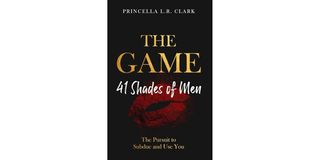
The cover of Princella LR Clark's book, The Game: 41 Shades of Men.


She also references a study published by the National Council on Family Relations, which analysed nearly 6,000 never-married men and women aged 15 to 44 over 10 years. The study found that marriages between a black husband and white wife were twice as likely to end in divorce as marriages between a white husband and white wife.
When adjusted for background factors such as age at marriage and education, some of these differences diminished—suggesting, she argues, that the elevated divorce rate is not simply about demographics but about something deeper.
For Princella, that 'something deeper' is historical trauma. She contends that laws against interracial marriage created an energy of insatiable desire—what emerges when one is denied access to what is forbidden. The subjugation of black people during slavery, and their oppression during colonialism and segregation, she argues, instilled intense self-hatred within black men. They developed what she describes as an unrestrained urge to be like white males and gain access to their women.
White men had power, she writes, and the white woman became a symbol of that power—a marker of success due to her proximity to white men. Now that laws have been relaxed, she suggests, many black men subconsciously feel accomplished by dating white women. The illusion of being with a white woman, in her view, strokes and fortifies the black male ego.
Princella frames her argument in scientific terms. Living organisms respond to stimuli in their environment, she notes. Slavery was a stimulus that extensively altered the environment for black people, fragmenting their psychological wellbeing and eroding their self-worth. Patriarchal philosophy, she adds, compounded this. Black people responded to these stimuli by adapting biologically and psychologically. This prolonged response, she argues, has created epigenetic changes within black men's biological and psychological make-up.
Because black men have endured centuries of what she calls 'ego abuse and racial assault,' they have developed a profound void and a distinctive urge to protect their fragile egos. The black male, she writes, is suppressed, disenfranchised, and outperformed in every sector of life by his white competitors. This breeds internal contempt—and because men view the world through the lens of how they view themselves, a black man with self-disdain seeks outwardly for what appears to have external value.
The writer is a novelist, Big Brother Africa 2 Kenyan representative and founder of Jeff's Fitness Centre (@jeffbigbrother).