Elizabeth Ocampo, a Kenyan woman married to Solomon Ocampo, a Filipino, is content in marriage despite theirs being a planned marriage. Elizabeth and Solomon, who are ordained Reverends, met for the first time 11 years ago on their wedding day.
“Ours was an arranged marriage, organised by our parents,” Elizabeth begins. “We began the relationship as strangers after our wedding. We knew very little about each other, only what we had heard about one another’s families.”
Elizabeth says that getting married to a foreigner was never a major concern. All she had asked since her younger days was to get a man who believes in God. However, her husband’s desires were different. He wanted a Philippine woman.
“When my husband was informed about the plans, he had a very different preference. He wanted a Filipina. It was one of his firm conditions.”
But Elizabeth has learnt that God has a sense of humour, as he writes the stories of people in ways they themselves cannot even understand.
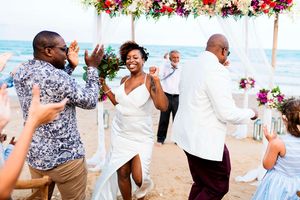
Asked what their wedding was like, Elizabeth says that Kenyan and Filipino weddings are different. Kenyan ceremonies are rich with tradition, music, and vibrant cultural expressions, while Filipino weddings are simple and quick. They got married in 2014, in the Philippines Manila Hotel.
“We decided to theme our wedding on both worlds. We added a lot of Kenyan vibe to our celebration and all guests appreciated this,” she says.
But after the wedding came challenges that lasted years. From their first day as newly-weds until almost five years into marriage, they disagreed on which food to cook in their house. “One of us always had to compromise. Kenyan and Filipino cuisines are worlds apart, and it took a lot of patience and love to find common ground,” she says.
Elizabeth agrees it has been a journey of learning, adapting, and growing together. Being in an arranged marriage, she struggled to accept the idea that she was getting married without a preceding love story.
“For two years, I rejected his parents’ proposal to our family. My heart wasn’t at peace at all,” she says. But with time, she came to a place of clarity and calmness, realising that the man, though a stranger, was truly created for her. She became certain and deeply sure Ocampo was the man she would settle down with.
Solomon and Elizabeth Ocampo with their children in the Philippines.
Photo credit: Pool
Elizabeth does not believe in divorce. “To me, marriage is for life, not something you step into lightly or walk away from when it gets hard,” she says. In any case, the Philippines is one of the few countries in the world where divorce is not legally allowed.
Elizabeth’s family had no issues with the proposal from Solomon’s family as discussions were going on for almost two years. Both the mothers were best friends for some time.
Siblings from the two families knew each other. During the 2007 post-election violence in Kenya, Elizabeth and Solomon’s families lived together for three months in Eastern Kenya (Ukambani). Strangely, the two never even met because Solomon had opted to stay at their Nairobi home. Years later, Solomon’s family left Kenya and when he returned to the country in 2008, Elizabeth had just left for the US to pursue further studies in Bible School.
In Kenya, Solomon interacted well with Elizabeth’s siblings as the two families were friendly. After their marriage, the duo stayed in Kenya for eight years before they relocated to the Philippines in 2022.
One of the most surprising and often painful reactions they have faced came from strangers in Kenya. She recalls how people would shout things like “Mchinku, wachana na msupa wetu !” (Chinese man, leave our girl alone!). “Many people think all Asians are from China, which is a big misconception,” Elizabeth says, chuckling.
She notes it was difficult for her and her husband during the Covid-19 pandemic, when anti-Asian sentiments were heightened. “Even taking walks became emotionally draining. It was a tough and eye-opening experience for both of us,” she adds.
She remembers an instance when immigration officers pulled her aside for questioning, while her husband, being light-skinned, was let through without any issues. “The same happened in Malaysia. I was asked to produce our marriage certificate to prove we were actually married,” she shares. “It is exhausting to constantly justify our relationship to strangers.”
Even in less serious settings, like supermarkets, if Elizabeth is ahead in the checkout line and her husband adds an item to the basket, people often get surprised. “People assume we are strangers and he is taking advantage to pass them in the queue. We usually have to explain loudly, ‘We’re married!’” she says.
Elizabeth admits that the first three years of their marriage was tough. There were clashes, arguments, frustrations, and moments where she felt like just leaving and planning life differently. But forgiveness and tolerance made them keep choosing each other through it all.
“It’s not unusual in our home to find chapati on the table next to Filipino adobo. Instead of fighting over whose culture was right we realised we could blend the best of both worlds and let go of the parts that didn’t serve our home,” she said.
In parenting, they have created a balanced approach that draws from both their backgrounds. They are intentional about the language they want their children to speak – both Kiswahili and Tagalog, to honour both sides of their heritage.
On holidays, when they can afford, they visit each other’s families. Despite the challenges she faced in her mixed marriage, she has experienced joyful discoveries in Asia. Growing up in Kenya, the Philippines for Elizabeth was just a distant name associated with typhoons. She has discovered stunning land made up of over 7,000 islands each with its own beauty, culture, and charm.
“The landscapes, the people, the richness of everyday life is all so vibrant and worth experiencing. I often find myself wanting to tell my fellow Kenyans, ‘Kujeni mujivinjari kidogo !’ (Come and enjoy yourselves a little!),” she says.
One of the cultural practices that took her by surprise was the belief that women should avoid bathing during their menses or for an extended time after childbirth, sometimes up to two months. Coming from Kenya, this was very unfamiliar. Elizabeth has always believed in daily showers.
“I have been gently cautioned about this, but I usually just smile and respectfully say, ‘Perhaps our bodies are just made to handle things differently. What works for one culture may not apply to another’.”
Asked what the hardest part in their marriage has been, she admits the early years have been about learning each other’s race, culture, and ways of life. It shaped the bond that they share today. “Every marriage has its challenges, but being in an interracial marriage adds another layer. It is like adding a pinch of extra spice. It can be intense, complex, and at times more demanding than most.”
Their four children have also felt the weight of finding an identity. “In Kenya, they’re often called ‘wachinku’ because of their eyes. In the Philippines, they’ve been teased for having coarse hair,” she says.
Elizabeth and her husband have made it a point to speak openly and frequently with their children about their differences. “We talk about where they come from, what makes them special, and the beauty of belonging to two rich, diverse cultures.”
She wishes people would stop believing the stereotype that in interracial relationships: one partner is always dominant and the other submissive. “This narrative is deeply rooted in racial and cultural biases and it’s simply not true. Every relationship is unique, and the dynamic between two people is shaped by their personalities.”
Kenneth Akal, his wife Britanny and their child in California.
Photo credit: Pool
Brittany Akal left her home country for Kenya with one agenda, to work in Mathare as a missionary at the Light and Hope Initiative, a non-governmental organisation. Kenneth Akal, who is Brittany’s husband, is the founder of the organisation and he says that he had given up on matters of love by the time the two discussed starting a family.
“I met my wife when she had visited Kenya for work at my organisation in Mathare. I was not even looking for love. The women I had dated had disappointed me enough.”
Kennedy had never thought of marrying outside his race, and when they realised they were falling in love, they had to have a serious discussion. “I had never thought of marrying someone outside my race. Both of us made our intentions clear. We were both looking for a long-term relationship.”
When the time to visit Brittany’s parents came, Akal, who had travelled to the US, was shocked when her parents turned down his proposal. “I was very surprised when I went to pay dowry. Americans don’t believe in dowry payments. Her family turned down the offer,” he says.
In Kenya, when dowry is paid, celebrations are done to seal the union. In the US, dowry payments are not common. Introducing your relationship to your family can always be a little intimidating, whether on your end or your partner’s end. But when you’re in an interracial relationship, things can get more complicated.
Kennedy’s family had no issue when he said that he would be marrying Brittany, a US national. However, to Brittany’s friends, the story was different as they told her that the man was out to milk her finances dry.
“She was told things like, ‘Africans only marry white women when they want to gain something. I remember one of Brittany’s friends mentioning how another black man had married an American woman only to divorce her later after acquiring a Green Card’.”
Married for four years now, Kennedy admits it has taken them time to adapt to each other’s language. Born and raised in Kenya, he says it has been a challenge even teaching his children Swahili. “Most of the time, they play with other American children who only speak English. But I try teaching them a little bit of Swahili,” he says.
At home, they have embraced both Kenyan and American food. They also made a decision on home schooling their children due to Kennedy’s Christian values. The church they worship at has a school where they go thrice a week.
One of the things he has had to learn is to how to deal with pets and avoid statements such as, “You are fat,” which is abominable in the US.
“My mother-in-law has a dog and she treats it like her own child. The dog is even rewarded for behaving well, with candies and chocolates. It even has its own swimming pool!”
“Another striking thing is that in Kenya, when your parents get old, you take care of them but there, they take their parents to nursing homes as early as age 70.”
Another cultural practice that has baffled Kenneth is how individualised the society is. “This is not like in Kenya where a neighbour’s problem is also yours to solve. Here, everyone is for himself,” he says.
The society’s expectations of a man are different among Americans. He says it has been his biggest challenge, especially adapting to both roles of a man and a woman. There are no distinct roles for men and women. “Here you are the provider but you also take care of children and home chores. You do everything,” he says.
Americans value celebrations like birthdays and Christmas, which come with high expectations of presenting gifts and dressing up. Kennedy doesn’t understand events like Halloween, which are mostly celebrated in the US. “In my family, we celebrate Christmas differently, the Christian way,” he says.