The king is dead, but long live the crown—Winnie Odinga's cryptic political signal
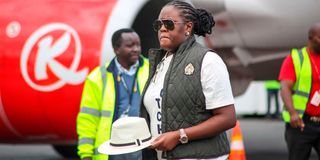
Winnie Odinga bears her father's fedora after the Kenya Airways flight from India. Raila Odinga died in her arms, and she carried his iconic hat home to hand to her mother—a moment many interpret as symbolic preparation for political inheritance.

What you need to know:
- The close bond between Raila Odinga and his daughter Winnie has fuelled speculation that she may be his political heir.
- Named after South Africa’s Winnie Mandela, Winnie Odinga embodies confidence, composure and defiance—traits reminiscent of both her namesake and her father’s legacy.
If there is one question in the minds of Kenyans about the Raila Odinga succession, it is whether his daughter Winnie is his heir apparent. This is based on a number of facts. She is his most visible child, demonstrated in her physical and abrasive presence during the 2022 presidential campaigns. That she was nominated to the East African Legislative Assembly by her father’s political party is a clear indication of preparation for a political career. She was obviously her father’s darling, going by the public intimacy between them and her presence at critical moments in his life. Take, for example, the statement that he died in her arms in India.
In African traditional belief system, parents usually summon their favourite children to their bedsides in their final moments, ostensibly to hand over the mantle. Call it superstition, but these things have symbolic and practical significance.


The rapport between Raila and Winnie brings to mind the “Daddy’s Girl” phenomenon, a reference to the strong bond between a daughter and father, often characterised by affection, admiration and a sense of protection. This concept is associated with the attachment theory, that daughters who form secure attachments with the paterfamilias often develop higher self-esteem, better emotional regulation and healthier relationships in life. In other words, a father's involvement influences a girl's sense of self, confidence and even career aspirations.
In African cosmology, it is also believed that naming a child after a particular person is an act of transferring the latter’s spirit and character to the former. As revealed by Ida Odinga, Winnie was named after Winnie Madikizela Mandela, the iconic wife of the South African freedom fighter and later president Nelson Mandela.
Indomitable
Winnie kept the Mandela name alive for the 27 years of his incarceration. She had an electrifying personality quite independent of her husband’s own. Thus, she forged her own identity as a fierce anti-apartheid crusader and lethal community mobiliser. This stood her in good ground even when their marriage broke down. The divorce did not condemn her into oblivion but she defiantly rose above it till her death. No word summarises her better than “indomitable”.
Winnie Odinga has so far displayed unparalleled composure during mourning, indicating the kind of steel she has gathered from being her father’s understudy and confidante. One cannot gainsay what political wisdom and secrets the father shared with her and how she will eventually unleash them, should she tread the same political path, which is more probable than not. Would she become Kenya’s Winnie Mandela?
The intricate relationship between Winnie Odinga and Raila was captured in her declaration that he was both her father and super-hero, ending in the dilemma of “I don’t know who I’ll miss more - my dad or my superhero”. A super-hero is “a fictional character who possesses extraordinary powers or abilities and uses them to protect others and fight evil”. In the word, Winnie simultaneously captured Raila’s magical powers that endeared him to millions and made him impossible to ignore as well as his democratic and human rights credentials.
A superhero is admired and emulated even if one is not able to rise to his or her level. In these words, Winnie signalled that her father’s larger than life profile would be her inspiration. The political intentions are perhaps hidden in the proverbial statement that “the spirit of the lion roars on forever, the King is dead, but long live the crown”. An allusion to the British tradition of showing that the death of the king (The King is dead. Long live the King) does not create a vacuum, the statement indicates that Raila’s demise should not be construed to mean the end of his political influence.
Note the parallelism that it is Winne who carried the father’s favourite fedora hat (crown for all you care) from India and handed it over to the mother in that heart-breaking moment of acceptance that the enigma was no more.
Winnie is already in the political arena, joining a growing list of daughters following their fathers’ footsteps now and in other eras. At the local level, she joins: her own aunt, Ruth Odinga- Kisumu County Women Representative; Susan Kihika, Governor of Nakuru County; Wavinya Ndeti,Machakos Governor; and Gladys Wanga, Governor of Homa Bay. At the African level is Samia Nkrumah and Zanetor Agyeman-Rawlings, both of Ghana. Extra-African examples are Indira Gandhi of India, Benazir Bhutto ofPakistan, Sara Duterte of the Philippines, and Liz Cheney and Ivanka Trump, both of the United States of America.
Should Winnie Odinga decide to enter elective Kenyan politics, would the Odinga name and fame be an asset or liability for her? Watch this space.
Follow our WhatsApp channel for breaking news updates and more stories like this.
The writer is a lecturer in Gender and Development Studies at South Eastern Kenya University ([email protected]).


