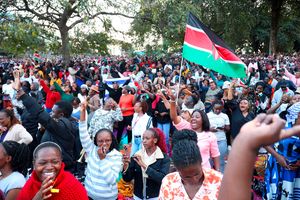
The legacy lives on: How Phoebe Asiyo shaped a generation of leaders
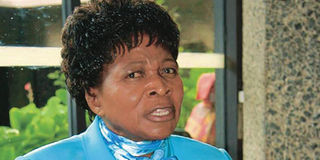
Phoebe Asiyo, who contested and won the Karachuonyo Constituency seat in 1979.

What you need to know:
- She championed women’s rights, pioneered affirmative action, and inspired generations.
- Her calm, courageous leadership in politics and grassroots movements played a critical role.
Phoebe Asiyo finally rests today at her home in Kibiri, Homa Bay County, having been flown in from North Carolina, USA, where she died on July 17 at the age of 92.
By now, you probably know many of her accomplishments—from tabling the Affirmative Action Motion in Parliament in 1997 (which sadly never saw the light of day but set the wheels of gender justice in motion) to mobilising women to travel to Kapenguria in West Pokot to visit detained Mzee Jomo Kenyatta. Mama Phoebe, as many women of her era fondly call her, was still on a mission: 50-50 representation of women in leadership.
To women of the 21st century who may not have the slightest idea of what she stood for or how she helped shape the gains they now enjoy, she has left behind a reservoir of history in the form of her book, It Is Possible: An African Woman's Reflections on a Life-Long Political Journey. Her biography takes you deep into her world in the pre-colonial and independence seasons, and sweeps you through the maze of being an elected woman in a Parliament dominated by men. In her struggles, she learnt. Through her accomplishments, she inspired and mentored women and men, some of whom now share what Mama Phoebe taught them, whether in person or from a distance. Their testimonies are lessons in themselves.


Martha Karua,
Party leader, People's Liberation Party
"We have lost a library"
“She was the first African chair of Maendeleo ya Wanawake, so the history of the women's movement in this country is intertwined with her history. And as we grew up, these are the women we heard about. On the political front, there were Phoebe Asiyo, Julia Ojiambo. We heard of young ones like Chelangat Mutai. These are names that impacted me and others alike as we grew up. I had the pleasure of working with Phoebe when I joined Parliament, and also in the women's movement.

People's Liberation Party leader Martha Karua delivers her speech during the party's launch in Nairobi on February 27, 2025.
“When the constitutional review process started formally in 1997–98, I remember that, within the Inter-Parties Parliamentary Group, Phoebe was the only woman in the legal committee, while I was the only woman in the constitutional committee. At that time, she was also chairing an umbrella of all the women's organisations: the Women's Political Caucus.
“She had been unanimously proposed and accepted by all the women's organisations to lead that caucus so that we could jointly push for women's gains in the constitutional review process. She ended up being a key pillar in the process, as one of the initial commissioners elected by women. We deliberately placed her there to represent the older women, the carriers of our history in independent Kenya as women.
“Working with Phoebe was easy. She gave a listening ear to everyone. She was always tempered in her responses. She truly was a resource, a source of wisdom for us. Beyond the women's movement, which culminated in the gains we have today, she also brought the affirmative action motion after the Beijing Conference. And together with Charity Ngilu, who brought a similar but slightly different motion, they set in motion the journey that eventually gave rise to the National Gender and Equality Commission—and more broadly, the journey towards gender inclusion.
“In the constitutional review, we argued, for the first time, that one-third of all organs of the review process should be women. That's how women ended up in the commission, in the national convention, and even when it went down to the districts and counties, women were there.
“So yes, she has left a lasting impact, not only on the women of Kenya but on the nation as a whole through her contributions. When you are in Parliament, you are a national leader. The National Assembly of Kenya. I also remember the work she did for her constituents. I remember knocking on the doors of development partners alongside her, looking for support for our respective constituencies. That was long before the Constituencies Development Fund, and at a time when the government of the day was responsive to development.
“So, I know she did a lot of work. We have lost a library, a library of the history of leadership in Kenya, and women. She had another first: the first woman secretary-general for the Local Authorities. She was an icon in leadership, political leadership, national leadership, and leadership within the women's movement. The current generation of older and younger women can carry on Phoebe's legacy by being authentic leaders, as she was. By genuinely working for the welfare of the nation and women. Luckily, she has left behind a memoir where people can read about her journey. But I believe we must also, collectively, record the contributions of women so that the women of Kenya can continue to be mentored by the legacies of those who came before them.
“As I've said, luckily for us, Phoebe has left a book: It Is Possible: An African Woman's Reflections on a Life-Long Political Journey.”
Cecily Mbarire,
Governor, Embu County
"She broke barriers"
“Hon Phoebe Asiyo's conviction and courage inspired an entire generation. As a trailblazer in politics, she broke barriers and paved the way for women like me to take our rightful place in leadership. Her fearless pursuit of equality and justice empowered countless women to find their voices, to stand tall, and to fight for what they believed in. Her historic motion on affirmative action in Parliament, the first of its kind, called for greater representation of women in leadership. That single act set in motion a transformation that continues to open doors for generations of women leaders.

Cecily Mbarire, Governor, Embu County.
“Beyond the walls of Parliament, Asiyo's work within the women's movement both locally and on the global stage cemented her legacy as a champion of empowerment, advocacy, and social transformation. She carried out her duties with unmatched grace, unwavering dignity, and profound humility—values that inspired and shaped many leaders who walk in her footsteps today. The people of Karachuonyo were truly privileged to be represented by such a visionary and principled leader.
“Her mentorship has shaped the paths of many women in leadership today, including myself. Her absence will be felt across the country, but her legacy will continue to ignite change for years to come. Phoebe Asiyo's life was a testament to what determination, courage, and vision can achieve. May her memory continue to inspire and guide us. RIP Mama Asiyo."
Dr Litha Musyimi-Ogana,
AU Commissioner for Human Rights
“She called me 'Lethal’”
"I met Phoebe way back in 1993, when we were preparing for the International Conference on Population and Development (ICPD) in Cairo. She had been trained at one of the institutions in the US called the Center for Development and Population Activities (Cedpa). She was an early alumna of Cedpa because she was a pioneer Kenyan woman politician. I went to Cedpa much later, in 1985.
“When I got there, they told me to reach out to Mama Phoebe, whom I used to admire as a little girl, because really, there were few women politicians in those days. It was either Grace Onyango, Phoebe Asiyo, Julia Ojiambo, later Nyiva Mwendwa, or Grace Ogot. And before that, there was Chelagat Mutai. You know, we had only one woman in Parliament at a time. So, these women truly inspired us.
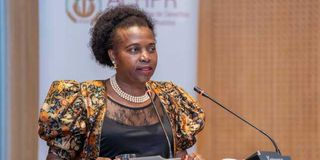
Dr Litha Musyimi-Ogana, Commissioner at the African Commission on Human and Peoples’ Rights, shares what she learnt from Pheobe Asiyo.
“During that training, they told me that once I returned home, I should look for her. So I tried but didn't manage until we eventually met in New York during the preparatory conference for ICPD. I had listened to her on the radio, Voice of Kenya, in those days, and every little girl wanted to be like Phoebe Asiyo. When I met her, she struck me in many ways. First, she was such a calm person. Intelligent. Humble. Elegant, from her hair, all the way to her shoes. She was among the women who taught me how to write in longhand. I had learned computers at university, so I arrived with tech skills.
“When I met these women, and they knew the issues we were discussing in New York, especially on women, and they could express themselves and write it all down. I would type everything out, of course, in between carrying handbags here and there. When I got back home, I learned that she had been the chairperson of Maendeleo ya Wanawake, which I had also joined. So, I began to overlap with Phoebe in the women's movement.
“From ICPD, we went on to Beijing. When we came back, we started meeting at conferences here and there. But it's the Women's Political Caucus that truly brought us together. When Hon Phoebe presented the Affirmative Action motion to Parliament, we were training the National Council of Women of Kenya in Embu, and we were all hopeful that the motion would pass, but something happened, and it failed. That's why we call it the Phoebe Asiyo Motion.
“When the motion failed, we converged at Silver Springs Hotel in Nairobi because we wanted to ask: what can we do as Kenyan women to change the situation? Eventually, we held a series of meetings, and that's how the Kenyan Women's Political Caucus was formed. My organisation at the time, the African Centre for Empowerment, Gender and Advocacy became a member of the caucus. It's in the Women's Political Caucus, where my organisation was a member, that we ended up working closely. At some point, the caucus split.
“I can't remember what the other group was called, but I stayed on the caucus side. We listened to Phoebe. We didn't want to lose the caucus. It wasn't an easy fight, but one good thing about us, Kenyan women, is that we know what matters most. We might disagree on petty issues, but when it came to the constitutional review, we came together again. And we rallied behind her leadership.
“Phoebe never held grudges. If she disagreed with you, that wasn't the end—she would still call you back. We came together when we were fighting to be part of the constitutional review. You know, those assemblies they talk about were born out of this process. They were part of our strategy to influence the local process. It was the caucus's idea that we must go to the location level and plant ourselves. Because Kanu was now too strong. If Kanu came with delegates from the local level, they would take control of the constitutional process. This is where Phoebe was at her best—by planting a female delegate alongside the opposition, women's voices could not be ignored.
“We disagreed, yes. But through leadership like Phoebe's at the caucus, we always found a way to focus on what was important, and agree. By the way, she used to call me 'Lethal'. Phoebe taught us how not to be confrontational.
“Later on, we made serious inroads in engendering the government. She was a peacemaker. Even when you listened to her, you wouldn't immediately hear what she was saying. You had to lean in to listen because she spoke so softly. I used to ask her, 'How do you even campaign?' That tells you she was approachable; someone you could share a laugh with. I even asked her one time why she never wore earrings and then she told me ‘Lethal... I am an SDA.’”
The voices from Parliament
Julius Mawathe, Embakasi South
“When Phoebe Asiyo was campaigning for her re-election, I was the vice-captain of Umeme FC. We travelled to Kendu Bay to play under the leadership of Joe Akech, the former Mayor of Nairobi. That’s when I saw her campaign with such strength and determination. (In 1979, Phoebe made history by winning the Karachuonyo seat for the second time, defeating then-Kanu chair David Okiki Amayo.)
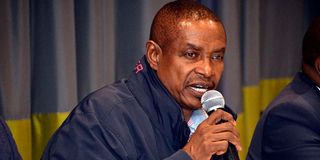
Embakasi South MP Julius Mawathe.
"I was a young man then, and Phoebe stood out as a woman leader everyone knew. She was vocal and truly admired. We loved watching her debate on television; she was sharp and articulate. She brought many positive changes to the community and never stopped fighting for what she believed in. Every time she spoke, she reminded us of the importance of having more women in leadership.”
Julius Sunkuli, Kilgoris
“Phoebe Asiyo was well known to me because she was a member of my party, Kanu. She was nurtured by the party and was part of Kanu.
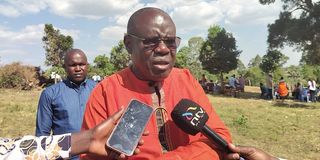
Kilgoris MP Julius Sunkuli.
"She was a model for many people in Kenya who aspired to ethical leadership. She was a strong debater in the House.”
Rahab Muiu,
National chairperson, Maendeleo Ya Wanawake Organisation
“Did more and spoke less”
“She reminded me many times of my mother, who often worked in silence. Very little noise, but a lot got done. I always remembered that, especially when I later came to work with her in Maendeleo ya Wanawake. When we were reviewing the Maendeleo constitution, she stuck to her role, and I stuck to mine.
“Even before the Affirmative Action motion, there was the journey to Kapenguria in 1960, because they believed women needed to be at the table. All of this is in Mama Phoebe's book. She and Priscilla Abwao, who had been nominated to the Legislative Council, mobilised women from across Kenya, visited Mzee Jomo Kenyatta, and pushed for 50-50 representation in Parliament and local authorities.
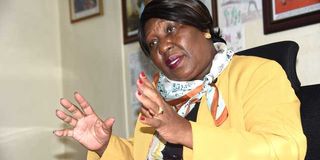
Maendeleo ya Wanawake chairperson Rahab Mwikali Muiu during an interview at her Maendeleo House office in Nairobi on July 18, 2022.
“So I have seen a woman of great value. A woman of high integrity. A woman who does more and speaks less. She never commanded you to do things her way, but she would offer wisdom. She had a soft-spoken way of passing on information.
“When you look at her leadership throughout the years, you realise that pressing hard, pushing loudly, that's not always where change happens. She was an excellent listener. Mama Phoebe never classified people. She dealt with everyone in their own space, without judgement. The rest was up to you.
“Let me talk about when I worked with her as a patron from 2018. It has been seven years of great wisdom. She gave me the space to make decisions and accepted that I was the leader. That kind of trust moved the institution forward. When we transitioned the building from individual trustees, including her, she stood with me. She helped me. She was there when we reviewed the constitution. We needed to bring all these elements into the document, and I'll forever be grateful that the institution now sits on a clear, inclusive constitution.
“There was a constitution in the last regime; I was part of it, but we needed to include the sub-counties, so we could cover the entire country and address other structural gaps. We've had many challenges during my time. Transitions bring a lot of uncertainty. She stood with me. Mama Phoebe never interfered. She didn't lobby board members behind the scenes or tell anyone what to say in meetings. None of that. She let me do my work and offered her advice from a distance.
“May the good Lord rest you in everlasting peace. You were a gentle soul.”