Ruto secures Putin deal to halt recruitment of Kenyans into Russian army
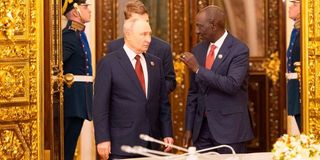
President William Ruto and his Russian counterpart, President Vladimir Putin, during bilateral talks at the Kremlin in Moscow, Russia on October 29, 2026.

What you need to know:
- The agreement seeks to close recruitment channels that have seen Kenyans enlisted to fight on the Russian side.
- Kenyans have been killed on the battlefield, others reported missing and five being held as prisoners of war in Ukraine.
Kenya has secured an agreement with Russia to stop the recruitment of its citizens into the Russian military, following mounting concerns over the deaths, disappearances and detention of Kenyans drawn into the war against Ukraine, according to a State House statement.
The statement said President William Ruto announced the agreement after talks with Russian President Vladimir Putin at the Kremlin in Moscow on Thursday. The two countries had agreed to designate Kenya as a non-source country for recruitment into the Russian military.
The agreement, which seeks to close recruitment channels that have seen Kenyans enlisted to fight on the Russian side, comes after months of diplomatic engagement by Nairobi and repeated warnings by Prime Cabinet Secretary Musalia Mudavadi over the growing number of Kenyans caught up in the conflict.


It also comes as the human cost of the recruitment has become increasingly apparent, with the government confirming that Kenyans have been killed on the battlefield, others reported missing and five being held as prisoners of war in Ukraine.
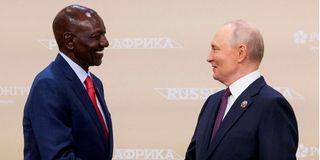
Russian President Vladimir Putin shakes hands with Kenya's President William Ruto during a welcoming ceremony for participants of the Russia-Africa Summit in Moscow, Russia, October 28, 2026.
The agreement is significant because it moves Kenya’s efforts beyond warnings to an arrangement involving direct cooperation with the Russian government, although its effectiveness will depend on implementation and the ability to prevent recruiters from exploiting alternative channels.
“I informed President Putin that I have appointed a Defence Attaché at the Kenyan Embassy in Moscow, who will liaise with the Russian Ministry of Defence to facilitate the repatriation of Kenyans who had travelled to Russia for military purposes,” President Ruto was quoted by State House as saying.
The Defence Attaché will also work with Russian authorities to facilitate compensation for affected Kenyans and coordinate their safe return home.
The announcement, however, raises questions about the fate of those already deployed to the frontlines, particularly families who have spent months seeking information about relatives whose whereabouts remain unknown.
The agreement follows warnings by Mr Mudavadi in April, when he disclosed that at least 252 Kenyans had been recruited into Russian military operations, many through illegal recruitment networks.
On April 1, while responding to concerns raised in Parliament, Mr Mudavadi said 47 Kenyans had been rescued and repatriated through the Kenyan Embassy in Moscow, while two others were being held as prisoners of war in Ukraine.
He warned Kenyans against being lured into foreign military operations through promises of employment, as the government intensified efforts to dismantle recruitment networks and secure the return of those already enlisted.
On October 9, while appearing before a joint sitting of the Senate committees on Labour and Social Welfare and National Security, Defence and Foreign Relations, Mr Mudavadi told lawmakers that the government had documented 354 Kenyans linked to the Russia-Ukraine conflict.
Of these, 77 were believed to be on the frontline, 38 were in military camps, 52 were in unknown or unclassified locations and 34 were hospitalised.
Another 62 had been repatriated, while five were confirmed prisoners of war in Ukraine.
The most troubling category comprised 84 Kenyans reported killed or missing in action, although the government cautioned that the two classifications were not interchangeable and that some deaths remained unverified.
Repatriating remains of deceased Kenyans
The designation announced by President Ruto gives fresh political weight to an arrangement that Kenya had previously said was already being implemented.
However, the challenge will be ensuring that the prohibition covers recruitment through intermediaries, private agencies and third countries, particularly given that some Kenyans travelled outside official government channels.
The agreement also places renewed responsibility on Kenya’s diplomatic mission in Moscow to establish the whereabouts of affected nationals, engage Russian authorities over their welfare and coordinate their return.
Mr Mudavadi told Parliament that Russia had indicated it could not meet the cost of repatriating the remains of deceased Kenyans, meaning the arrangements would have to be handled on a case-by-case basis.
Beyond the military recruitment question, the Moscow meeting sought to deepen economic relations between the two countries, with Dr Ruto acknowledging the historical ties dating back to Kenya’s independence in 1963.
Russia was the second country to recognise Kenya’s independence, a relationship that both leaders said provided a foundation for expanding trade, investment and cooperation.
Ruto acknowledged the trade imbalance between the two countries, which currently favours Russia, but said Kenya wanted to expand exports, particularly tea and flowers, to the Russian market.
“I recognise there is a trade imbalance in favour of Russia, but there is an opportunity to look at what other trade avenues we can explore,” he said.
He also invited Russian investors to explore opportunities under Kenya’s proposed National Infrastructure Fund, saying the initiative would provide commercially viable opportunities for private sector participation in infrastructure development.
Mr Putin, on his part, reaffirmed Russia’s commitment to strengthening economic, cultural and humanitarian cooperation, identifying fertiliser exports as one of the existing pillars of trade between the two countries.
“Russia is one of the top fertiliser exporters to Kenya. I reiterate that we need to preserve this trend. We maintain fruitful cultural and humanitarian ties between our countries,” he said.
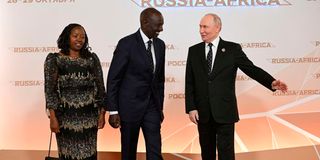
Russian President Vladimir Putin with Kenya’s President William Ruto and First Lady Rachel Ruto during a welcoming ceremony for participants of the Russia-Africa summit at the Grand Kremlin Palace in Moscow, Russia, October 28, 2026.
The Russian President also announced an increase in the number of scholarships available to Kenyan students seeking higher education in Russia, from 70 to 300 annually.
The two countries signed five memorandums of understanding covering economic cooperation, labour inspection and employment promotion, transport, diplomatic training and visa-free travel for holders of diplomatic and service passports.
One of the agreements establishes an Intergovernmental Russia-Kenya Commission on Economic Cooperation, while another provides for collaboration between Russia’s Federal Service for Labour and Employment and Kenya’s Ministry of Labour.
The labour agreement is particularly significant given the recruitment scandal, as it is expected to provide a framework for improving employment opportunities and labour protection.
However, its implementation will be closely watched against the background of the exploitation allegations that have left Kenyan families searching for missing relatives.
The two leaders also discussed international cooperation, including reform of multilateral institutions, the role of the United Nations and Russia’s support for strengthening the United Nations Environment Programme headquarters in Nairobi.
Follow our WhatsApp channel for breaking news updates and more stories like this.