The men challenging harmful traditions to keep Kenyan women, girls safe
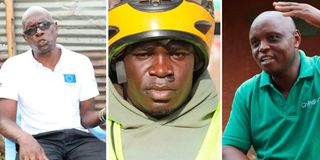
Human rights defenders Tom Onzere, Oscar Permmy and Geoffrey Gitonga.

What you need to know:
- Community champions are challenging harmful traditions and helping survivors access justice.
- From Vihiga to Tharaka Nithi and Mt Elgon, men are confronting gender-based violence.
More men in Kenya are pushing back against the old idea that toughness and silence make a man. Some have gone further, taking on the harmful cultural practices in their own communities and calling out fellow men where it matters. Tom Onzere is one of them.
A community paralegal in Vihiga County, he has spent years helping widows fight disinheritance, still a common problem in Western Kenya. He gives survivors of sexual and gender-based violence basic legal advice, connects them to organisations for legal and medical help, and helps them gather evidence for their cases.
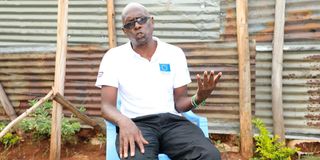
Tom Onzere, a human rights defender in Vihiga County who is helping survivors of sexual and gender-based violence to get justice, on November 10, 2023. He is the convener of Magharibi Social Justice Centre has been giving paralegal services.


“We have continued to stand up for people whose voices are often unheard. Survivors in the community turn to us to report violations and seek support. However, kangaroo courts remain a challenge, making it difficult for many survivors of sexual violence to access justice,” Mr Onzere says.
As convener of the Magharibi Social Justice Centre, his work now reaches beyond Vihiga into Bungoma, Busia and Kakamega counties. Ten social justice centres have been set up across the four counties so far, helping survivors get access to justice.
The journey has not been easy. Mr Onzere has faced intimidation from community members opposed to his work on women's rights, but he remains determined, hopeful that the community will come to appreciate the importance of supporting girls and women.
He has also contributed to the development of the Vihiga GBV Policy, enacted in 2024, which sets up a formal legal and institutional framework to prevent abuse, protect victims and hold perpetrators accountable. The policy tightens local laws and enforcement around abuse, child neglect, defilement and abandonment, and rules out the informal community settlements that often let offenders go free.
Survivors are guaranteed trauma-informed care under the policy, from safe housing to psychosocial counselling and legal aid, alongside better medical support covering physical, sexual, reproductive and mental health needs. It also requires systematic data collection, so authorities can track trends and sharpen prevention efforts over time.
Mr Onzere sits on the Court Users Committee too, working to get the Judiciary, the Office of the Director of Public Prosecutions and the police pulling in the same direction.
“My passion is advocating justice and defending the fundamental legal and human rights of women and even men in the region. I actively campaign against human rights violations, which traditionally encompasses grassroots legal support for vulnerable populations like widows facing forced disinheritance and land disputes," he says.
Geoffrey Gitonga, more than 500 kilometres away in Tharaka Nithi, is a household name for his gender and human rights work. It started after he found out a young girl in his village had been abused by her own father. He was a father of daughters himself, and the discovery shook him. Working with the community, he made sure the man was arrested, taken to court and eventually imprisoned.
That case changed the course of his life. Fifteen years on, and now a father of five, he is still fighting harmful traditional practices and championing girls' rights and wellbeing. “My work is driven by the discrimination girls face, including FGM, sexual abuse, and barriers to education. In the course of my work, I have helped to rescue hundreds of girls from child marriage and FGM,” Mr Gitonga says.
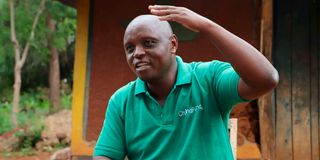
Geoffrey Gitonga, a male champion against harmful cultural practices in Tharaka Nithi County, during an interview in Ngainii village, Igamba-Ng’ombe, on December 10, 2014.
His efforts have earned him training as a male champion from organisations including Men End FGM and Child Fund.
The 2022 Kenya Demographic and Health Survey (KDHS) shows Tharaka-Nithi has the highest FGM prevalence in the Mt Kenya region, at 27 per cent. The impact of prolonged drought has also reportedly pushed some families to marry off, or "sell", their daughters to cope with financial hardship.
'Danger seasons'
December holidays are another period of concern, with cases of FGM and child marriage rising, as FGM is sometimes viewed as a sign that a girl is ready for marriage. The holidays may also increase girls' exposure to unsafe sexual practices, contributing to teenage pregnancies and unsafe abortions.
In Mt Elgon, boda boda operator Oscar Permmy is leading a campaign to tame the area's high rate of defilement. Oscar tells Nation he decided to take the bull by the horns after realising that hardly a week passed without a defilement or rape case being reported in the area, a situation that kept bothering him, especially after learning that some boda boda riders were being accused of involvement in such cases.
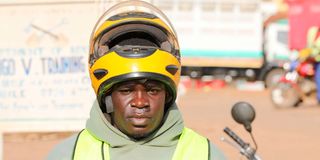
Oscar Permmy, a boda boda operator during an interview in Cheptais, Mount Elgon, on May 26, 2026. He is a leading anti-sexual and gender-based violence champion and human rights defender.
That pushed him into becoming a human rights defender and an advocate against sexual and gender-based violence. He wanted to bring the numbers down and clean up the name of boda boda riders in Mt Elgon. He has been at it since 2024, training riders across the region on SGBV, the laws around rape and defilement, and where survivors can turn for help.
“I told myself that something had to be done. As a father of daughters, I could not sit and watch as the situation continued like this. I began engaging fellow riders and encouraging them to speak out against sexual violence”" Mr Permmy says.
So far, he has reached around 400 riders and trained 15 of them as community champions who now help spread the word and push back against gender-based violence across Mt Elgon.
Sexual and gender-based violence is still common in the area. The most recent KDHS data puts Bungoma County's physical violence prevalence, the county that covers Mt Elgon, at roughly 62 per cent, with intimate partner sexual violence at 30 per cent among women. Intimate partner violence remains the most common form of SGBV here, and defilement and teenage pregnancies are frequently reported, particularly in the remote areas that once saw civil strife.
Salome Ndiwa, a human rights defender in the area, credits the boda boda riders with playing a real role in helping authorities track down and arrest men suspected of using online platforms to target young girls.
“I commend the boda boda riders for the important role they are playing. They have become a key source of information and strong partners in our efforts to address gender and human rights violations. Several defilement cases are currently before the courts, and many of them resulted from information and interventions provided by the riders,” she says.