The prison volunteer who refused to give up on Kenya’s young offenders

Gloria Achieng' during the interview with the Nation in Kisumu on March 27, 2025.

What you need to know:
- After encountering a childhood friend in prison who later died from mob justice, Gloria Achieng discovered that children in remand homes were caught in a cycle of crime due to stigma and lack of opportunities.
- She founded an organisation, which offers a comprehensive approach including counselling, family reunification, skills training, and apprenticeships to break this cycle.
The sound of metal doors clanging shut echoed through the corridors as Gloria Achieng carried trays of leftover food toward the prison cells. What began as a routine charity event at Kodiaga Prison in Kisumu would become the catalyst for a life-changing mission that would transform not only her future but the lives of countless vulnerable youth.
"As we walked out of the cells, I heard a voice call me by my childhood name 'Glory'. Whereas I did not expect anyone in the cells to know me, I turned back and looked around only to be met by a familiar face," recalls Gloria, then a 27-year-old psychology graduate from Chuka University.
The voice belonged to someone she had grown up with in Manyatta slums, Kisumu—a childhood friend now confined behind bars. Their brief interaction—just a wave and a smile through the cell doors—left her with lingering questions about how he had ended up there.


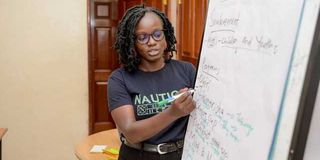
Gloria Achieng’ during a counselling session. She says children and youth in conflict with the law should not be defined by their past but by their potential for transformation.
Prior to this pivotal encounter in April 2021, Gloria had been working as a volunteer psychologist with an organisation in Kisumu that focused on reuniting street children with their families. She primarily offered counselling sessions to the organisation's staff, putting her fresh psychology degree to good use.
Several weeks after the prison visit, while shopping in Kisumu, a casual conversation with another friend delivered devastating news. The young man she had encountered in prison had been released, only to be killed by a mob after being caught stealing in Siaya town.
"My friend had gone on to say that the young men in the slums we were brought up with were slowly dying due to criminal activities," Gloria says. The statement suggested this fate was considered almost inevitable for youth from their background—a notion that deeply troubled her.
Months later, Gloria attended another charity event, this time at the Kisumu children's remand home. Her attention was drawn to a solitary teenage boy who revealed he was 17 years old and approaching his release date. Rather than excitement, the prospect filled him with dread. Having been incarcerated for theft, he paradoxically felt safer within the confines of the remand facility than facing the stigma awaiting him outside.
As the day progressed, Gloria engaged with more young residents. Their stories followed disturbingly similar patterns—children from Kisumu's slums and surrounding rural communities, pushed into crime by circumstances largely beyond their control.
"There were children who claimed that their parents left home in search of jobs but failed to come back, some were orphans who ran away from home due to mistreatment by caregivers or step parents, while others were from humble backgrounds that could hardly afford a single meal," she explains. "In their search for food, the minors would end up stealing."

Gloria at the entrance to the children's remand home in Kisumu.
Moved by their plight, Gloria approached the remand home manager with an offer to provide free counselling sessions, hoping to ease the children's reintegration into society upon release. Throughout 2022, she dedicated herself to this cause, creating safe spaces where the children could express their fears, hopes, and traumas.
But as months passed, a troubling pattern emerged.
"A couple of months later, I realised yet another worrying trend, most of the released children would be back at the remand home within a couple of weeks or months," she notes. At that time, the facility housed 60 children, with 20 being repeat offenders.
Determined to understand why her efforts weren't yielding lasting results, Gloria deepened her conversations with the returnees. What she discovered was sobering: counselling alone, no matter how well-intentioned, couldn't counter the harsh realities awaiting these children outside.
"The stigma and rejection they were subjected to made it impossible to successfully integrate into the society," she explains. Labelled as criminals and shunned by their communities, these young people found themselves isolated and without support systems. With few options for legitimate income and facing constant suspicion, many reverted to criminal activities to survive.
It was a vicious cycle with devastating consequences. Some would graduate to adult prisons, while others, like her childhood friend, might meet violent ends through mob justice.
This realisation led to an epiphany: "I realised counselling was not enough. Most of the children needed skills relevant to the job market to enable them to integrate back into society."
With renewed determination, Gloria joined forces with a friend to co-found a non-governmental organisation called Soulevement. The organisation's mission was clear: to equip the children with practical skills that could translate into employment opportunities after their release.
Through the organisation, they focused on performing arts—drawing and music—areas where these children could express themselves while also developing marketable talents. Throughout 2023, Gloria and her co-founder poured their energy into the program, hoping to see tangible results in reduced recidivism rates.
Despite their dedication, the end-of-year assessment delivered a sobering verdict: "When we did the end of year assessment in 2023, the challenge remained the same, the children still kept coming back," Gloria admits.
The performing arts training, while valuable for self-expression and confidence-building, wasn't enough to overcome the formidable barriers these children faced upon release. Yet rather than seeing the continued recidivism as a defeat, she viewed it as evidence that her approach needed refinement.
"I was, however, not willing to give up, I still wanted to help but did not know exactly how to do it," she says, demonstrating the tenacity that would become her hallmark.
Gloria's unwavering commitment to solving the problem of youth recidivism opened an unexpected door in 2024. Her search for more effective solutions led her to apply for the prestigious Kanthari Leadership Program in India—an intensive training ground for social entrepreneurs dedicated to creating positive change in their communities.
"My proposal to find a solution to the remand home returnees was part of my application that saw me accepted to the program," Gloria explains. She was one of just three Kenyans selected to join 22 other participants from around the world—recognition not just of the significance of the problem she was tackling but also of her potential to solve it.
"The program gave me an opportunity to conduct research on the possible gaps affecting children remand homes and the possible remedies," she says. This wasn't just theoretical learning—it was practical knowledge she could immediately apply to her work in Kisumu.
After completing the leadership fellowship, she returned to Kenya with renewed purpose. Earlier this year, with support from the Kanthari program, she launched a pilot project in Kisumu, working directly with remand homes to identify and address the root causes of recidivism.
"My pilot project found that the major challenges encouraging remand home returnees include short-staffed rehabilitation facilities, inadequate follow-ups, lack of environmental adjustments, stigma, and high poverty levels," Gloria explains.
Even as she worked to develop solutions, she encountered first-hand the stigma that permeated attitudes toward these children. "Stigma is one of the biggest challenges, I am yet to find an office space, reason being a number of tenants are unwilling to host me once they learn that I am working with ex-remandees," she reveals.
This prejudice—extending even to those trying to help—illustrated the deeply ingrained negative perceptions these children faced. If a professional with legitimate business credentials encountered such resistance, how much more difficult must reintegration be for the children themselves?
Undeterred by these challenges, Gloria founded a new organisation called Okiri, implementing a holistic approach to breaking the cycle of recidivism among young offenders. Drawing on everything she had learned—from her personal observations to her formal training at Kanthari—she designed a program that addressed multiple aspects of a child's journey through and beyond the juvenile justice system.
"The program starts with offering counselling sessions to the children while still in remand homes," Gloria explains. But now, this psychological support is just one component of a much broader strategy.
While in remand, Gloria and her team follow up on the children's court cases while tracking down their families to prepare them for reunion. This pre-emptive approach represents a significant evolution in her methodology. Rather than waiting until problems arise post-release, she works to anticipate and mitigate potential obstacles before they materialise.
"We engage the families to ensure the children are surrounded by a healthy environment upon release. We also seek alternative shelter for the children who are likely to face stigma," she says.
Once released, the young people enter the next phase of the program: skill development. "Upon their release, they are taken through a digital literacy training where they are also allowed to choose the kind of skills they would like to explore," Gloria says. This element of choice is crucial—allowing the children agency in determining their own futures rather than prescribing paths for them.
After identifying their interests, the children are linked with organisations that provide relevant training. Gloria's team follows their progress through completion, offering support and encouragement along the way. But the assistance doesn't end there.
"We also work on ensuring the trainees are attached to an organisation for apprenticeship while they are also followed up to ensure their criminal records remain clean," she says, describing how theory is translated into practical experience.
This comprehensive approach—addressing psychological needs, family dynamics, educational gaps, and economic opportunities—represents a significant departure from more narrow interventions. It acknowledges that successful reintegration isn't just about what happens inside the remand home but about creating supportive structures that extend well beyond those walls.
Though still in its early stages, Gloria's holistic approach is already showing promising results. "We have had two successful remandees from my pilot project, one aged 17 is currently a plumber, while the other aged 16, has just cleared her bakery course," she shares with evident pride.
These success stories, while modest in number, represent profound transformations. Young people who might otherwise have remained trapped in cycles of crime and punishment are now building skills, gaining confidence, and creating legitimate futures for themselves.
These individual victories fuel Gloria's determination to expand her reach. "I am now on the lookout for sponsors in order to reach out to more children," she says, aware that scaling up will require additional resources and partnerships.
Read more: Inside ODPP's revolutionary program turning teen prison sentences into rehabilitation journeys
As she looks ahead, her vision extends beyond just expanding the number of children served. She hopes to create a model that can be replicated in other regions facing similar challenges, a blueprint for effective reintegration that addresses the multifaceted nature of youth recidivism.
Central to this vision is changing public perception. The stigma these children face isn't just harmful to them—it's harmful to society at large. When young people are written off because of mistakes made when they were hungry, desperate, or without guidance, their potential contributions are lost.
For now, though, her focus remains on the children currently in her program—ensuring they receive the comprehensive support they need to break free from the cycle of crime and build meaningful lives. Each success story reinforces her belief that change is possible, that no child's future is predetermined by their past or their circumstances.
What began as a chance encounter in a prison corridor has evolved into a mission that touches the lives of some of Kenya's most vulnerable youth. For Gloria, it's a responsibility she embraces with unwavering commitment and hope.