The reality behind Liza Chelule’s woman representative role
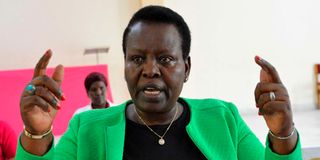
Nakuru woman rep Liza Chepkorir Chelule addresses a congregation at Christ the King Cathedral Church in Nakuru City on May 9, 2025, after she distributed avocado seedlings to women, youth and vulnerable groups as part of an empowerment initiative.

What you need to know:
- Nakuru woman representative Liza Chelule’s journey reflects persistence, grassroots activism, and commitment to inclusive, accountable leadership.
- From Senate nomination to three parliamentary terms, Chelule champions empowerment, education, cohesion and equitable resource allocation.
When Liza Chepkorir Chelule was 20 years old, she already knew what she wanted to do with her life. Growing up in the South Rift, she had watched women occupy the fringes of every important conversation, sidelined from decisions that determined the quality of their lives at home, in the community and in the wider development arena. She did not accept it as the natural order of things. She decided, young as she was, that she would one day be in a position to change it.
What she could not have known then was just how long and winding the road to that position would be. Before she became Nakuru Woman Representative, Liza contested the parliamentary seat in Kuresoi, Nakuru County, three times and lost all three. She did not quit. Instead, she continued her work in community-based organisations and non-governmental organisations, championing the rights of women, children and vulnerable groups, building a reputation not through political office but through sustained, unglamorous work on the ground.
“One does not need to be rich to go into elective leadership and make a positive impact in the lives of others,” she says. “I was able to do that in the background before I became an MP.”


Eventually, her persistence opened a different door. She was nominated to the Senate, and it was that experience, she says, that truly prepared her for what came next. “With that exposure, I came to understand the parliamentary process. I then went for the woman representative position, which I have held for two terms.”
She succeeded Njoki Mary Mbugua, the first woman rep for Nakuru, winning the position in the 2017 General Election and retaining it in 2022. Counting her earlier stint as a nominated senator, she is now serving her third term in Parliament. Her political journey has taken her through the Kenya African National Union (Kanu), the United Republican Party (URP), Jubilee and now the United Democratic Alliance (UDA), a breadth of experience she says has given her a thorough understanding of how leadership in Kenya works.
If she wins again in 2027, she will join the ranks of the longest-serving MPs in a House widely known for its revolving doors.
A calling, not just a career
Meeting Liza at Parliament buildings in Nairobi, it does not take long to appreciate what the job demands. Her mobile phone buzzes constantly throughout the interview. Some calls she picks up immediately; others get a quick text promising a call-back. Yet, she handles it all without missing a beat, moving between the personal and the political with the ease of someone who has long learned to hold many things at once.
“Leadership, which is recognised in the Bible, is a calling like that of the clergy,” she says. “It is not for the faint-hearted and those who want to be noticed, but for people with deep commitment to making a positive change in society.”
She is equally firm on the question of what qualifies a person for leadership. Wealth, she says, is not a requirement. Neither, strictly speaking, is a string of academic qualifications. “Higher education is only an added value to leadership, as it makes one easily navigate through issues and make informed choices. But you do not need to be highly educated to be a leader. What you need is an agenda, a focus and resolve to make an impact in the lives of the people.”
It is a view rooted in lived experience. Long before Parliament, Liza was already doing the work that she now does with the backing of a legislative seat. The difference, she says, is the platform. “My position as a legislator has given me a platform to fuse my dreams with the needs of the people, draw a road map to actualise them and rally the government, non-governmental institutions, donors and various actors into action.”
Turning lives around, group by group
On the ground in Nakuru County, the MP's empowerment work has reached women, youth and vulnerable groups across constituencies. Through her office, groups have been registered to access funding from both government and non-state actors, mentored, and supported to start and grow small enterprises. Some have received car wash machines and tents; others have been helped to get into table banking, buy plots, land and livestock, and take up farming.
She has also prioritised education, raising and sustaining students from vulnerable backgrounds in schools with what she describes as the limited resources at her disposal, and making scholarships available for needy children in the county.
“Having been involved in empowerment programmes for decades, I have seen lives turned around for the better,” she says.
“Women and vulnerable groups have started small enterprises and grown them into successful outfits. The impact of education scholarships on needy children from humble backgrounds is immense, and there are tens of thousands of such children in our constituencies.
“Education is an equaliser. It does not know a child from a rich, middle-class, or poor background.”
Beyond economic empowerment, her office has been active in sensitising residents to voter registration, encouraging families to register under the Social Health Authority (SHA) for medical insurance, promoting gender parity and seeking employment opportunities for locals.
Cosmopolitan county
Nakuru is one of the most cosmopolitan regions in Kenya, home to communities from virtually every part of the nation. “In Nakuru County, we are lucky we live in a highly cosmopolitan area with communities living together, intermarrying and exchanging cultures,” Liza says. “Besides being the heartbeat of Rift Valley politics, Nakuru carries the face of Kenya.”
It is a setting in which ethnic politics can be tempting and, for some, even rewarding in the short term. Some of her colleagues have been known to push a partisan and tribal agenda in the region. Liza has consistently taken a different position, publicly, politely but firmly calling out leaders and supporters who sell a “them-versus-us” narrative.
“In resource allocation, it is impossible for a leader to sideline other communities. Apart from being uncalled for and in bad faith, it would amount to political suicide. We must carry all the communities along in the spirit of national cohesion,” she says.
Her constituents have noticed. Jane Atieno, a trader and resident of Rhonda estate in Nakuru town, says the woman rep has succeeded in uniting communities more than most. “Some of the leaders are openly biased against some communities with skewed allocation of resources, but the Nakuru woman rep has been a leading light in pushing for cohesion and uplifting the vulnerable,” Jane says.
Consolata Moraa, a resident of the Ngata area, echoes that view. “In Liza, we have a leader who has united communities, demonstrated it is possible to stamp out tribalism and that the available resources can equitably be shared among the vulnerable and deserving groups without reference to one's political affiliations.”
Sh7 million for an entire county
For all the work she has managed to do, the legislator is candid about a fundamental problem that has constrained what her office can achieve. The woman rep, whose constituency covers the entire county, receives just Sh7 million annually under the National Government Affirmative Action Fund. To put that into perspective, the Nakuru governor's office receives more than Sh14.3 billion. An ordinary MP representing a single constituency receives an average of Sh200 million through the Constituency Development Fund.
The disparity is one that Liza believes must be corrected through legislation. “There is a need for a change in the law on resource allocation to raise the funding for the woman representative’s office to at least Sh150 million per constituency. That would be Sh1.6 billion for Nakuru County's 11 constituencies. That would make a lot of sense on economic empowerment for the people,” she says.
She explains that such an allocation would enable her office to give at least Sh200,000 to each benefitting group, creating employment opportunities and bringing more Kenyans into the tax bracket, which would, in turn, generate more income for the Kenya Revenue Authority. “I am engaging lawyers to see whether this push for more funding would require a constitutional referendum or not,” she says. “We are in a situation as a country where we have to ensure equitable distribution of resources through established structures and offices.”
The critics and the faithful
Not everyone in the county is fully satisfied with Liza's record. Beatrice Koech, a resident of Kiptagich in Kuresoi South, voices a concern shared by some that her activities and programmes have been concentrated in Naivasha, Gilgil, Nakuru and Subukia, leaving Rongai, Njoro and Kuresoi feeling short-changed.
“She may need to do a balancing act to avert an imminent falling-out with some pockets of voters,” Beatrice says.
Others feel that after three terms in Parliament, it is time for the woman rep to step aside. “Having served for three terms, Liza should pave the way for others to take charge in the leadership position she is holding,” says Stellah Njoki, a resident of Subukia.
Liza does not dodge scrutiny. She acknowledges the funding bottlenecks that have shaped what her office can and cannot do, and makes her case for 2027 on the basis of transparency and delivery.
“As a leader, I engage the people openly, discuss the issues affecting them candidly and seek both short-term and lasting solutions with the help of government and other institutions,” she says.
“Once people understand that you are genuinely committed to resolving their issues and honest about what is possible and what is not, they will rally behind you.
“I have been as open as practically possible with my constituents. From the moment I was elected, I was clear about what I wanted to do for the people, and I am delivering on that agenda, despite the funding bottlenecks.”
In a cosmopolitan constituency and region like Nakuru, she says, there is simply no room for exclusion. “It is important to take all the communities along in all activities, projects and public participation processes. You cannot afford even for a minute to sideline others.”