The women turning AI into a midwife, accountant and social media manager
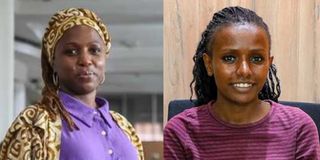
Acyberschool founder Evalyn Oloo (left) and Malaica software engineer Annmaria Kerubo.


What you need to know:
- As Girls in ICT month ended, two Kenyans show how artificial intelligence is already reshaping lives and livelihoods.
- From teenage motherhood to tech leadership, their journeys reveal how resilience and curiosity fuel Africa’s digital transformation.
She was 17 years old, a brand-new mother, and convinced that her life was over. Decades later, Evalyn Oloo sits across from you cracking jokes about being fired from a Cambridge pub for mixing up drinks, and tells you she would not change a single thing. Not the teenage pregnancy, not the two jobs and full-time studies she ran simultaneously, nor the hundred portable massage chairs she ordered from China. Not a single moment.
Across town, Annmaria Kerubo traces her entire career back to a throwaway comment her mother made when she was a small girl frozen in front of a screen. Her mother joked about whether she was training to become a computer engineer. Annmaria was not joking back.
As we close the International Girls in ICT month, with the global theme "AI for Development: Girls Shaping the Digital Future," both women are grounded proof that the future being built with artificial intelligence in Africa already has women's hands all over it, not in some distant headline, but right now, in real businesses and real maternity wards.


Evalyn Oloo: 'Talk to it as a friend. Make it your business partner'
Evalyn is many things at once: a business transformation advisor at Stanford University's Graduate School of Business Seed Institute, a doctoral researcher, a former World Bank expert, a self-taught coder, a licensed mental health therapist, and the founder of Acyberschool, a premier African training institution focusing on cybersecurity and artificial intelligence education. She is, by her own cheerful admission, someone who has never done one thing at a time and has never stopped hustling.
She grew up on Buru Buru estate, Nairobi, the daughter of a stock market investor father who taught her about shares when she was still a small girl, and a long-haul trader mother who moved fish and goods from Nyanza and supplied all over Nairobi. "My mum gave me the knacks for business while my dad gave me the knacks for investment," she says, beaming.
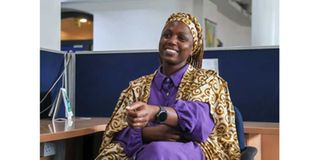
Acyberschool founder Evalyn Oloo, also a doctorate researcher, during the interview at Nation Centre, Nairobi, on April 18, 2026.
Life was good until it threw a curveball. She had just finished high school when she became a mother at 17. "I thought my life was finished," she remembers. Her strict parents were furious but eventually took the baby and sent her away to school.
She enrolled at the Kenya College of Accounting but did not last one full semester before landing a job at Standard Chartered as a clerical officer. Her work ethic got her noticed and she moved to Safaricom, helping set up shops in Western Kenya, all while keeping up with her studies. "I believe I am a lifelong scholar," she says.
An agency spotted her drive and placed her with World Vision in South Sudan, where she had gone to study counselling. She kept taking short courses, hungry to learn, and then came a scholarship to England. She arrived as a full-time student but had her son with her and needed to support them both. Her first job was at a pub called Eagle in Cambridge. "I was terrible at it," she laughs. "I was fired the second day for mixing up drinks."
That did not slow her. She landed a customer care role through an agency, took a short course in nursing, and started caring for elderly people in care homes. But she wanted more, so she registered a company in Cambridge; "It's still there. You can go to HMRC and check it out," she says, and started connecting students like her from Africa and Asia with jobs. "Instead of them waiting for a big agency to place them, I became a sub-agency. If someone was earning nine pounds an hour, I would take one pound."
Within no time she had ten people working through her, then 20, all while studying full-time, taking shifts herself, and raising her son. On weekends she worked retail at John Lewis handling financials. "My son would sit and colour. I would go for two shifts, come back to the car, and we'd go home. I was a full-time student. It was crazy."
She graduated, worked in mental health, and came back to Kenya to start a wellness business for teenage mothers in informal settlements, because she had been one, and she understood their struggles. The startup came complete with custom-made portable massage chairs she designed herself. "I ordered a 100 from China. I trained 50 women in acupressure therapy. They would carry the chairs like guitars to offices and give massages."
Then a friend told her about the World Bank. They were designing a project to work with governments and startup ecosystems in Africa and needed someone who understood the youth space. "I walked in," she says simply.
What started as 15 days of consultancy kept extending, 10 more days, then more. "Before you know it, I was actually working for the bank."
She stayed seven years, designing digital development projects, connecting schools, hospitals, courts, and rural areas that had no internet. She became known as "the fixer."
After seven years she grew restless. "I looked at myself and said, I made that ministry sign that loan. And then you see the things they do. The money never trickles down," she says, pausing. "I felt I needed something more tangible, closer to economic development."
That is what drew her to Stanford's Seed Institute, where she now works directly with small businesses across Eastern Africa, taking them through a ten-month transformation programme. "By the time they graduate, they are literally going this way. If they started with 50 staff, they are adding 200. That is real job creation."
Through Acyberschool, she is making sure African youth are not left behind. In 2024, Acyberschool entered into a five-year Memorandum of Understanding with Konza Technopolis Development Authority to train one million Kenyan youths in artificial intelligence and cybersecurity, to accelerate digital skills development in Kenya. "I am a self-trained coder and I know how this training has empowered me and changed the course of my life. That is why I am focused and determined to pay it forward to Kenyan youth," she says.
Her core message is stripped of all jargon and very practical: AI is a business partner that fits in your pocket. "You don't need something sophisticated," she insists. "Google has made it so easy that you can just press and talk. Say it in Swahili. Ask it: Give me inspiration on what to buy at the market. It will give you answers. Keep refining."
She walks through a real example. "You sell clothes. You have your M-Pesa messages. Copy them. Tell the AI: This is how much I spent. This is my transport. Tell me how much I made today. It will do an Excel sheet for you. Then say: I have one spot. I want to put another person in a different spot. How much should I spend?"
She sums it up simply: "Talk to it as a friend. Literally, make it your business partner."
From there, she says, you can ask it to become your accountant, your social media manager, even your stylist. "Before you know it, you are not just waiting for customers. You are showing up. You have superpowers."
Evalyn is not naive about the risks. She knows jobs will change. But she refuses to play the role of doom merchant. "Plan to fire yourself in the next three years," she advises. "With AI, you cannot plan five years. Five years is 50 years. It is moving every single day. If I fire myself from this task, what will I do next? What skills do I need? That is what should keep you awake at night."
When asked about her proudest achievement, she does not mention the World Bank or Stanford. "I have touched lives," she says simply. "Everybody who spends time with me never leaves the same."
She recalls starting with teenage mothers in a small church in Mathare, paying for their tuition so they could finish school. "Those girls, when they got pregnant, some of their parents threw them out. Now some have finished university." That, she says, is why she keeps going. "I want to die spent. Exhausted. I do not want to die saying, I wanted to do this thing but I was waiting. No. Time is finite."
Evalyn is now in her early 40s and has never taken a break from building. She has never done one thing at a time and has never been out of school, not one month since her son was born. "That is just my life," she says. "And I would not change a thing."
Annmaria Kerubo: 'Having a solution is not enough, it also has to work'
Annmaria Kerubo's path into technology started with a screen she could not stop staring at and a mother who noticed. Whenever she was near a screen as a young girl, she found it impossible to look away. Her mother made a playful remark about whether she was training to become a computer engineer. It was not something either of them forgot. "That playful remark from my childhood ultimately grew into a career-shaping endeavour," she tells Nation.
After secondary school, she enrolled in Computer Science at the University of Nairobi, a notable beneficiary and alumna of the African Girls Can Code Initiative. The initiative, she says, opened her eyes to the digital gender gap and the urgent need for representation in technology. "Engaging in that experience truly reignited my passion for developing solutions that support women and to advocate for girls pursuing careers in technology," she says.
That passion found its clearest expression in Malaica, a platform she built to make pregnancy safer and more joyful for women in Kenya. Annmaria works as a software engineer at Malaica maternity centre in Nairobi, which offers comprehensive pregnancy and maternal care, including antenatal clinics, delivery, and postnatal care, with a strong focus on continuity and personalised attention. The platform she developed is built around a maternal health chatbot that gives expectant mothers real-time medical information about pregnancy.
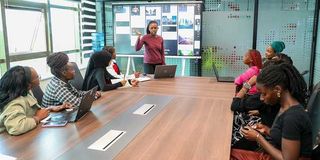
Malaica software engineer Annmaria Kerubo mentors fellow young women on how AI and digital technologies can be applied to solve real-world challenges in education, health, gender equality, online safety, and environmental sustainability at the Green and Digital Innovation in the African Centre for Technology Studies, Konza Technopolis, Machakos County, on April 23, 2026.
"Malaica has a phone management system with a 24-hour helpline that links expectant mothers to ambulance services in case of emergencies. It also helps in risk detection, where the AI tool helps to identify high-risk pregnancies early. It also has virtual consultations and 24-hour access to nurses and midwives," she explains.
The impact is already showing. Bridget Temusili, a mother who has used the platform, says it transformed her experience of pregnancy.
"Using Malaica was the best decision I ever made as the ultimate choice for my second baby. They erased the trauma I had with the first baby. I could stand four hours after a Caesarean section. I was very well taken care of, and my scar, wow, barely visible," Bridget says.
For Annmaria, what matters is not just building a solution but making sure it actually works and changes lives. "Each mother receives a care plan tailored to her specific needs, ensuring that her care is personalised and effective. This approach fosters better health outcomes and a greater sense of empowerment," she says.
The platform also facilitates seamless communication between mothers and their healthcare providers, ensuring that care is coordinated and continuous.
Beyond the technology, Annmaria is building the next generation of women in tech through her mentor circle initiative. One of her mentees, Alissa Ofula, a student at Strathmore University pursuing a Bachelor of Arts in International Relations, describes participating in the AI for Development Hackathon as one of the best decisions she has made. "I initially had a lot of doubts and fears, as I do not come from a tech background and did not know what to expect. All I had was a burning passion to make a difference," Alissa says.
Working with Annmaria, her group not only built a working solution but secured two awards: the Best Overall Innovation Award and the Best Pitch and Storytelling Award. "Working with her opened my eyes to a world of possibilities outside my usual comfort zone, growing my interest in tech," Alissa adds.
Annmaria is also an alumna of Siemens EmpowerHER, a mentorship and upskilling initiative run in partnership with UN Women, designed to empower young women in Africa with ICT, coding, and digital skills to bridge the digital gender divide.
Dan Bazira, UN Women Deputy Country Representative to Kenya, says initiatives such as the African Girls Can Code Initiative and Digital Platforms Kenya are expanding access to digital skills, innovation spaces, and mentorship for girls across the continent. "This is enabling girls to use artificial intelligence to solve real-world challenges in their communities. When girls are given opportunities in tech, they do not just close gaps; they create new paths and redefine what innovation looks like," he says.
For Annmaria, the formula comes down to two things working together. "Having a solution is not enough; the solution also has to work and improve people's lives," she says. The solution, for her, is a combination of technology and empathy.
Both women, one who once believed her life was over at 17, and another who took her mother's offhand remark as a calling, are now among the most compelling voices on what AI can do when it is put in the hands of women determined to use it. The future, it turns out, is not waiting for anyone. And neither are they.


