The women who get politicians elected but never run
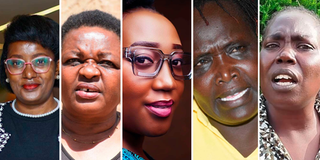
From left: Women behind politicians Anne Kinyua, Jerrica Kimali, Judy Wambui Kibicho, Veronica Burgei, and Cynthia Jerotich.
What you need to know:
- From voter mobilisation to campaign strategy, these women are shaping political contests from behind the scenes.
- Their work rarely makes campaign posters, but grassroots organisers are helping candidates build networks, rally support and win votes.
Politics in Kenya is everywhere. Under a village tree, men can argue for hours about something that has nothing to do with the El Niño. Chances are, it is politics. In the market, women argue just as loudly, and if you missed yesterday's news, someone will fill you in fast.
Behind almost every candidate who eventually vies for a political seat, though, is a woman who helped put them there. She worked out which voters to target and wrote the messages that moved people. She organised the rallies and kept the machinery running long after the candidate had gone to bed. Her name is rarely seen on campaign posters or on the ballot. Yet without her, many campaigns would not survive.
These are the stories of five such women who have shaped political battles from the ground up. All are now looking ahead to the 2027 General Election.


Judy Wambui Kibicho - Becoming the candidate
For Judy Wambui, campaigning in Juja Constituency, Kiambu County, has meant more than persuading voters to support a candidate. At times, it has meant becoming the candidate herself. "I have to become you to be able to sell you to the people," says Judy, popularly known as Judy James, who was born and raised in the sub-county.
She has been involved in political activities for 10 years, beginning in 2016 when she started blogging about community issues affecting residents. At the time, she wrote on a Facebook group called Juja People, where her criticism of one politician eventually opened the door to politics. "One of them, I criticised him publicly. So, he told me, you should come criticise me from within, not from without," she recalls.

Judy Wambui Kibicho, the campaigner who became the 'candidate' for the Juja parliamentary seat when a hostile ground forced her ‘boss’ into hiding.
But the work also exposed her to intimidation, insults and propaganda. She says she would wake up to find her photographs circulating on social media, accompanied by vulgar comments from bloggers supporting opponents.
Rather than seek help, she learned to endure the attacks. By 2021, she was back in campaign mode as the candidate contested the Juja by-election. This time, the circumstances were more difficult because the team was in opposition, she says. The candidate would often disappear, leaving her to take his place.
"Most of the time the candidate had to disappear into hiding. So, I had to act as the candidate," she says. "People told me police officers were looking for me because, when they could not find the candidate, the focus turned to me," she says.
The candidate eventually won the May 2021 by-election. After the campaign, the now Member of Parliament (MP) hired her as a secretary in his parliamentary office. But their relationship later broke down over payment; she says the salary did not match the sacrifices she had made during the campaigns.
Six months after taking the job, she quit. "I don't stay where I'm not listened to," she says.
Her decision marked another turning point in her political journey. After leaving the position, she says another politician approached her almost immediately, and she later found herself working against the very candidate she had helped elect. The bid failed, and her former boss went on to retain the parliamentary seat in the 2022 General Election.
During her first campaign experience, she says she was not paid a salary until the candidate won and she received an official job. Before then, she received what she describes as appreciation tokens of between Sh300 and Sh1,000. Transport was provided through the candidate's cars, she says, but campaigns consumed enormous amounts of time.
"Campaigns could take 23 out of 24 hours in your schedule," she says.
Judy believes campaign workers deserve greater appreciation after elections. She describes the abrupt end of campaigns as demoralising, saying candidates can stop calling once the campaign is over. "There should be a very good goodbye package," she says.
For her, the experience has nevertheless left her with something that cannot be taken away: political experience. Her cosmetic shop, which she says has been running since 2018, remains part of her life. For now, she is focusing on business and her community, and says she has not found an ideal candidate to work with.
"I wouldn't campaign for an MP. I wouldn't campaign for an MCA. I would only campaign for a governor, president or even senator," she says.
But if a candidate approaches her from outside Juja, Judy says she is ready and capable of taking up the job, as long as her efforts are compensated in proportion to the energy she puts in. "My skin is so thick right now. I'm not afraid of anything," she says, when asked whether she would be fearful of working in a new environment.
Veronica Burgei - A formidable force behind the scenes
As the political landscape of Uasin Gishu County shifts ahead of the 2027 General Election, Veronica Burgei, 43, is a formidable force whom few voters would recognise by name, though many have felt the impact of the campaigns she has orchestrated.
Veronica ventured into politics as early as 2013, when she was an expectant mother and one of the chief campaigners for Kapseret MP candidate Oscar Sudi. She helped mobilise voters for his successful bid for the seat, and Sudi has been re-elected ever since. She has been a political mobiliser for about 20 years. She currently serves as lead strategist and two-term ground mobiliser under an umbrella group, the Ruto Women Brigade. On any given day, her work starts at the ward level, mobilising voters.
"I am always involved in crafting voter campaign messages and coordinating transport logistics for thousands of women who support the re-election of President William Ruto. When things overlap, I step up to public podiums, delivering high-energy rally speeches that translate complex policy points into issues that resonate locally, as we work towards ensuring President Ruto is re-elected in 2027," she tells the Nation.
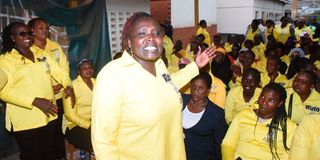
Nominated Member of County Assembly Veronica Burgei, the leader of ‘Ruto Two-Term Women Brigade’ during a meeting with other officials and members in Eldoret, Uasin Gishu, on September 15, 2026.
She recalls that her defining success in political mobilisation came in 2013, when she campaigned for Sudi's election as MP, a first-time candidate then known as a matatu tout.
"For a first-time candidate running against well-funded, polished politicians, I sacrificed my time and endured political turbulence to get votes in favour of Sudi, who was then a little-known politician," she says. "I am good at mapping out key women voters across the region who have the potential to secure a decisive victory for any given candidate."
She says her effectiveness lies in relational organising. Rather than relying solely on grand rallies, she works through established social structures such as market women, church welfare committees and boda boda stage chairpersons, among other small groups.
According to Veronica, people vote for those who remember their daily struggles, and her labour has paid off: she was nominated as a Member of the County Assembly in 2023. "I am proud to have been nominated as MCA in the Uasin Gishu County Assembly. This is due to my commitment to see others being elected to elective positions," she said.
She is often the one packing up campaign public address systems or settling venue invoices, despite facing discrimination from the opposite gender. "Politics in our region remains heavily patriarchal. If a woman leads a victory parade, critics call the candidate weak," she says.
Despite her operational mastery, Veronica has no desire to put her own picture on a poster for 2027. "Being the candidate means performing for the crowd. Being the strategist means directing the play. I prefer having my hand on the steering wheel without the distraction of public vanity," says Veronica.
One of her most memorable moments in politics came when she suspended her son's school admission to ensure William Ruto secured his first term as president. "People mocked me when I sacrificed my son's admission to school so I could dedicate my time to campaigning. Today, that sacrifice has paid off; my son is now in one of the country's most prestigious international schools," she says amid laughter.
Cynthia Jerotich - Grassroots beginnings
For nominated MCA Cynthia Jerotich, politics has never been about standing at the front of the campaign stage. Her influence has largely been built behind the scenes: mobilising voters, reading the political mood on the ground, and helping candidates build support.
Since the advent of devolution in 2013, she has twice been nominated to the Baringo County Assembly, first on a Kanu ticket and later through UDA.
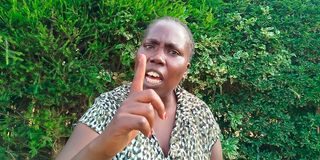
Cynthia Jerotich, a nominated MCA, during the interview in Kabarnet in Baringo Central on September 22, 2026.
Cynthia traces her political journey to 2011, when she joined the campaign team of former Baringo Senator Gideon Moi, who was then seeking the Senate seat. "When I fully chose to be part of Moi's campaign team, they took me in as one of the youths. When he wanted to present his nomination papers at the IEBC offices, I represented the youth during the address," says Cynthia.
At the time, Moi was seeking to revive his political fortunes after losing the Baringo Central parliamentary seat in the 2007 elections. Cynthia used the opportunity to speak up during his nomination address. "During my address, when he was presenting his papers, I told him to change his campaign strategy if winning the Senate seat was anything to go by. I advised him to do away with the previous campaign team and listen to the people on the ground," she says.
She went on to run an intensive campaign, moving from one household to another to persuade voters to support Moi. It paid off: The Kanu chairman became Baringo's first senator after the 2013 election.
For Cynthia, the victory opened an unexpected political door. "I least expected that my efforts as a mobiliser would be rewarded because I was simply doing it to assist him. He opened a new chapter in my life and made me realise that I had a calling for politics and the potential to be an effective mobiliser," she says.
She was subsequently nominated to the county assembly on a Kanu ticket. Knowing when to step back, though, has also been part of her political journey: when Moi sought a second term as senator, some of the campaign team members she had earlier persuaded him to drop came back into the fold, and she chose to withdraw from active politics for a period.
She returned in 2017, supporting former Baringo Central MP Joshua Kandie. "My candidate, Kandie, was not in the ruling party, so I decided to shelve my campaigns and take the back seat," she says.
By 2022, Kandie had moved to UDA, and Cynthia once again joined his campaign. She also campaigned for other UDA candidates, including Baringo South MP Charles Kamuren.
"I am also a businesswoman, and because I traverse many areas, Kamuren approached me to mobilise votes. I am also a talkative person, and that has given me an upper hand in approaching people and convincing them to join my team," she says.
Her efforts again earned her a nomination, this time on a UDA ticket. She said her political network had also drawn her into the campaigns of the late Baringo Senator William Cheptumo and, later, Vincent Chemitei during the Baringo Senate by-election.
She describes herself as a politician who studies the ground before deciding which candidate to support. "I normally take time to know which is the right candidate for that seat. For instance, in the Senate by-election, I saw that Chemitei would win, and I supported him. He actually won, to the dismay of many," she says.
Her approach, she says, involves assessing the mood on the ground before committing to a candidate. "I go to forums to listen to the ground and know what people are saying. I also do due diligence to establish whether, if we go in that direction, we will win," she says.
She also relies on vocal, influential people in villages to spread the campaign message. "Politics needs a good listener. You should not make enemies. Give everyone a chance to air their views, and sometimes take the back seat to allow other players to play their role. It should not be a one-man show," Cynthia notes.
For the nominated MCA, political support was never driven by the expectation of a reward. "I am naturally a politician. I was not campaigning and supporting people just to be rewarded. I was doing it because of passion, and in the end, it turned out to be a calling for me," she says.
Loyalty, she says, is another principle she has adopted in politics. "If I decide to support someone, I do it with passion. I do not mind what I will get. If I say this is the right way, I make sure I deliver," says the MCA.
Grassroots mobilisation, however, sometimes comes at a personal cost. She says she occasionally spends her own money while campaigning. "When you are in a hotel, you will have to buy tea to start conversations on politics or support for someone. When you go to a fundraiser, and your candidate is not there, you may have to give something on their behalf. That is both moral and financial support because you need that person to win," she says.
Now an experienced campaigner, she hopes to move from working behind the scenes to serving in Parliament in future, either as an elected or nominated lawmaker. For now, though, more than a decade into building networks on the ground, she remains focused on turning grassroots support into votes.
Anne Kinyua - Politics came calling
When Anne Kinyua first became interested in politics in 2013, she did not know where that interest would lead. People encouraged her to vie for the Zimmerman ward seat in the Nairobi County Assembly, but she did not understand enough about politics to pursue it.
Politics came calling in 2017. Her mother was running as an independent candidate for the Roysambu parliamentary seat, and Anne saw the campaign as an opportunity to learn how politics worked. "I decided this is a good way to start and just learn the game," she says.

Anne Wanjiku Kinyua, an MP aspirant for Ndia constituency in Kirinyaga, during the interview at Nation Centre, Nairobi, on September 30, 2026.
For three months, politics consumed nearly all of her time. Officially, Anne was the campaign manager, photographer and social media manager. In reality, she became the person coordinating communications, maintaining her mother's online presence, taking photographs, accompanying her across the constituency, sourcing resources, and learning the mechanics of campaigning.
"There was no stage. Roads were congested. The sewage system was poor. We were always stepping into sewage-filled puddles whenever I travelled," she says.
The experience also deepened her interest in women's representation. Having held leadership roles in church, Anne says she noticed a disconnect between women leaders, their communities and the public's understanding of leadership positions. Supporting her mother's campaign became another way to challenge that, she says.
She recalls seeing blocked toilets at the National Youth Service headquarters and wondering why such basic problems were not being addressed. Residents also raised concerns about insecurity, including reports of women being attacked in poorly lit areas, she says.
The campaign, she says, became a period of listening. "What issues is my community facing? What issues are young people facing? What issues are young women facing?" she says.
Money was one of the campaign's biggest challenges. Anne approached several organisations that supported women candidates, but says she received little encouragement. "I went to about five different organisations, and they were all like, 'We don't support women in Nairobi,'" she says.
However, the lack of funds became a major obstacle on election day. They could not afford enough polling agents to monitor voting and counting across the constituency. Anne says some members of the campaign team later admitted they had worked against her mother's interests, even though they claimed to have witnessed her receive a large number of votes at their polling stations. In one village, she says, her mother received many votes despite never having campaigned there.
Anne's mother was the only woman competing against 11 men for the parliamentary seat. When the results were announced, she came fourth.
She did not give up. In 2022, her mother again contested the Kieni parliamentary seat, but was unsuccessful. This time, Anne supported her from a distance, because she had a newborn to care for. "But I would support her by managing her social media, her team and the resources coming in," she says.
Anne now plans to contest the parliamentary seat in Ndia, her father's home constituency in Kirinyaga County. "One of the things I've come to learn is that we have very many young women aspirants right now, which is something that was a dream in 2017," she says.
"But they do not understand that the fight is just to get on the ballot. That's where the fight begins. You can be as popular as you want, but if political parties do not have the political goodwill to have women on the ballot, it will be difficult," she adds.
After nearly a decade around politics, Anne says what worries her most is the unfairness that happens behind the scenes. "You will assume that just because people like you, the system will be fair to you. And that's not how it happens," she says.
Then comes the fear of emerging ‘goonism’ at political events. "So, you are wondering if I go to the ground and they decide they don't like me and resort to violence and get away with it, what will I do? So, staying alert in that situation is becoming a little bit stressful," she says.
In the meantime, she is laying the groundwork for her campaign. "I have been introducing myself to organisations that support women during elections, and also identifying people I can fundraise with," she says. "I will probably look for a finance manager, someone who will tell me, 'You need to stop doing this.'"
She adds that she is also "working towards building a network of people of goodwill who will support me."
Jerrica Kimali - Gateway to the politicians
When she describes herself, Jerrica Kimali tends to focus on the political mobilisation she does daily. She runs political errands for Makueni Woman Representative Rose Museo, businessman James Mbaluka, who is seeking the Kibwezi West Constituency seat, and Jonathan Masombe, a Makueni County administrator who has declared interest in the Kikumbulyu South MCA seat. Apart from mobilisation, she also addresses political rallies.
Away from organising and addressing rallies, Jerrica speaks at public participation forums that drive development in Makueni County. She is good at reaching out to individual voters, and uses the leadership of organised groups to spread her influence across the entire group.
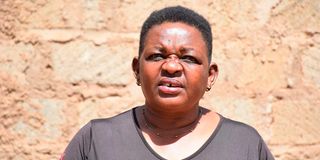
Jerrica Kimali during an interview in Kibwezi township, Makueni County, on September 22, 2026. She is a political mobiliser in the region.
"We go beyond assessing the size of a political rally to measure the influence of our mobilisation work. We expect the people we have driven to the rallies to remain vibrant during the rally. The audience should cheer at the right speakers and dance when necessary," she explains.
The mother of four does not remember how she became an orator. It still surprises her every time she gets her audience rolling with her political speeches. "Sometimes I stop to ask a section of the audience what I said that stirred the rally," she tells the Nation.
Growing up in Kibwezi Township, the Class Eight dropout never saw herself working in a political office. She grew up believing that politics was for the wayward. That attitude evaporated when a friend invited her to a political rally. Over time, she developed a thick skin and became highly influential. She was, therefore, not surprised when former Makueni Governor Kivutha Kibwana's campaign enlisted her ahead of the 2013 General Election.
Jerrica was among a lean team that campaigned for Kibwana in Kikumbulyu South Ward. Many members of the campaign team have since secured jobs in the county government, and Jerrica says she is satisfied with the opportunities she benefited from during his ten-year tenure.
"Kibwana educated two of my nephews after their parents died. They have since become breadwinners in our family, having landed lucrative jobs after completing university," she says.
Working to develop the community she calls home has remained her main source of inspiration. Seeing all manner of people go through her to access various politicians keeps her going. "Sometimes a prominent person comes complaining that they are unable to access a particular politician. It takes a single phone call to sort the problem," she says.
Jerrica does not harbour political ambitions of her own. She believes she is not qualified to occupy political office because she is not educated. "I am comfortable being politicians' gateway to the community. Sometimes it pays more than working in an office," she says.
Managing the electorate's expectations has been a Herculean task for Jerrica. Transparency has helped her fight a recurring notion that she uses the community for self-aggrandisement.
By Moraa Obiria, Pius Maundu, Titus Ominde and Florah Koech