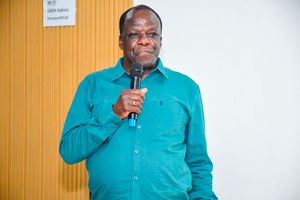
They were called 'bad girls'. Today, they are changing lives
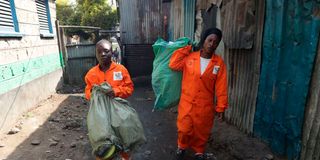
Brenda Chebet (left) and Agnes Wairimu Wanjiru, both members of the Young Resilient Advocacy Network, collecting garbage in Mathare, Nairobi on July 14, 2026.

What you need to know:
- Through a grassroots mentorship network, they learned to transform waste into marketable products and in doing so, transformed their own lives. Now they are earning sustainable incomes and supporting one another.
When Damaris Nyahondo discovered she was pregnant at 23, the hardest part was not preparing to become a mother. It was facing a community that quickly judged her.
The young woman from Mathare in Nairobi County had already built a reputation as a youth advocate, speaking to girls about their rights and encouraging young mothers to believe they still had a future. But when news of her pregnancy spread, the whispers began.
"People spoke badly about me," recalls the now 25-year-old. "They said I was a bad influence."


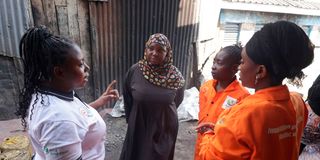
Young Resilient Advocacy Network Founder Damaris Nyahondo speaking to her members Agnes Wanjiru (right), Brenda Chebet (centre) and Mariam Kiyau in Mathare, Nairobi on July 14,2026
Her relationship did not lead to marriage, and support from the child's father was minimal.
Overwhelming judgement
Overwhelmed by shame and the constant judgment, Damaris withdrew from public life. She stopped her advocacy work, avoided friends, and spent most of her days indoors, questioning everything she had worked so hard to build.
Her experience reflects the reality faced by many young mothers in Kenya. A study published in the peer-reviewed journal PLOS Global Public Health on adolescent pregnancy, social exclusion and (dis)empowerment of girls in an urban informal settlement in Kenya, found that pregnant and parenting girls are often marginalised, pushing many out of school, vocational training and employment while exposing them to mental distress.
The researchers found that this social exclusion begins long before pregnancy and continues during and after childbirth, with lasting consequences for young women's health and socio-economic empowerment.
They argue that breaking this cycle requires interventions that address the exclusion girls face before, during, and after pregnancy. According to the Kenya National Bureau of Statistics, people aged 18 to 24 are classified as young adults — the age group in which Damaris became a mother.
Grandmother's power of change
For Damaris, however, one conversation changed everything.
Her grandmother, who had raised her through years of poverty in Mathare, refused to let pregnancy define her granddaughter's future.
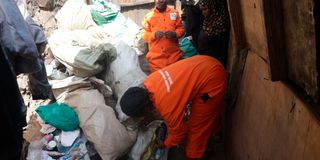
Members of the Young Resilient Advocacy Network collecting garbage in Mathare,.
"She told me this was just a phase," Damaris says. "What matters is what you choose to do next."
Those words became the turning point.
"I asked myself, if I give up now, what happens to all the young mothers I have been encouraging? How can I tell them to be strong if I am not willing to be strong myself?" she shares.
Instead of surrendering to shame, Damaris used savings she had accumulated from photography and community facilitation jobs to pay for hospital expenses and prepare for her baby's arrival.
Slowly, she returned to the work she loved.
Hope for fellow young mothers
Today, she is the founder of the Young Resilient Advocacy Network, a community-based organisation in Mathare that is helping young mothers rebuild their lives through economic empowerment, climate action, advocacy, and leadership.
The young women, she says, recycle discarded tyres into chairs, tables and stools. They also transform plastic bottles into flower vases, pencil holders and decorative pieces.
At the same time, they earn an income by collecting plastic waste in the informal settlement every Saturday.
The young mothers plan to acquire their own machinery to scale up production and diversify their products. To achieve this, they set aside a portion of their earnings towards purchasing the equipment.
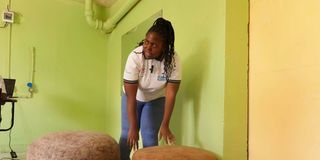
Young Resilient Advocacy Network Founder Damaris Nyahondo explaining about furniture made from waste materials by her members in Mathare.
"We want to own our future," Damaris says. "If grants end, we should still have something that belongs to us."
The organisation officially launched in September 2023, after Damaris and other young people underwent leadership and advocacy training through an international non-governmental organisation.
A friend invited her to the training, but at first, she accepted the invitation only because she hoped to receive some money to help her make ends meet.
However, she soon found herself surprised by the powerful training she received.
"I learnt about lobbying, leadership, and how communities can solve their own problems," she says.
Those lessons transformed the shy young woman who once struggled to speak in front of a crowd into a confident community leader.
Since then, she has represented young people at national and international forums, including serving on the Youth Executive Board for the global Right Here Right Now programme, participating in youth leadership initiatives in Senegal, and speaking about gender equality and climate change at international forums.
Trickle-down impact
Catherine Kabiru is one of the young mothers whose life has been transformed by Damaris's journey of empowerment.
At 25, Catherine is a passionate advocate for young women and girls in Mathare, championing sexual and reproductive health and rights, climate action, economic empowerment and technology.
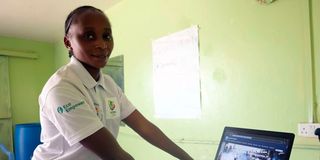
Catherine Kabiru, a member of Young Resilient Advocacy Network, Sexual and Reproductive Health and Rights champion and an ICT expert during the interview in Mathare.
But just a few years ago, she was a young mother trapped in a toxic marriage, uncertain about her future and struggling to find her place.
She became a mother at 21, after marrying at the age of 20. Instead of finding the stability she had hoped for, Catherine says she experienced domestic violence and emotional abuse.
"I couldn't be empowering girls during the day and then go home to be beaten," she says. "I realised I had to stand up for myself because no one else would."
Leaving the marriage was not easy. She had no stable source of income, a young son to care for, and little confidence that life would improve. Yet through the Young Resilient Advocacy Network, she found something she had long been searching for: a safe space where young mothers were encouraged to dream again.
She threw herself into every opportunity that came her way.
Despite never having attended university, Catherine spent nights teaching herself new skills using a basic mobile phone. She woke up as early as 3am to research topics before advocacy meetings so that she could contribute confidently alongside more experienced peers.
"I didn't want people to think that because I came from Mathare, that was all I could be," she says. "Mathare is where I come from, but it does not define who I am."
Persistence paid off
The journey was filled with setbacks. She estimates that she was rejected more than 20 times after applying for various leadership programmes and opportunities.
"Every rejection hurt," she recalls. "But I told myself I had to keep learning."
Her persistence eventually paid off.
She was selected for the My Girl Tribe programme, where she received mentorship on menstrual health advocacy, before later earning a place in a UN Women-supported technology boot camp that brought together young women from across Africa.
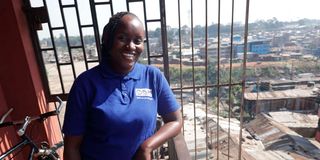
Sexual and Reproductive Health and Rights advisor Pauline Njoroge during the interview.
For two intensive weeks, Catherine learnt coding, web development and data analysis alongside university students studying software engineering and computer science.
"I was the only one who had never gone to university," she says. "At first I thought I didn't belong there, but I kept reminding myself that where I come from does not determine where I can go."
The experience ignited a passion for technology as a tool for social change. She and her team developed a digital platform to connect people living with HIV to community health promoters and health facilities, while protecting users' privacy.
Although the project did not win the top prize, it reinforced her belief that young mothers could compete and excel when given the opportunity.
Bright future for Catherine
Today, Catherine continues to mentor other young women while pursuing opportunities in technology and artificial intelligence. She is also developing a digital platform that will provide information on health, climate change and economic empowerment for girls and young mothers in informal settlements.
Her dream is to establish a community technology hub where children and young women from low-income families can access computers, learn digital skills and compete for opportunities that often seem out of reach.
"I don't want children from my community to struggle the way I did," she says. "Technology has opened my eyes. I want other girls and young mothers to realise they are capable of much more than society tells them."
Like Damaris, Catherine believes that motherhood should never define a woman's potential.
"Being a mother who is a sole parent does not define who I am," she says. "I will keep pushing because I know there is a bigger purpose ahead."
The transformation of Damaris and Catherine reflects a growing body of evidence that investing in adolescent and young mothers can unlock significant social and economic benefits, not only for the women themselves but also for their communities.
Gains of investing in young mothers
A 2025 World Bank brief, Pathways to Prosperity for Adolescent Girls in Kenya, estimates that investing in adolescent girls' empowerment between now and 2040 could generate more than US$150 billion (about Sh19 trillion) in additional income for Kenya, at an estimated investment cost of US$13 billion.
The report argues that empowering girls through education, skills development, and economic opportunities increases productivity, drives innovation, and contributes to long-term economic growth.
The experiences of Damaris and Catherine also echo findings from Unicef's 2024 report, Transforming Futures of Adolescent and Young Mothers in Eastern and Southern Africa, which found that peer-led and community-based support models can help young mothers rebuild their lives despite the multiple barriers they face.
The report notes that many adolescent and young mothers experience intersecting challenges, including poverty, gender inequality, harmful social norms, weak health systems, limited access to education and skills training, and inadequate social protection.
Together, these factors trap many in cycles of poor health, unemployment, and intergenerational poverty.
To break that cycle, Unicef supports peer and community models in which young mothers aged 18 to 24 mentor and support other adolescent mothers.
The peer providers receive training, mentorship and financial compensation while helping fellow young mothers access maternal healthcare, sexual and reproductive health services, mental health support, protection from gender-based violence, and livelihood opportunities.
Community leaders and health workers identify pregnant adolescents early, connecting them to support services before and after childbirth.
The model has produced promising results. In Lesotho, all adolescent mothers participating in income-generating activities under the programme were earning an income, up from just one per cent at the start, while 73 per cent reported having greater influence in household decision-making.
Additionally, 82 per cent registered their children's births, improving access to essential services and legal identity.
Unicef estimates that it costs about US$25 to support an adolescent or young mother and her infant through the peer community model — a relatively modest investment that can help restore confidence, build livelihoods and equip young mothers to become advocates and leaders in their own communities.
A different path
Rebecca Kemunto, from Kisii County, mirrors what this transformation looks like in practice.
She became a mother at 16. In her village of Geteri, that would ordinarily have meant marriage. Her parents chose differently; they cared for her baby so she could finish school.
At 18, she married, hoping for stability. Instead, she endured three years of violence. In 2016, she left the marriage with her two children.
Her turning point came when a local non-governmental organisation enrolled her in counselling and empowerment programmes.
Soon after, she was recruited as a peer mentor. Drawing from her own struggles, she began counselling girls and women facing teenage pregnancy and abuse.
"Many who had hated themselves finally began to value themselves," she says.
In 2019, she travelled to Saudi Arabia as a domestic worker. From her salary, she bought sanitary pads and uniforms for children back home.
When she returned in 2021, she registered the Children Sweetness of Love Foundation, a community-based organisation operating from Geteri Junction. Through it, she says, she provides counselling, mentorship and material support to teenage mothers and to girls and young women at risk.
In 2024, she secured sponsorship to register Geteri Starlets Football Club. Today, she says, its 45 players — aged between 11 and 35, and drawn from Kisii, Kericho and Bomet counties — are competing in the Nyanza Regional League.
Breaking the cycle
However, one doesn't have to be a young mother to become a mentor and source of hope for young mothers. Faith Adoyo is living proof.
At 25, the Mathare-born community organiser, child psychologist and social worker has dedicated her career to helping adolescent girls and young mothers rebuild their lives
through skills training, employment and mentorship.
Growing up in the informal settlement and being raised solely by her mother, she says, gave her a deep understanding of the realities young mothers face, even though she does not have a child herself.
Through the Mto Wangu, Faith involves young mothers in recycling textile waste into products such as clothing, tote bags and home décor, as well as collecting and reselling waste sacks as a source of income.
She says that, so far, the initiative has supported 40 young mothers aged below 24, with 10 securing jobs in Export Processing Zones and 25 others actively earning an income as waste collectors, recyclers, artisans and workshop assistants. Among them is a young mother who joined the programme at the age of 14, after dropping out of school.
"We realised that not every girl would return to school, so for some of them the best option was to equip them with technical skills," Faith says.
The community organiser says empowering young mothers is about restoring dignity as much as it is about generating income.
"Many of the young women who come to us feel isolated, judged, or uncertain about their future," she says.
"By the time they leave, they have employable skills, renewed confidence, and a support system."
They sell what they make through exhibitions, partnerships with grassroots organisations, and online marketing platforms.
Although some people question her ability to mentor young mothers because she is not one herself, Faith remains undeterred.
"I don't have a child yet, but I was raised by my mother in an informal settlement. This is my home; I see these challenges every day," she says.
"If we want young mothers to thrive, we must go beyond giving them information. We must give them the skills, opportunities and confidence to build a different future for themselves and their children."
As development organisations increasingly turn to peer mentorship and livelihood programmes to help adolescent and young mothers rebuild their lives, experts say the success
of these interventions depends less on the idea itself and more on how they are implemented.
Dorise Ng'ong'a, a gender mainstreaming and social inclusion expert, says peer mentorship among adolescent and young mothers can be highly effective when it is organised in a structured way.
She recommends placing young mothers in clubs, particularly in schools, and taking them through a curriculum rather than relying on informal interactions.
Beyond formal sessions, she says peer learning also happens through observation, with young women drawing inspiration from others who have returned to school, completed their education, or are successfully raising their children.
"Stigma is not limited to teenage mothers. It also affects young mothers parenting alone in their late teens and early twenties, because society continues to question women who have children outside marriage, regardless of their age," she says.
Betty Kanyiri, a gender officer in Machakos County, also says peer mentorship among young mothers works best when it is carefully managed.
According to her, young mothers selected to mentor others should be trained and supervised, to ensure they provide accurate information and positive guidance.
"Mentors should inspire hope without normalising adolescent pregnancy," she says.
While waste recycling can provide a livelihood for adolescents and young mothers, Dorise says its success largely depends on the local context.
"You have to be aware of the socio-cultural factors. There are cultural contexts where waste recycling is not acceptable, or is not seen as a viable source of income. The question is, can adolescent or young mothers see other people doing it and making money from it? That could be an encouraging factor. If not, that initiative is bound to fail," she says.
For Betty, waste recycling initiatives targeting adolescent and young mothers need diversified business models to remain sustainable over the long term.
"I have seen initiatives where they turn waste fabric into reusable sanitary towels. But reusable sanitary towels are long-lasting products, meaning customers do not need to buy them frequently. So if they are to earn a regular income, they must have an alternative source of income," she says.
Beyond preventing teenage pregnancy
Meanwhile, Pauline Njoroge, a sexual and reproductive health and rights advisor at Plan International – Kenya, says that while preventing teenage pregnancy remains critical, equal attention must be given to empowering young mothers to rebuild their lives.
"Many girls become pregnant because they lacked access to accurate sexual and reproductive health information. But once they become mothers, they still need information, support and opportunities," she says.
"They need to realise that pregnancy does not define the rest of their lives."
Beyond reproductive health information, she notes that young mothers need leadership skills, economic empowerment, and access to employment opportunities that enable them to care for themselves and their children.
"Programmes that build girls' agency have shown that when young women are equipped with knowledge, confidence and practical skills, they often become leaders who create change in their own communities," she says.
They become change makers
"We've seen girls who were initially too shy to speak become founders and CEOs of organisations that are now transforming the lives of other young women. Young mothers have a future beyond pregnancy. When we invest in their potential instead of judging them, they become leaders, employers, and change makers in their communities," Pauline says.
As the afternoon sun dips below the skyline of Mathare, Damaris bids goodbye to a group of young mothers and heads home, certain that a young mother's future should never be defined by her past.
"They called us bad girls," Damaris says. "But we refused to believe them. Every day, we are proving that becoming a young mother does not mean the end of your dreams. It is only one chapter of your story. If someone believes in you, and you choose to believe in yourself, you can become the leader your community never imagined you could be."