Early pregnancy, forced unions and violence: The hidden struggles of young mothers in Kibra
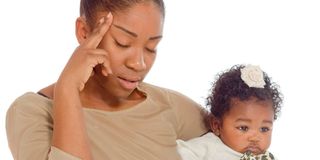
A young woman with her child. Young mothers in Kibra, Nairobi, are trapped in abusive marriages.

What you need to know:
- Young mothers trapped in abusive relationships say poverty, isolation and lack of support leave them powerless.
- Experts say escaping abusive marriages requires financial stability, emotional preparedness and safe alternatives for children.
At just 21, Maureen* has already endured painful and life-altering experiences. “My aunt raised me in Kibra in Nairobi. Do not ask me about my mother or father; I don’t know them,” she says.
Her life changed at 17, when she was impregnated while still in Form Three. Her aunt expelled her, insisting she could not stay after “choosing” to get pregnant. “She told me to go live with the man who impregnated me. So I went to him, and that was it,” she says.
The man, a boda boda rider, was 21 and unprepared for marriage. “He wasn’t ready, but he had no choice,” Maureen recalls. What followed is a union marked by hardship and humiliation.


Insults
“Whenever we disagree, he insults me, saying I’m useless and homeless, that I have nowhere else to go. Even if he abuses me, I can’t leave, I have nowhere to go.”
Financial strain compounds the abuse. He contributes Sh200 a week, insisting he cannot feed her “seven days a week”.
Their daughter, nearly four, attends pre‑primary school for Sh4,500 a term. He pays Sh2,500, leaving Christabel to raise the rest through casual laundry and cleaning jobs. “Sometimes you can go two weeks without work,” she says.
She longs for the moment she can escape his grip, even if she cannot yet see how. “I wish I could earn enough to buy land away from Nairobi and live in peace with my daughter,” she says.
“What keeps me going are my friends, who also married young. We meet and share our tribulations; that helps us survive.”
Violent and unfaithful husband
Esther*, 22, is one of those friends. A mother of two, she left school in Form Two in 2019 and had her first child at 16.
She was raised in Kibra by her father after her mother died when she was just a year old. Later, her father remarried and moved to the family’s rural home in Kisumu. She says his new family wants nothing to do with her.
She lives with the man who impregnated her. “Don’t think this marriage is good. I’m only staying because I have nowhere to go,” she says.
Her husband is violent and unfaithful, leaving her scarred not only physically but also psychologically. “When I ask him about other women, he beats me. He says, ‘Who are you to ask me? I haven’t locked you in. You’re free to leave,’” she says.
In her circumstances, leaving is like driving in darkness. She cannot even imagine packing up and leaving with her children, she says. “A week rarely passes without him beating me two or three times,” she says. “It’s a hard life, but what can I do?”
What Maureen and Esther have experienced is part of a broader, troubling reality of intimate partner violence, which UN Women defines as behaviour used to gain or maintain power and control in a relationship.
It includes physical violence such as slapping and hitting, as well as psychological abuse through intimidation and constant belittling; the kind of ordeals they have endured at the hands of the men they call husbands.
While survivors can call the 1195 national helpline, experts stress that escaping violence requires more than temporary shelter or persuasion.
Way out
Catherine Chacha Menganyi, gender-based violence prevention and response programme manager in Migori County’s health department, explains that escaping abusive relationships is rarely straightforward.
“It demands financial preparation, emotional resilience, and safe alternatives for children,” she says. “You cannot force someone into a decision they are not prepared for. The important thing is helping them understand the danger, prepare themselves, and make informed choices.”
In some countries, survivors of domestic violence are offered pathways to escape and rebuild their lives.
On April 28, 2024, Australia’s prime minister, Anthony Albanese, declared violence against women and children a national crisis. Just days later, on May 1, the National Cabinet met to discuss the crisis as a standalone agenda item, a significant shift in political prioritisation.
That meeting resulted in a package of new measures, including the creation of the Leaving Violence Programme was launched on July 1, 2025. The programme supports victim-survivors leaving violent intimate partner relationships, offering up to A$5,000 (Sh451,624) in financial assistance including up to A$1,500(Sh135,487) in cash alongside goods, services and safety support.
*Names changed to protect young mothers’ dignity.