Three young women, three abusive marriages, one common path to freedom
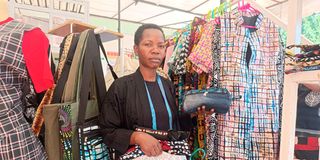
Lydia Achieng showcases some of the tailored products at the Smiles Hub , Kisumu on July 2,2025. Three years ago, she was nursing wounds from a violent marriage, her dreams of becoming a teacher long abandoned, her options nearly exhausted. Today, she pays rent, keeps her two children in school, and is saving to open her own tailoring shop.

What you need to know:
- Women and girls make up a majority of the world's 628 million unemployed young people without education or vocational training.
- Barriers caused by gender inequality and discrimination prevent girls from acquiring skills needed to access decent work and break out of poverty.
At a clothing shop in Kisumu's Central Business District, 27-year-old Lydia Ochieng is attending to a client. She exchanges pleasantries, discusses fabric choices, and a few minutes later, the customer leaves with a set of Ankara clothes packed in a shopping bag.
It is a mundane scene—a young woman at work—but for Lydia, this ordinary moment represents a life rebuilt from ruins.
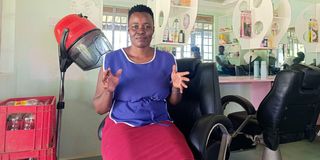
Diana Atieno, 27, during the interview at Make Me Smile Kenya beauty shop in Angola, Kisumu County. She was married at 19 after her dreams of becoming an Early Childhood Development Education teacher failed to materialise due to poverty.


Three years ago, she was nursing wounds from a violent marriage, her dreams of becoming a teacher long abandoned, her options nearly exhausted. Today, she pays rent, keeps her two children in school, and is saving to open her own tailoring shop.
Also read: Stigma keeping women in abusive unions
Lydia's story mirrors that of many young Kenyan women trapped in a cycle that begins with poverty, leads to early marriage, and often ends in abuse.
Married at 18, she was divorced in 2023 after a six-year relationship. The turn of events was not what she had pictured when she moved in with her husband back in 2016.
Her husband, nine years her senior, had promised to see her through a tertiary learning institution and to love and respect her.
"While I always wanted to become a teacher, my dreams faded after the death of my mother, a single parent who had supported my education since childhood," says Lydia, who scored a mean grade of C+ in the Kenya Certificate of Secondary Education (KCSE).
During their courtship, she had revealed her desire to pursue a course in teaching. The man, who worked at a bank, promised to pay her fees on condition that she moved in with him.
"I agreed to his demands, and we relocated to Mumias in Western Kenya, where he had bought land and settled," she says.
To honour his promise, her husband requested a fee structure from a nearby teacher training college, but later had a change of heart, claiming the fees were too high. He asked Lydia to seek support from her brothers instead—a request the siblings turned down, arguing they could not support another man's wife.
"My brothers would hear none of it. To them, I was a wife and no longer their responsibility," she recalls.
She later came across a training school that admitted young women and girls to courses in dressmaking and hairdressing at Sh1,500 per month. Lydia approached her husband, who paid the first month's fee but again sent her to seek support from her brothers for the following months. Once more, her siblings declined.
With no other option, she became a housewife while her husband worked to meet their domestic needs.
At first, the relationship was rosy. Over the years, however, he turned abusive, hitting her at the slightest provocation and eventually stopping all financial support.
"He asked me to look for menial jobs, arguing that I was fit for any work," she says.
Her husband later secured a job transfer to a neighbouring county, returning home only on weekends—arriving Saturday evening, leaving Sunday afternoon—to collect clean clothes and dump dirty ones. He also invited two of his sister's children to live with them, despite contributing nothing to the household.
Lydia resorted to working as a farmhand, earning Sh100 a day to feed the growing family.
"My earnings would go towards purchasing our daily meals. On bad days, we went to bed on empty stomachs," she says, adding that she could barely afford a packet of sanitary towels.
On each visit, her husband would accuse her of infidelity. What followed was physical and emotional assault. The beatings worsened after she conceived their second child, with her husband claiming the baby was not his. While assaulting her, he would rain kicks on her pregnant abdomen.
"One Sunday afternoon, as he prepared for work, he threatened to kill me if by the following weekend I was still in his house," says Lydia. "That was the day I decided to walk out of the marriage."
She moved in with her sister while nursing injuries from the assaults.
Six months after delivery, Lydia enrolled in a free tailoring course offered by Make Me Smile Kenya, a non-governmental organisation working with adolescent girls and women in Kisumu County. She trained for over a year, graduated with a Grade Two certificate, and later secured employment.
"Apart from learning how to sew, our trainers hold a two-hour session on customer service skills and Sexual and Reproductive Health every week. It is there that we learned how to handle customers and maintain good relationships," she says.
Lydia has since moved out of her sister's house. Her monthly earnings cover rent and school fees for her two children. She has also joined a savings group, preparing to open her own tailoring shop within two years.
"I still hope to get married someday. This time, however, it will be a marriage by choice. I am now empowered and know exactly what I want in a relationship," she says.
When school ends, vulnerability begins
Lydia's experience reflects a pattern documented across the developing world. According to Plan International, women and girls make up a majority of the world's 628 million unemployed young people without education or vocational training. Barriers caused by gender inequality and discrimination, the organisation says, prevent girls from acquiring skills needed to access decent work and break out of poverty. Each year of education boosts a girl's wages as an adult by up to 20 per cent.
Easter Achieng, executive director of the Kenya Female Advisory Organization, says ensuring girls transition to tertiary institutions is key to achieving gender equality.
"We have girls who have done so well in school but fail to proceed due to the inability of their parents or guardians to further their education," she says.
"This is one of the factors that exposes girls to early marriages, pregnancies and gender-based violence."
A recent study by the Education Development Trust supports this view, finding that difficulty transitioning from school to higher education or work remains one of the key barriers facing girls in disadvantaged households. These transition periods, the organisation argues, present windows of opportunity to intervene—though less is understood about what actually works.
Escaping a familiar trap
Sonia Akinyi, 23, recognises how easily her life could have taken a different path. Working alongside Lydia at the same tailoring shop, she enrolled for a training programme shortly after sitting her Form Four exams in 2022.
Her parents, both self-employed, had been unable to raise her high school fees, forcing her to rely solely on a sponsor. Her low KCSE score denied her a chance at further scholarship.
The firstborn in a family of four says a number of her classmates who ended up married or pregnant are now struggling with abusive partners, single parenthood, or economic instability.
"I know of three girls who are currently back at their parents' homes with more than one child. The situation is not any better for them because the parents are also financially unstable," says Sonia, who hails from Nyalenda slums.
Her earnings now cover personal necessities and allow her to support her family. Part of her monthly salary goes into a savings account, which she hopes to use to start her own business.
"Economic empowerment shields women from exploitation and abuse. Maybe I would have also ended up in marriage had it not been for the empowerment programme," she says.
Starting over at 27
Approximately 15 kilometres east of Kisumu City, Diana Atieno's story echoes Lydia's in unsettling ways.
The 27-year-old mother of twin boys aged seven runs a beauty shop at the Make Me Smile Kenya Angola Craft Centre in Kolwa Central, Kisumu East Sub-County, while also working as a trainer.
She was married at 19 after her dreams of becoming an Early Childhood Development Education teacher failed to materialise due to poverty. Her husband, over 15 years older, had promised to support her if she moved in with him.
"While he worked at construction sites, I would walk through the neighbourhood looking for house-cleaning jobs," says Diana.
Her husband, however, spent most of his time indoors waiting for job invitations—sometimes going weeks without offers, leaving Diana to fend for the family alone.
"Whenever I brought nothing home, I would be subjected to physical assault until I eventually walked out," she says.
After enrolling in a vocational programme in 2022, Diana trained in hairdressing and beauty for a year, then secured a job as a trainer. Her earnings now support the education of her twin boys.
Keeping young mothers in class
The craft centre where Diana works trains over 58 girls and young women from vulnerable homes, offering free courses in clothing and textiles, hairdressing, solar energy, and information and communication technology.
Mercy Odero, a trainer at the centre, says some of the learners are married, divorced young mothers, or adolescent girls fresh from school.
"We have 25 students learning hairdressing and 25 in dressmaking, 14 pursuing solar energy, while 40 have just graduated with a certificate in ICT," she says.
Retaining young mothers, who form a large percentage of the learners, was previously a major challenge. Mercy explains that many would miss classes to care for their children, especially without a caregiver. Poor performance was also common among those who came to class hungry.
"We introduced a baby unit to shelter the children while their mothers learn. We offer breaks at intervals to breastfeed and later carry on," says Mercy, adding that the institution has also placed learners and their children on a feeding programme.
A model taking shape
Simon Peter, director of Make Me Smile Kenya, says the initiative was founded in 2010 after research revealed that adolescent girls are more vulnerable than boys. Without empowerment, he says, girls and women face gender-based violence, early marriages, unplanned pregnancies, and HIV/Aids.
"These are the challenges we are working to address. If the girls and young women are not supported, the future will judge us harshly," he says.
Most trainees walk into the facility seeking help; the rest are referred by schools, chiefs or village elders. The programme initially taught life skills and sexual and reproductive health, but later added economic empowerment after realising its necessity. The curriculum now includes tailoring, hairdressing, solar energy, and ICT.
On graduation, the young women receive business start-up kits including sewing machines and supplies. They are free to seek employment elsewhere or apply to remain as trainers. Follow-ups are conducted to track their progress and address challenges.
To date, 1,057 girls and young women have been trained across six cohorts, according to Simon—though independent verification of this figure was not available.
For Lydia, the statistics matter less than the simple reality of her transformed life.
"I am now empowered and know exactly what I want," she says.
It is the kind of certainty that eluded her at 18 when she moved in with a man who promised her the world. This time, she is building it herself.


