Twice the work, half the chance: Women preparing to fight it out in 2027 elections
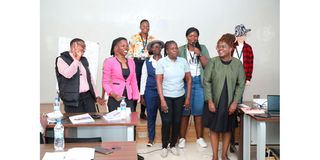
Aspiring female politicians take part in a mock campaign exercise during training organised by Social Justice League in Homa Bay town on June 20, 2026. The organisation runs an initiative dubbed Young Women in Politics 50/50 campaign meant to enable Kenya to have equal number of elected leaders from both genders. George Odiwuor I Nation Media Group

What you need to know:
- Female aspirants face financial woes, patriarchal attitudes and violence as they prepare for the 2027 elections.
- Despite setbacks, women leaders are rebuilding strategies to challenge gender barriers in Kenyan politics.
When Rachel Ogutu missed the ODM nomination for Kakelo Kokwanyo Ward in Homa Bay in 2022, she walked away with a lesson she had not expected to learn.
"I was one of the most influential people in the community because of the support I offered to the people. I thought my work with vulnerable groups would speak for me. I was wrong," she tells the Nation.
Rachel had resigned her job as a Kiswahili and History teacher at Nyalinya Secondary School to vie, inspired by the success stories of National Assembly Minority Whip Millie Odhiambo, Homa Bay Governor Gladys Wanga and former Karachuonyo MP Phoebe Asiyo. Through her NGO, Rural Environmental Conservation and Health, she had spent years supporting women and youths in her community. She believed that record would count for something. It did not.


She lost the ODM certificate to one of 30 male aspirants who contested for the same position. The party nominated Paul Barry, who went on to win the MCA seat in the August 2022 General Election.
"I have a passion for community development. Teaching did not give me enough time to use my CBO to empower the community. I thought being an MCA would enable me to have time and mobilise more resources to empower the community," she explains.
Looking back, Rachel identifies several things that went against her. She started campaigning only a month before the ODM primaries—her first mistake, she now acknowledges. Her rivals had been on the ground for months, speaking to the same voters repeatedly. By the time she entered the race, she was already playing catch-up, and countering what her opponents had been saying over that period proved a significant challenge.
Male aspirants also outspent her and had deeper networks within the party.
Then there were the attacks that had nothing to do with politics. She was threatened during campaigns and branded with names. "Some people accused me of venturing into politics as a means of trying to divorce my husband," she says.
Funding her campaign was its own battle. While a few individuals offered to help with campaign resources, some men made those offers conditional. They asked for sexual favours before offering any assistance, she says.
And then there was culture. In parts of Homa Bay, the belief that women are not supposed to lead is not whispered; it is said openly. She had difficulties explaining to some voters why they should elect a female MCA when they simply preferred to be led by men. "There is a cultural barrier that prevents women from venturing into leadership positions. It is common in rural areas and prevents many potential female leaders from ascending to power," Rachel notes.
In Homa Bay, having the ODM certificate is widely regarded as a step closer to victory at the general election. When Rachel's name appeared at the bottom of the nomination list, she went back to the drawing board. She has since developed new strategies to counter the challenges she faced and is now vying for the woman representative seat in Homa Bay, using her position as education director in the county to reach out to voters ahead of August 2027.
She is not alone in this experience.
Jeazmen Aoko, 26, was the only female candidate in the November 2025 Kasipul by-election. A software developer, she ran as an independent against nine men—Isaac Kiche of Kenya Moja Movement, Aroko Philip, Money Bior and Kotiende Rateng’ of United Progressive Alliance, Collins Okeyo of the Movement for Democracy and Growth, Ishmael Omondi of the National Liberal Party, Robert Ouko of the Labour Party of Kenya, and ODM's Boyd Were, who won the seat.
Jeazmen came ninth with 26 votes.
While her opponents moved around in large vehicles with heavy convoys, supported by various backers, she chose a more modest means of transport, motorcycles, to move from one village to another. She banked on the support of women and youths, but found that even that support had limits when voters could not get past her gender, age and marital status.
Financial constraints were among her biggest challenges. On top of that, she was branded as someone's girlfriend rising on a man's support, a claim she firmly denies. "I was branded as someone's girlfriend who was rising on the support of a man. That was not true," she says.
Ageism and capacity
The questions she faced on the campaign trail were rarely about policy. Voters questioned her age and asked whether she had the capacity to lead a constituency that had previously been led by men. Some told her outright she could not be elected because she did not have a husband. Others said she would "take leadership to where she would get married."
"In an African set-up, leadership is believed to be reserved for men. It becomes very difficult for women to convince men to vote for them," she says.
Being an independent candidate in a region where an ODM certificate is widely seen as a near-guarantee of victory added yet another layer of difficulty. "It was a bit difficult for me to go against people who are members of bigger political parties," she acknowledges.
Despite all of it, Jeazmen has not stepped back. "I will still be in the race in 2027. This is not the end of my political career," she says, describing the by-election as a learning experience.
The barriers Rachel and Jeazmen describe are not unique to Homa Bay. Across Kenya, women running for office face a predictable combination of limited finances, cultural resistance, party gatekeeping and, at times, outright violence.
The data paints a discouraging picture. Women currently hold 23 per cent of MCA seats and 21 per cent of National Assembly seats, well below the constitutional threshold. The Constitution requires that not more than two-thirds of elective or appointive bodies be of the same gender.
Leon Achieng, Secretary General of the Homa Bay County Civil Society Organisation Network, says the law can only be met if more women are elected, noting that democracy allows anyone from any gender to vie for political seats.
Psychologist Tabitha Wamoshie says the problem runs deeper than politics. "The country is stuck in a patriarchal society where men are thought to be able to lead better than women and have more privileges than the opposite gender," she says.
Women aspirants are specifically targeted because they are perceived as the weaker gender, she adds, and the training being offered is meant to empower them to go for leadership roles regardless.
She also urges women entering the political arena to remember that there is life after politics—the personal toll is real and must be prepared for.
Tabitha argues that women actually make better leaders. They are known to take good care of families, she says, and can apply those same skills to governing a ward, constituency, county or country. She points to examples of women who have led giant nations, among them the late Queen of the United Kingdom and former German Chancellor Angela Merkel.
Ahead of 2027, some organisations are working to shift these odds.
Social Justice League, a women-led organisation that promotes gender democracy and equality, is running an initiative called Young Women in Politics 50:50, focused on building female leadership at the grassroots level. The campaign is dedicated to empowering young women across Homa Bay, Samburu, Kiambu and Bomet counties to take up political leadership and drive gender equality in Kenya's decision-making spaces.
The organisation's chairperson Elizabeth Odondi says the project, which started in 2024, aims to amplify the lived experiences of women in politics and mentor them to run successful campaigns. "It is also meant to prepare leaders and achieve democracy through equal representation of men and women," she explains.
Challenges
In the first phase, the organisation developed a video documentary capturing the voices of women politicians on the challenges they face—limited training, lack of mentorship, poor campaign financing and limited knowledge of resource mobilisation. From that, a training programme was developed for 80 women aspirants, 20 of them from Homa Bay County.
At the Homa Bay sessions, participants said their biggest obstacle was the lack of financial muscle to run campaigns. They were trained in fundraising strategies, public speaking and manifesto development. Gender-based violence also featured prominently in the discussions. "Many political gatherings are infiltrated by goons who disrupt speeches by women," Elizabeth notes. She adds that while the challenges are common across all four counties, cultural barriers vary depending on where one comes from.
The programme is set to culminate in a Mentorship Summit in November 2026 in Homa Bay, bringing together all 80 trainees and stakeholders, including politicians and county government representatives from the four counties. "Women should be involved early by amplifying their lived experiences in politics. This will increase their interest and participation and propel Kenya towards 50/50 representation," Elizabeth says.
Among those who have gone through the training is Lydia Hongo, who vied for the Kendu Bay Township MCA seat in 2022 but dropped out of the race when she could not match opponents with deeper pockets. She says the training gave her the tools she lacked before. "We have also learnt about communication and safety, which are critical during campaigns. With the new knowledge acquired, I am confident that I will be a candidate in the next election," she says.
Both Rachel and Jeazmen believe 2027 can be different, but they are clear-eyed about what it will take. Jeazmen says geography matters. "We might see an increment in the number of elected female leaders. But this will depend on the geographical regions, where metropolitan areas will have females having equal chances of winning elections as men," she says.
For the numbers to shift in rural areas, both women say, civic education is not optional. Voters need to hear, repeatedly, and from trusted voices, that women can lead just as men can.
Rachel proved one thing at least when she lost in 2022: she did not stay down. She went back to the drawing board, rebuilt her strategy and re-entered the race with her sights set higher. "Women in Kenya must work twice as hard to win political seats," she said after that loss.
By 2027, she intends to prove that it does not have to be that way.


