Two sisters humiliated at school remind us how power and GBV intersect
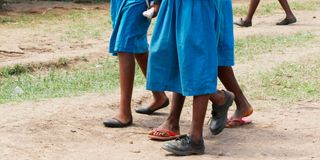
Schoolgirls. There is a worrying trend of violence involving teachers against learners as was reported in Njoro, Nakuru County.

What you need to know:
- A case in Njoro highlights how gender-based violence can occur in schools, where two sisters were humiliated by a female teacher for lacking undergarments—revealing intersections of poverty, power, and abuse of dignity.
- When a teacher paraded two girls before colleagues for not wearing underwear, the incident exposed how emotional, sexual, and economic GBV play out in education, raising urgent questions on uniforms, dignity, and child protection.
Gender-based-violence (GBV) is any harmful act perpetrated against a person, based on gender identity and as an expression of power relations. It can come from a person of the same or different sex or gender identity and can occur in private and/or public sphere.
GBV is often classified into physical, sexual, socio-cultural, economic, emotional and technology-assisted forms. A case reported by the Daily Nation of September 24 is a classic illustration of emotional GBV and its intersection with other forms.
Shamed

According to the report, two sisters attending Kenana Primary School in Njoro, were humiliated by their own teacher (and a female one at that) for not wearing underwear.
The younger girl in Grade Four who reported to school later than her elder sister was ordered by the teacher to remove a pair of trousers she had worn under her dress to keep herself warm. The teacher then dragged her to the staff room and paraded her before 20 other tutors, including male ones, before announcing that the girl had no undergarments.
The elder sister in Grade 9 was also summoned and similarly asked about undergarments. Meanwhile, some male teachers, perhaps out of spite, offered to buy them the items. The teachers also asked whether their own mother had undergarments.
Totally humiliated and embarrassed, the girls returned home crying and vowed never to return to that school. “It broke me”, the mother was quoted as saying. “I send my children to school expecting them to be safe, but they were stripped of their dignity. The teachers could have sent them home instead of humiliating them”. Let us decode this case.
First, it is obvious that the teacher not only asked the girl to remove her trousers but also inspected her, hence, was able to determine that she did not have an undergarment. This conforms with what the Inter Agency Standing Committee calls sexual abuse, defined as “the actual or threatened physical intrusion of a sexual nature, whether by force or under unequal or coercive conditions”. That it was done to a child qualifies it as child abuse.
Second is the issue of power. The teacher, by virtue of her position, had the authority to summon the pupil and to expect obedience. But she misused this power to expose the girl’s situation to other teachers, making what is private a public matter.
Third is the concept of vulnerability. The girl’s vulnerability was her age and status as a pupil that had to defer to the teacher who exploited this to degrade her. Inlaid in the case is poverty. A girl going to school without an undergarment is an obvious indicator of lack. A sensible teacher would not treat this as a source of mirth and opportunity to abuse her power but one for empathy. It is particularly distressing that this was done by a female teacher. Compounding the girls and their mother makes this a case of double violence.
Fourth are the consequences - personal embarrassment, the pain expressed in tears, interference with school attendance and potential dropout from school. Transferring to another school implies time and money being spent by the mother on a new set of uniforms and levies. Perhaps the girl will have to walk a longer distance to the next school. But even with this, the stigma among her peers and neighbourhood would remain.
This case also raises the issue about dressing. Why exactly must school girls wear tunics? The report shows that the girl wore the trousers to keep herself warm. This means that her legs were suffering from the cold weather.
In many circumstances, girls are deterred from participating in physical activities because dresses expose them and limit mobility and manoeuvrability. Educational authorities must re-think some of these nonsensical traditions which perpetuate gender based discrimination. Could the teacher not have taken the cue and asked the school administration to allow girls wear trousers as part of the school uniform?
This case illustrates the intersection of physical, emotional, sexual and economic GBV. It also highlights the issue of dignity, guaranteed by human rights instruments. Article 1 of the Universal Declaration of Human Rights states that “all human beings are born free and equal in dignity and rights.” Article 28 of the Constitution of Kenya avers that “every person has inherent dignity and the right to have that dignity respected and protected”.
The teachers abused the girl’s right to dignity. By extension, the government is also guilty of violating the girl’s right to dignified treatment. It can redeem itself through stern action against the teachers and adequate remedies to the girls and their mother and policy reform on girls’ school uniforms.
The writer is a lecturer in Gender and Development Studies at South Eastern Kenya University ([email protected]).


