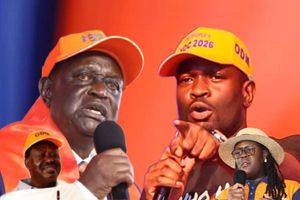
A disciplinary summons, a looming hearing, and a legal counteroffensive have set the stage for a dramatic confrontation within the Orange Democratic Movement.
Embattled Secretary-General Edwin Sifuna is digging in for a protracted fight as party leaders push to assert authority over what they describe as growing indiscipline.
The outcome of this clash could redefine ODM’s internal order and influence the broader political chessboard ahead of the 2027 General Election.
Summoned to answer charges of gross misconduct, Mr Sifuna now faces a disciplinary process that is as much about internal party control as it is about ideological direction, coalition politics, and succession dynamics in a post-Raila Odinga era.
In a letter dated April 2, 2026, signed by ODM National Chairperson Gladys Wanga, the party formally accused Mr Sifuna of a pattern of conduct deemed detrimental to party unity and discipline.
Homa Bay Governor Gladys Wanga speaks during the Orange Democratic Movement (ODM) Special Delegates Convention at the ASK Dome, Jamhuri Expo Centre in Nairobi.
Photo credit: Bonface Bogita | Nation Media Group
The accusations are weighty: contradicting official party positions, issuing inconsistent public statements, engaging in unsanctioned political activities, and skipping crucial party meetings.
At the heart of the fallout is Mr Sifuna’s persistent criticism of the ODM-UDA pact and his declaration that the memorandum of understanding between ODM and the ruling United Democratic Alliance was “dead.”
ODM argues that such statements, including those made during televised appearances, undermine collective decisions and erode institutional coherence.
The party also accuses him of participating in the “Linda Mwananchi Initiative” without approval—an act interpreted as establishing parallel political structures.
Mr Sifuna has been given until April 8 to respond in writing and is expected to appear before a disciplinary panel on April 10 at 10:00am.
The panel, constituted under ODM’s Internal Dispute Resolution Mechanism, is expected to draw from the party’s Disciplinary Committee framework.
While the ODM disciplinary committee consists of East Africa Law Society President Ramadhan Abubakar (chair), Dr Florence Omosa (secretary), Mumbi Ngaru, Seth Kakusye, and former Siaya Governor Cornel Rasanga, Saturday Nation understands that a team to be appointed by the NEC would arbitrate the matter.
Oburu Oginga: At my age, who can buy me? ODM has not been bought
Under ODM’s constitution, the disciplinary committee has powers to hear cases and recommend sanctions ranging from reprimand to expulsion, subject to ratification by higher party organs.
However, the process is already facing legitimacy questions.
All members of the disciplinary structures are appointed by the National Executive Committee (NEC)—the same organ that resolved to initiate Mr Sifuna’s removal.
An MP allied to Mr Sifuna questioned how such a panel could act independently, arguing that “it is both accuser and judge.”
But party insiders insist the process will adhere to natural justice, with one official describing it as “more of mediation than a purge,” adding that even the disciplinary team is a NEC appointee.
The Nairobi Senator, himself a lawyer, has assembled a formidable legal team that includes Senior Counsels John Ohaga, Jane Onyango and Zehrabanu Janmohamed.
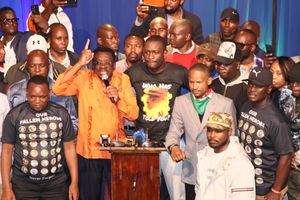
The Linda Mwananchi leaders, led by Siaya Governor James Orengo and Nairobi Senator Edwin Sifuna address the meeting amid high tension as police are trying to gain access to discontinue the meeting.
Photo credit: Wilfred Nyangaresi| Nation Media Group
Through his advocate, former Law Society of Kenya president Isaac Okero, Mr Sifuna has declared the NEC decision unlawful and invoked Article 88 of the ODM Constitution to trigger a formal dispute.
He had initially moved to the Political Parties Disputes Tribunal (PPDT), arguing that due process was not followed in his removal.
The tribunal, chaired by Gad Gathu in an acting capacity, instead directed both parties to exhaust ODM’s internal dispute mechanisms.
Importantly, the tribunal also halted the implementation of Mr Sifuna’s removal, ensuring he remains in office pending the outcome of internal processes.
Political analyst Rachael Omollo argues that “arbitration processes are known to be lengthy and would buy him (Mr Sifuna) time to capitalise on his position as the SG of the largest political party.”
Time, in this case, she notes, is political currency.
Ms Omollo says that by prolonging the process, Mr Sifuna retains his position and visibility as Secretary-General of one of Africa’s most influential political parties.
“It also allows him to shape the narrative—the intention is to keep the issue of suspension alive and frame himself as a victim of ODM internal struggles.”
She went on: “He could also be intending to use the resolutions of the arbitration and further appeal the case, unfortunately this will not happen given the action by the party for a show cause.”
These possibilities, Ms Omollo notes, would delay Mr Sifuna’s removal until the National Delegates Convention, which is expected in December.
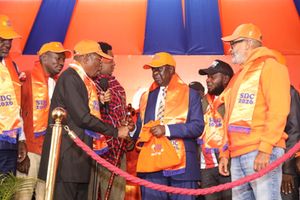
Ratified ODM leaders Gladys Wanga, Simba Arati, Oburu Odinga and Abdulswamad Nassir during the party's Special Delegates Convention at the A.S.K Dome, Jamhuri Expo Centre in Nairobi.
Photo credit: Bonface Bogita | Nation Media Group
Mr Sifuna’s strategy, she says, appears designed to stretch the dispute timeline as far as possible.
By engaging lawyers, invoking constitutional provisions, and pushing for arbitration, he is effectively creating multiple procedural layers that could delay a final decision.
Ms Omollo suggests this could push the matter closer to the party’s National Delegates Convention later in the year—where broader political considerations may come into play.
At the same time, the prolonged battle keeps his supporters mobilised and the issue alive in public discourse.
“He is maximising optionality,” she explains, adding that exiting ODM prematurely would weaken his national appeal and diminish the Linda Mwananchi movement.
Political analyst Dismas Mokua outlines three possible paths: align with ODM leadership and retain his position, trigger mass resignations and force by-elections to demonstrate political strength, or use arbitration to negotiate a favourable outcome.
Each option carries risks, he explains.
Mass resignations would be high-risk but potentially transformative, echoing past political realignments.
Arbitration, meanwhile, offers a middle path—delaying resolution while preserving leverage.
“Mr Sifuna, however, needs to develop a helicopter view of politics and political party management to guarantee an upward political trajectory. His recent statement that he cannot be the SG of a political party whose leader is Dr Oburu Oginga was not strategic.”
“The statement can be interpreted as condescending and not aligned to political leadership best practices and will potentially invite unnecessary disciplinary measures,” adds Mr Mokua.
Within ODM, the Sifuna saga has exposed deep divisions.
Party leader Oburu Oginga has struck a conciliatory tone, emphasising unity while warning against indiscipline.
“Democracy does not mean chaos,” he said, adding that members who oppose party positions risk losing leadership roles.
At the same time, he revealed that ODM is preparing for 2027 negotiations following the recent special NDC greenlight.
Meanwhile, Prof Makau Mutua offered a blunt assessment, describing Mr Sifuna as “a dead man walking”—a reflection of the high stakes and hardened positions within the party.
Dr Oburu Oginga delivers his speech during ODM's Special Delegates Convention at Nairobi’s Jamhuri Grounds.
Photo credit: Bonface Bogita | Nation Media Group
ODM has already signalled its intention to enter pre-election negotiations with President William Ruto’s UDA.
Internal cohesion is critical in such negotiations, and the Sifuna saga threatens to weaken the party’s bargaining position.
Analysts warn that a fragmented ODM could struggle to present a united front, potentially ceding ground to UDA.
At the same time, Mr Mokua argues that negotiations will proceed regardless of Mr Sifuna’s fate, noting that most ODM leaders are aligned towards a deal.
Analyst Omollo argues that Mr Sifuna’s matter “may not mean much for the ODM party’s planned coalition with UDA.”
“However, the internal wrangle weakens the party’s internal cohesion and may possibly reduce ODM’s negotiation strength with UDA. A fragmented ODM benefits competitors, especially UDA, which would thrive when opponents are shaky,” says Ms Omollo.
This, she argues, would also be seen to complicate the coalition arithmetic, as negotiations require cohesion and when key figures are missing then it gets complicated.
But beyond individual careers and political strategy, Mr Sifuna’s case is a test of ODM’s internal democratic processes.
The PPDT, in its ruling, emphasised the need to strengthen internal party democracy and adherence to governance procedures.
How ODM handles the case—whether through a transparent and fair process or a perceived political purge—will have lasting implications for its credibility.
As April 10 approaches, all eyes are on the disciplinary panel that will hear Mr Sifuna’s case.
“We shall cross that bridge when we get there, if at all we shall be part of the team to prosecute the matter,” he told Saturday Nation.
The outcome of the matter, according to the ODM Constitution, could range from exoneration to suspension or even expulsion—each scenario carrying significant political consequences.
For Mr Sifuna, the battle is about more than survival; it is also about positioning himself within a rapidly evolving political landscape, while for the ODM Party, it is about asserting authority while maintaining unity in a period of transition.