Two-thirds gender rule: Women governors seek cross-party support for bills before 2027 polls
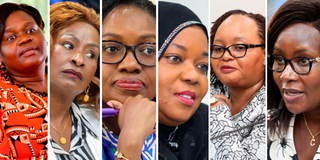
From left: Women governors Gladys Wanga (Homa Bay), Wavinya Ndeti (Machakos), Susan Kihika (Nakuru), Fatuma Achani (Kwale), Anne Waiguru (Kirinyaga) and Cecily Mbarire (Embu). Under the G7, they are building cross-party coalitions to secure the passage of constitutional amendment bills before the 2027 General Election.

What you need to know:
- The G7 women governors are building cross-party coalitions to secure passage of two constitutional amendment Bills before the 2027 General Election.
- Ann Waiguru and Gladys Wanga say implementing the two-thirds gender rule is a constitutional obligation, not a favour to women.
The latest bid to have the implementation of the two-thirds gender rule is gathering momentum, with women governors joining the clamour to have the bills before Parliament passed.
The G7, a women governors’ caucus, led by Ann Waiguru (Kirinyaga) and Gladys Wanga (Homa Bay), have taken the lead in the push for the gender bills before the National Assembly and the Senate for the implementation of the two-thirds gender rule.
On Tuesday last week, they announced that they would lobby stakeholders to ensure smooth passage of two bills. The governors spoke during the G7 High-Level Women Leaders Strategic meeting under the theme “Catalysing Women’s Leadership”. They saidthey are building strategic coalitions to ensure the pieces of legislation, which seeks to implement the gender principle, become law before the 2027 General Election.


The two are the Constitution of Kenya (Amendment) Bill, 2025 (National Assembly Bill No. 29 of 2025) and the Constitution of Kenya (Amendment) (No. 2) Bill, 2025 (Senate Bill No. 16 of 2025). The former seeks to amend Article 97 by adding special seats to ensure no more than two-thirds of the members elected under single-member constituencies belong to the same gender.
On the party list and allocation, the bill modifies Article 90 to establish a framework for party list special seats designated for women. It indicates that the exact number of special seats required will only be determined after general election results are declared.
The latter proposes changes to Article 90 to ensure transparent and democratic participation of party members on nomination lists. To ensure gender parity and inclusion, it introduces formulas to help achieve the two-thirds gender principle, alongside provisions targeting at least five per cent representation for persons with disabilities in both the National Assembly and the Senate.
Waiguru urged leaders from all political formations to support the proposed legislation, saying the responsibility for gender balance should not rest solely on women lawmakers. She noted that the gains enshrined in the Constitution on the gender rule should be protected.
“It is sad to note that 15 years after the promulgation of the Constitution, we are still debating the gender rule. This is not progress; it is our collective failure. We must support the two bills before Parliament, and our voice must be heard. They are not a favour to women but fulfilling unfinished constitutional business,” she said.
The governors indicated that besides individual MPs, they will approach leaders whose parties command a presence in Parliament to ensure their members vote in support of the bills. Wanga recalled when she served as an MP and many of her colleagues failed to show up in Parliament when a bill on the two-thirds gender rule was set to be debated. “I remember many MPs failed to show up in Parliament to support the bill. I, however, recall that Raila Odinga, who was the ODM party leader, came to give us the support we needed,” she said.
She reaffirmed her dedication to pushing for the full implementation of the two-thirds gender rule and dismantling political barriers ahead of next year’s election. Wanga challenged women in senior leadership to actively mentor and pull up aspiring female politicians, emphasising that individual success is incomplete if systemic barriers remain for others. She called on women leaders to support legislative and multi-party frameworks designed to increase women's representation in elective and appointive positions.
The forum brought together women governors, national and county leaders, members of Parliament, women's rights organisations, development partners, and emerging women leaders. They identified practical strategies for advancing women's political participation, leadership, and representation.
Dan Bazira, UN Women Kenya Deputy Country Representative, underscored the importance of sustained collaboration to accelerate women's leadership. “Catalysing women’s leadership for 2027 and beyond requires more than ambition. It demands collective resolve, strategic action, and an unwavering commitment to inclusive governance. The decisions we make today will shape the future of women's representation and leadership in Kenya,” he said.
Nominated Senator Veronica Maina said the two bills are good news in the push for the implementation of the gender rule. “We finally must have a matrix to implement the two-thirds gender rule through the bills. After they are passed, we need to move the two-thirds issue to 50-50 between men and women on matters of leadership,” she said.
'Realisable in our lifetime'
Mercy Wanjau, the Secretary to the Cabinet, was optimistic that the gender rule will be realised in “our lifetime”. The rule mandates the state to take steps to ensure not more than two-thirds of members of all elective and appointive positions are of the same gender. It recognises that certain sectors of society, historically women, have been marginalised by the political system, thereby requiring the state to put in place measures to guarantee their right to equality.
However, the push for the implementation of the gender rule has dogged the country for the past 15 years since the enactment of the Constitution. And even though there have been more than 11 attempts through bills in Parliament to have it implemented, all of them have failed.
The gender dilemma has stalked the 10th, 11th, 12th and current parliaments. For the past decades, women leaders and gender activists have been leading a spirited campaign to have the government implement the two-thirds gender rule. The caucus, in conjunction with the Kenya Women’s Parliamentary Association and the Kenya Women Senators’ Association, seeks to ensure the political party lists handed by political parties to the Independent Electoral and Boundaries Commission adhere to the rule and make public their nomination rules.