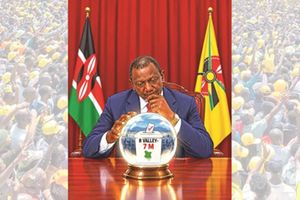
Women sidelined: The gender cost of Kenya’s political realignment
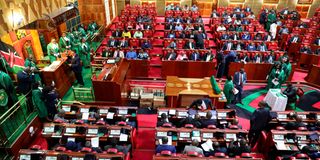
The Majority and Minority parties in Parliament play a decisive role in committee chairperson appointments. Women have borne the brunt of Dr Ruto’s falling-out with Gachagua.

What you need to know:
- Kenya's political realignment between UDA and ODM has diminished women's representation, with female CSs reduced from six to five and only one woman chairing a departmental committee in Parliament.
- The Gender ministry remains without leadership after the rejected nominee was never replaced.
The political divide came and the UDA-ODM agreement followed! Casualties? Women.
A division emerged between President William Ruto and Deputy President Rigathi Gachagua, and the latter's successful impeachment created clear lines of allegiance among the former's supporters. Then came the bloody national protests against the Finance Bill in 2024, leading to the dissolution of the Cabinet.
In forming his new Cabinet, Dr Ruto prioritised a broad-based team, incorporating members from opposition parties, ODM and Jubilee. Initially, he had appointed six women to the Cabinet, excluding a seventh nominee for the Gender docket, who was rejected by Parliament.


Despite a reshuffle last December to bring in Jubilee Party nominees, he has yet to replace Gender nominee. This reshuffle led to the removal of ICT Cabinet Secretary Margaret Ndung’u, who was reassigned as Kenya’s High Commissioner to Ghana, a position she rejected.
Now, there are only five women Cabinet Secretaries (CS), with no Gender CS in place. Women have also borne the brunt of Dr Ruto’s falling-out with Gachagua. With his newfound political alignment with ODM leader Raila Odinga, their gender-insensitive political collaboration trickled down to Parliament, influencing committee reorganisations.
Lawmakers allied with Gachagua were removed from party leadership roles and reassigned or retained as committee members. Women suffered the consequences. Thika Town Member of Parliament (MP) Alice Ng’ang’a retained her chairpersonship of the Social Protection Committee, the only one of the 20 parliamentary departmental committees chaired by a woman. Departmental committees are crucial as they oversee operations of ministries.
For instance, her committee, which spans the four ministries of Gender, Social Protection, Public Service, and Youth, saw a reduction in its women membership from nine to eight in the 15-member team.
Before the purge, out of 25 audits, appropriations, and other select committees, whose roles are not ministry-based, five were led by women. With the changes, one was dropped: Gathoni Wa Muchomba (Githunguri MP), who chaired the Constitutional Implementation Oversight Committee. Wanjiku Muhia (Kipipiri MP), who chaired the Regional Integration Committee, was removed and replaced by Irene Mayaka.
Two women retained their positions: Fatuma Mohammed, the Migori Woman Representative, who chairs the Special Funds Accounts Committee; and Lydia Mizighi, the Taita Taveta Woman Representative, who leads the Diaspora Affairs and Migrant Workers Committee.
The Majority and Minority parties play a decisive role in committee chairperson appointments. For instance, ODM nominated Irene for the position. Party leadership also determines committee memberships, and while any member can apply through the Clerk of the National Assembly to chair a committee, doing so without party endorsement risks conflict with party leadership.
Notably, the Special Funds Accounts Committee chairpersonship is reserved for independent members or those from a party not forming the government if there are no independent members available. This applies to Fatuma’s committee, which examines financial statements and reports on special funds such as the Women Enterprise Fund.
“Though I came in as an independent candidate, both Azimio and Kenya Kwanza supported me,” she told Gender Desk on March 14.
During her tenure over the past two years, her committee has audited at least 40 funds and tabled “several reports”.
“Those that had serious queries were forwarded to the relevant authorities for action.”
Alice says her UDA party nominated her for the chair position and she was elected unopposed. She highlighted her committee’s achievements, including overseeing the enrolment of an additional 500,000 elderly persons, orphans, vulnerable children, and persons with severe disabilities under the Inua Jamii program, bringing the total number of beneficiaries to 1.76 million.
“I have led the committee in passing the Persons with Disabilities Bill in the National Assembly. The Bill is now at the Senate, and upon its passage, it will be presented to the President for assent to law. The Bill is historic because of its anticipated impact,” Alice says.
Yet, the question remains: Why are women often assigned the so-called ‘weaker’ committees with minimal influence on gender-sensitive budgeting, a major barrier to achieving gender equality in Kenya?
A 2023 report by the National Gender and Equality Commission assessing gender equality and inclusion in the public sector painted a grim picture. It revealed that in the 2022–23 financial year, public sector institutions allocated about Sh1.9 billion, just 0.08 per cent of the total public sector budget, to gender equality initiatives.
When this question was posed to the Majority and Minority leaders in the National Assembly, neither of them responded to texts nor answered calls. However, Majority Party Whip Silvanus Osoro stated that he was unaware of any woman who contested a committee chairpersonship and lost.
“You can’t force anyone to fill nomination forms and become a candidate,” he told Gender Desk on March 14, 2025. “Those who tried were elected. But be that as it may, there is no superior committee in Parliament. All committees are equal.”
An email was sent to the Clerk of the National Assembly requesting a list of women who contested leadership positions for verification. The office has yet to confirm receipt of the email.