Unpacking misconception: The two-thirds gender rule was never meant to guarantee men a majority
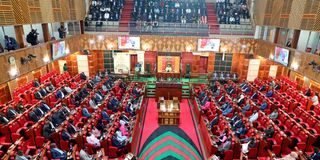
Members of the National Assembly follow proceedings during the presentation of the FY 2026/27 Budget Highlights at Parliament Buildings, Nairobi, on June 11, 2026. Figures contained in the Economic Survey 2026 by the Kenya National Bureau of Statistics show that women accounted for 23.6 per cent of National Assembly members in 2025, compared with 23.7 per cent in 2024.

What you need to know:
- A new report and recent data show Kenya remains far from achieving the principle, with women's representation stagnant or declining in key institutions.
Sixteen years after the Constitution was adopted, misconceptions about the two-thirds gender principle continue to influence debates about representation, leadership, and equality.
Many still interpret the two-thirds gender principle as guaranteeing two-thirds of positions to men and one-third to women.
Yet the Constitution says no such thing.


The government’s own assessment identifies this belief as a persistent misconception that continues to limit women's opportunities in public service.
Also read: Two-thirds gender rule: Women governors seek cross-party support for bills before 2027 polls
The 2025 Status of Implementation of the Not More Than Two-Thirds Gender Principle in Ministries, Departments, Agencies, and Counties for the 2024/25 Financial Year, published by the State Department for Gender and Affirmative Action, cites patriarchal norms, stereotypes, and social stigma among the socio-cultural barriers affecting women's participation in leadership.
One-third for women misconception
The report specifically identifies the perception that women should occupy only the minimum one-third threshold, rather than compete on equal footing, as a continuing obstacle to gender equality.
The Constitution does not reserve either the majority or minority share of positions in elective and appointive bodies for any gender. Instead, it establishes a simple principle that no more than two-thirds of members of such bodies should be of the same gender.
Article 27(8) requires the State to take legislative and other measures to ensure that no more than two-thirds of members of elective or appointive bodies are of the same gender. Article 81(b), which sets out the principles of Kenya's electoral system, applies the same requirement to elective public bodies.
Recent data suggests that the country remains far from achieving that goal.
Figures contained in the Economic Survey 2026 by the Kenya National Bureau of Statistics show that women accounted for 23.6 per cent of National Assembly members in 2025, compared with 23.7 per cent in 2024.
Drop in gender representation in the National Assembly
The survey records 82 women and 266 men in Parliament in 2025, compared with 82 women and 264 men in 2024.
However, those figures do not reflect a subsequent change in the composition of the House. One of the 82 elected women MPs from a constituency seat was later appointed to the Cabinet, reducing the number of elected women MPs in the National Assembly to 81.
This places women's representation at about 23.3 per cent, moving even further away from the constitutional threshold.
The Senate presents a marginally stronger picture. Women held 21 of the 67 seats in both 2024 and 2025, representing 31.3 per cent of senators.
Wider gender gap in counties
The gender gap is even more pronounced at county level.
The survey records seven women governors in 2024, representing 14.9 per cent of Kenya's 47 governors. In 2025, that figure dropped to six, or 12.8 per cent.
The decline follows the removal of Meru Governor Kawira Mwangaza from office. The Senate impeached her in August 2024, a decision later upheld by the High Court's Constitutional and Human Rights Division in March 2025.
Women remain a small minority among deputy governors, although their numbers rose from nine in 2024 to 10 in 2025, increasing their share from 19.6 per cent to 21.3 per cent.
Ironically, while Meru lost its woman governor, it gained a woman deputy governor. Linda Gakii Kiome was sworn in on May 30, 2025, becoming the county's first female deputy governor.
The picture is equally stark among county secretaries. Women held just five of the 47 positions in 2024, representing 10.6 per cent. In 2025, the figure increased slightly to six, or 12.8 per cent.
Among members of county executive committees, women occupied 148 of 450 positions in 2024 and 148 of 449 positions in 2025, representing about one-third of the total membership in both years.
Nearly six men for every woman chief
The disparity extends to grassroots administration.
Among chiefs, there were nearly six men for every woman. Women occupied just 375 of the 3,131 chief positions in 2024 and 480 of the 4,008 positions in 2025, with their percentage representation remaining unchanged at 12 per cent.
While the number of women chiefs increased by 105, the number of men increased by 877 over the same period.
The trend was similar among assistant chiefs. Women accounted for 1,476 of 7,520 positions in 2024 and 1,818 of 9,575 positions in 2025.
Although the number of women rose by 342, the number of men increased by 2,055, widening rather than narrowing the gender gap.
Judiciary comes closest to parity
The Judiciary remains one of the few public institutions where women have come closest to achieving parity with men.
Women held three of the seven seats on the Supreme Court in both 2024 and 2025, accounting for 42.9 per cent of judges.
At the Court of Appeal, women's representation increased from 10 of 29 judges in 2024 to 15 of 34 judges in 2025.
At the High Court, the proportion of women judges fell slightly, from 53 of 114 judges in 2024 to 45 of 99 judges in 2025.
Women, however, remain the majority among magistrates, accounting for 57.7 per cent in 2024 and 58.5 per cent in 2025.
The Kadhis' Courts remained entirely male, with no women among the 47 Kadhis recorded in 2024 or the 40 recorded in 2025.
Courts and the two-thirds gender principle
The figures show that while women are making gains in some institutions, they remain least represented in positions that wield the greatest political authority.
The meaning and application of the two-thirds gender principle has also repeatedly found its way into the courts.
In 2017, a petition challenging proposed appointments to the Supreme Court was filed in the Constitutional and Human Rights Division of the High Court.
The case arose after the Judicial Service Commission recommended one woman and four men to fill five vacancies, a move that would have left the seven-member court with five men and two women.
The National Gender and Equality Commission had earlier advised the JSC that at least two of the positions should be filled by women to ensure neither gender fell below one-third representation.
The commission argued that no position belonged exclusively to either gender and that men and women should enjoy equal opportunities.
The petitioners claimed the proposed appointments violated the constitutional gender principle. The High Court disagreed.
In its judgment of 12 May 2017, the court held that merit and fair competition remained the primary considerations in public appointments before other factors, including gender, were taken into account.
The judges concluded that although appointing another woman would have been preferable, the recommendation did not amount to a clear violation of the Constitution or the two-thirds gender principle.
The court also noted that because the Supreme Court consists of an uneven number of judges, the one-third and two-thirds calculations could only be applied approximately.