Unsung heroines: The defenders winning justice for GBV survivors
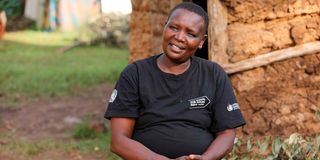
Salome Matakwei. She is a household name in Mt Elgon for her fierce campaigns to help widows facing succession battles and survivors of sexual violence.

What you need to know:
- For women like Florence, the impact is measured in something simpler: a second chance, and someone who showed up.
Bungoma tops the list nationally for gender-based violence. According to the Kenya Demographic and Health Survey 2022, 62 per cent of women and girls who have experienced physical violence in Kenya are from the county, which also recorded the highest proportion of women who have experienced sexual violence, at 30 per cent. Kisumu and Vihiga are not far behind, both named among the counties with the highest GBV numbers in the country.
Behind those figures are the women stepping in where the system falls short.
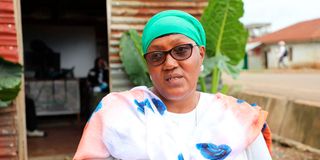
Fatuma Nyerere a Human Rights Defender in Kaloleni, Kisumu .


Salome Matakwei is a household name in Mt Elgon for her fierce campaigns to help widows facing succession battles and survivors of sexual violence. She wears many hats: certified paralegal, psychosocial counsellor, case manager, and women's rights defender.
Her path into the work was personal. Salome became a women's rights defender after she was discriminated against following the killing of her husband in 2008. She stood her ground against the discrimination from her community and family, and won.
"My firm stance against the discrimination that was being perpetrated on me led me to become a human rights defender," she says.
Since 2013, Salome has helped 130 widows with legal aid, 90 of them on succession cases, alongside 40 survivors of sexual abuse who are receiving justice, guidance, and trauma counselling.
"As a women's rights defender who is also a widow, I am very passionate about ensuring that my fellow widows get justice. That's why I help them get legal aid to win their succession cases, linking them with counselling and medical services for those who have been sexually abused," she says.
Florence Nasimiyu* (not her real name) is one of the women Salome has helped. After she was sexually abused in Mt Elgon forest and contracted fistula, Salome connected her with well wishers who paid for two surgeries.
"I thank Salome very much. When I was sexually abused and contracted fistula, she helped link me up with well wishers who paid for my two surgeries. She also assisted me to get counselling services that have since helped me reduce the trauma I had and heal," Florence told the Nation.
In Luanda, Vihiga County, Beatrice Otuma is doing similar work, leading the push for justice for sexual violence survivors. We meet her on a sunny afternoon at Emuhaya Health Centre, where she has just brought in two minors, siblings, allegedly defiled by their father.
"This is normally my daily routine. My work is to traverse the county and rescue girls and even boys who have been sexually abused. It is not an easy job, but by the grace of God, I am managing," Beatrice tells the Nation.
Trained as a paralegal and psychosocial counsellor, Beatrice works with the community to track perpetrators and hand them over to police.
"As human rights defenders, we have to be there for the community. We guide the survivors through the process of seeking medical treatment and help with the documentation of evidence. We also offer legal aid to survivors and assist them in getting counselling services, since many of them are usually very traumatised," she says.
She handles about three defilement cases a week. "Cases of defilement have hit the roof. I do not know what is happening, but the truth of the matter is that girls and women are not safe," she adds.
Very few of these cases make it to court, Beatrice says, due to kangaroo courts, legal loopholes, and gaps in evidence collection. And the work of pursuing them comes at a personal cost, one both she and Salome know well. Threats follow them home. Salome says she regularly receives threats from relatives of the widows she helps, who resent her involvement in their family disputes. Beatrice faces worse.
"At times I even receive death threats for the work that I do. The county is also very vast and needs a lot of money to traverse at times, which is not available. Some of the work we do is pro bono and is not paid for by anyone. My passion for seeing justice for survivors is what drives me," she says.
Residents in Vihiga credit Beatrice's work with opening up access to justice that many did not know existed. "The rights defender has been doing a commendable job. Due to her work, residents are now more aware of referral pathways at their disposal in cases where girls or women are sexually violated. They need to be empowered more through capacity building to help them be more impactful," says Valentine Nanjala, a resident of Sabatia.
In Kaloleni Estate, Kisumu, Fatuma Nyerere is fighting the same battle from a different angle. A member of the children's court users' committee and convener of the Winam Justice Centre, she tracks down SGBV cases that have stalled and works to revive them.
Fatuma offers survivors paralegal support and basic legal advice on pursuing their cases, and refers them to well wishers for legal aid and medical attention. Her organisation also manages cases from start to finish, walking with survivors until they get justice.
"We have also been doing a lot of advocacy through awareness campaigns on the need for justice for SGBV survivors. Due to this, we now have a 75 per cent success rate in access to justice cases. We have over 50 successful cases, and survivors served with justice," she says.
Salome, Beatrice, and Fatuma are among the human rights defenders supported by the Let It Not Happen Again initiative, a UN Women led programme launched in 2019 with the Office of the High Commissioner for Human Rights and the Government of Italy, through the Italian Agency for Development Cooperation. It is delivered with Physicians for
Human Rights, the Centre for Rights Education and Awareness, and CSO Networks.
"Across Bungoma, Kisumu and Vihiga counties, the initiative has contributed to tangible progress in advancing access to justice," says Antonia Sodonon, UN Women Kenya Country Representative. Fabio Minniti, Head of the AICS Nairobi Office, calls it "one of the most impactful efforts" in the agency's portfolio in the region.
For women like Florence, the impact is measured in something simpler: a second chance, and someone who showed up.


