Kenya approves Bill requiring GBV offenders to compensate survivors
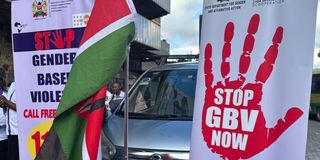
Anti-GBV banners displayed ahead of a digital campaign in Nairobi on June 9, 2025. Kenya has approved a Bill requiring perpetrators of domestic violence and GBV to compensate survivors in addition to serving prison sentences.

What you need to know:
- Kenya has approved a Bill requiring perpetrators of domestic violence and GBV to compensate survivors in addition to serving prison sentences.
- The reforms implement key recommendations of the Presidential Technical Working Group on GBV and Femicide.
Perpetrators of sexual and gender-based violence (SGBV) in Kenya could soon be required to compensate their victims, not just serve prison time, if a new Bill becomes law.
The Protection Against Domestic Violence (Amendment) Bill, 2026, approved by Cabinet last week, requires offenders to pay compensation and financial reparations to survivors, in addition to serving prison sentences.
The proposed law is set to strengthen legal and institutional frameworks against gender-based violence (GBV) and femicide. It criminalises interference in GBV cases, outlawing the obstruction of justice, coercion and concealment, as well as the use of family, clan or community-led settlements such as kangaroo courts and the Maslaha system, which often bury GBV and femicide cases instead of resolving them.


Cabinet resolutions
To ensure survivor-centred support and justice, the law also emphasises timely access to justice, psychosocial services and protective measures for survivors.
National and county governments will be required to coordinate their response, improve victim rescue shelters and strengthen referral pathways for survivors. The Bill also formally recognises and standardises GBV recovery centres and safe houses across the country.
It is among the outcomes of the Presidential Technical Working Group on GBV, including Femicide, which handed its report to the President earlier this year.
"To reinforce protection of women and vulnerable groups, the Cabinet has adopted the Protection Against Domestic Violence (Amendment) Bill, 2026, and endorsed the Report of the Presidential Technical Working Group on Gender-Based Violence and Femicide to strengthen survivor support, improve coordination and enhance protection for women," reads part of the Cabinet resolutions.
The Bill has the backing of key oversight bodies, including the National Gender and Equality Commission (NGEC), which is pushing to close legal loopholes and hold perpetrators strictly accountable. NGEC Chairperson Rehema Jaldesa says the decision is an important step in strengthening Kenya's legal, policy and institutional framework for protecting women, children and vulnerable families.
"The Commission made formal submissions to the Technical Working Group, calling for stronger prevention measures, survivor-centred responses, enhanced accountability, greater coordination among institutions and meaningful engagement of communities, including men and boys, in preventing gender-based violence," says Jaldesa.
Among the key recommendations of the Presidential Taskforce on GBV and Femicide are stricter bail and bond terms for perpetrators, to ensure victim safety, and amendments to the Sexual Offences Act to introduce stiffer minimum sentences for aggravated offences, repeat offenders and child defilers.
The taskforce has also recommended establishing a centralised, digitised and transparent database to track GBV cases, identify hotspots and deploy resources more effectively, as well as faster case processing to hasten court case management and ensure the judiciary can process restraining orders and cases efficiently.
The taskforce has further called for a dedicated national fund to cater to the needs of victims and survivors, including compensation, reparations and livelihood support, and for the improvement and funding of "One-Stop Centres", where survivors can access medical, legal and psychological support in one place.
The proposed law comes against the backdrop of an acute surge in cases of SGBV in Kenya, with women and girls bearing the greatest brunt.
Last month, Cabinet Secretary for the Ministry of Gender, Culture and Children's Services, Hannah Cheptumo, raised the alarm over a surging national crisis of femicide and GBV, warning that violence against women had reached critical levels and stressing the need to strengthen protection systems across all sectors of society.
Without a trace
The Bill's approval also follows a peaceful protest last month, when hundreds of women marched in Nairobi and staged a sit-down on Kenyatta Avenue to press the government to act against rising cases of femicide and the disappearance of children. They sang songs, waved banners and chanted anti-femicide slogans, urging leaders to prioritise the safety of women and children and saying that every life lost to femicide or infanticide represents a failure of society and the justice system.
The protesters accused the government of laxity over the working group's recommendations, saying it had done little as more women continued to lose their lives and children continued to disappear without a trace.
The protest followed a distressing wave of murders targeting women, which activists have termed a mass burial for the victims of these crimes. Demonstrators marched in solidarity, wearing white shirts and attire to signify peace and mourning.
Njeri Migwi, Executive Director of Usikimye, an organisation fighting for the eradication of GBV and femicide, says her organisation has documented 67 cases of femicide since January this year.
"We are calling on the government to act swiftly and implement the report. Women are no longer safe, and things cannot continue this way, where women live in perpetual fear. We have to say no to femicide," says Migwi.