Inside Antonia Sodonon's mission to change the lives of Kenyan women
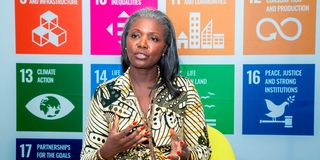
Antonia Sodonon, the UN Women Representative in Kenya, during the interview at the UN Women offices in Gigiri, Nairobi.

What you need to know:
- She is calling for stronger investment in laws against femicide and closer cooperation with neighbouring countries, as perpetrators often cross borders to hide.
Fifteen years after she last worked in Kenya, Antonia Sodonon is back, this time as UN Women Country Representative, mandated with advancing women's political leadership, promoting economic empowerment, ending gender-based violence, and integrating women into peacebuilding and humanitarian action. She arrived in Nairobi in December 2024 to take up the role, a job she calls "a calling and a passion." It is also her first interview since taking office; she is media-shy.
"I feel privileged to work with UN Women, especially in making a difference in the lives of people, particularly women and the vulnerable in society. For me, this is more than a job; it is a calling and a passion to create meaningful change for Africa," Antonia says.
As our conversation unfolds, she reflects on Kenya’s position in the journey toward gender equality. She points out the country’s strong civil society, with its wide network of women’s organisations and the expertise to drive the agenda forward. Still, she emphasises that real progress will only come through collaboration among government, civil society, the private sector, and non-state actors.

Even so, she says, challenges persist: gender-based violence (GBV) and femicide cases are rising, with at least one woman murdered in Kenya every day. Between 34 and 40 per cent of women have experienced physical violence since the age of 15, and nearly 40 per cent have been exposed to intimate partner or domestic abuse in their lifetime.
Antonia says the country needs to confront the root causes of this, which she links to economic vulnerability.
"Mental health too is a big problem that must be dealt with. The government should put money into programmes that stop GBV and femicide. To end this problem, we need a full approach that looks at all sides," she says.
She is calling for stronger investment in laws against femicide and closer cooperation with neighbouring countries, as perpetrators often cross borders to hide.
“We also need to strengthen gender desks in police stations. We are talking with the police about adding training on sexual violence to their curriculum," she says.
She reveals that UN Women has also worked with the judiciary to establish specialised SGBV courts and to train justice actors. There are currently 12 operational courts, with plans to expand to additional counties. They are designed to speed up case processing, reduce re-traumatisation for survivors and protect vulnerable victims.
A farmer's bumper harvest
With poverty still a major challenge in Kenya, the UN Women boss says bringing women into the economy would help reduce their vulnerability to GBV. One example she points to is the Climate-Smart Agriculture project, funded by the Korea International Cooperation Agency (KOICA), through which UN Women has partnered with the FAO to train thousands of women farmers in arid and semi-arid regions on climate-resilient agriculture, boosting incomes, food security and participation in agricultural policy.
One such woman is Avia Munyao, from Mutomo in Kitui, who was trained in climate-smart farming techniques. The result has been strong harvests over several seasons of maize and green grams. In 2024, Avia made Sh702,000 from selling green grams, using part of the money to expand her farming and the rest to pay school fees for her children. The following year, she harvested 80 bags of green grams, selling them for more than Sh1 million.
Avia credits the bumper harvests to Zai-Pit technology, introduced to her and other women in 2021 through the project. This is a water-efficient farming technique used in arid and semi-arid areas to maximise water use for crops, creating a micro-environment that increases drought resistance and improves yields.
Avia also keeps Gala goats, introduced through the same project. She started with four goats in 2021; her herd has now grown to more than 80. She now earns more than Sh 200 a day from selling goat milk.
"Since our area is arid, climate-smart agriculture has really benefited us. The farming techniques have helped us experience bumper harvests over the last four years, which has given us food security and economically empowered us," Avia says.
Still, Antonia says it is unfortunate that women in rural areas are often seen as the face of poverty, because they have limited access to land and other resources that could help them improve their economic lives.
"The climate-smart agriculture project in Kitui, Laikipia and West Pokot counties has helped women get involved in the decision-making process. It has helped improve family incomes and decreased incidents of gender-based violence," she says.
She emphasises that more still needs to be done to equip the women with modern, climate-responsive farming skills, and believes that if Kenya is serious about its development trajectory, it must implement its women's economic policy.
The UN Women Country Representative is also pushing for women's involvement in gender-responsive procurement, saying it is critical to leveraging their purchasing power to close economic gaps.
A study by Strathmore University found that although Kenya's affirmative action legislation reserves 30 per cent of public tenders for women, youth and persons with disabilities under the AGPO programme, only an estimated 1.75 to two per cent of public procurement is actually awarded to women.
It is for this reason, Antonia says, that UN Women is training local women entrepreneurs on gender-responsive procurement (GRP) to help them secure corporate and government tenders, through the UAE Strategic Partnership Framework-funded project. The project supports women entrepreneurs through capacity-building on gender-responsive procurement, women's empowerment principles, and access to finance and trade, with about 1,500 women across 10 Kenyan counties, including Nairobi, Turkana and Samburu, building their skills for procurement markets.
"Gender-responsive procurement creates enabling ecosystems for women entrepreneurs and women-owned businesses to thrive, compete and drive economic development. The UAE-SPF programme, therefore, provides much-needed momentum by expanding economic opportunities for women entrepreneurs in Kenya, including through making procurement policies and practices more gender-responsive," she says.
Rebecca Cherop, a contractor in West Pokot and a beneficiary of the project, says the training on GRP opened her eyes to e-procurement, helping her secure lucrative business opportunities.
"Before the training, I knew nothing about e procurement. But through the sessions, I was able to register for Access to Government Procurement Opportunities (AGPO). Together with another woman contractor, we have since secured two tenders," Rebecca says.
The work no one pays for
UN Women has also been at the forefront of pushing for the National Care Policy, which the Kenyan Cabinet endorsed last year to formally recognise, reduce and redistribute unpaid care and domestic labour. It is the first comprehensive policy of its kind in Africa, shifting care from an invisible burden to an acknowledged public good.
Antonia observes that women and girls have borne the greatest burden of unpaid care work.
"We have a scenario where women are participating in the care economy without any monetary benefit. The cost of caring for the elderly and the sick is normally passed on to women. These are the things that we hope the care policy will address," she says.
According to UN Women and the Kenya National Bureau of Statistics (KNBS), unpaid care and domestic work in Kenya is valued at Sh2.54 trillion, equivalent to 23.1 per cent of the country's GDP, with women performing the vast majority of this labour.
In May 2025, UN Women Kenya, with support from the Gates Foundation, launched the Evidence to Policy for Kenya Care Economy project nationally and across Kitui, Laikipia and West Pokot counties, to raise awareness of unpaid care work. The initiative aims to recognise, reduce, redistribute, reward and represent care and domestic work, most of which is carried out by women and remains unpaid and invisible. It has reached 2,700 community members across the three counties through awareness campaigns.
Harrison Kibet, a boda boda operator in Kacheliba, West Pokot, is one of those who has taken the message to heart.
"The initiative has been an eye-opener. I am helping my wife in some of the domestic duties. I find nothing wrong in washing dishes and helping my wife to cook. In fact, she is very happy that I assist her in domestic chores. I believe both men and women should share responsibilities at home," Kibet says.
Numbers that shape policy
Persistent gaps in gender data continue to hamper effective planning, policy-making and resource allocation for women and girls in Kenya, where data is often incomplete or insufficiently disaggregated to track progress, identify inequalities and design targeted, evidence-based interventions at both national and county level.
To address this, UN Women, together with the Kenya National Bureau of Statistics and the Council of Governors, and with support from the Swedish government, launched the Women Count Phase III in March this year. The programme aims to strengthen gender data systems nationwide and improve the production and use of gender statistics.
"These are not just statistics; they shape policy, influence budgets, and ultimately improve lives. This next phase will focus on deepening impact and bringing data closer to communities and decision-makers," Antonia says.
What 2027 will test
The UN Women boss says she is encouraged by progress on women's political participation and leadership, though more needs to be done to achieve the elusive two-thirds gender rule. With the August 2027 General Election approaching, she is calling for strict compliance with the election code of conduct, particularly on violence, which greatly impacts women.
"There is a need to level the political playing field to ensure that women participate. That is how democracy functions. We need to rein in violence against women during elections," she says.
UN Women is also working with political parties on how they engage women. Antonia warns that a disconnect between older and younger women in politics, and, more broadly, unchecked individualism, could derail the push to get more women into political leadership.
Despite these gains, she acknowledges that it has not been a walk in the park, with challenges still mounting, chief among them budget cuts that could affect the implementation of some programmes.
Antonia’s resilience is rooted in her long career. She started as a civil liberties lawyer, before joining the United Nations Development Programme (UNDP) at its headquarters in New York, where she held a senior role in the Africa Bureau Regional Programme Unit, coordinating governance and peacebuilding work with regional bodies including the Economic Community of West African States, the Economic Community of Central African States, the Southern African Development States and the African Union. She later headed the UNDP field office in Central Kasai, DRC, and later served as UN Women Representative in Côte d'Ivoire before her appointment in Kenya. Trained as a lawyer, she holds a Master's degree in Comparative Law from the University of Paris II and the City of London Polytechnic.
As the interview ends, the UN Women Country Representative says she is confident that, with combined effort among stakeholders, gender equality in Kenya will become a reality.