Wajir elders draw a line: Rape and defilement no longer negotiable
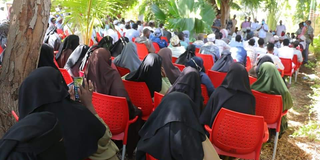
Women follow proceedings at a Maslaha session in Garissa County.

What you need to know:
- Under Maslaha, elders, perpetrators and their families approach the victim's family and negotiate an out-of-court settlement.
- Money, cattle, goats and camels typically change hands as compensation, with the system widely blamed for denying survivors any chance of justice.
Zainab Ibrahim* was 15 when her cousin forced himself on her repeatedly in the room where she slept. When the family found out, elders raised Sh60,000 to settle the matter quietly. They kept Sh40,000 for themselves. Her uncle took Sh3,000. Her mother got the remaining Sh17,000. The case was closed before it ever reached a police station.
Zainab from Wajir tells the Nation that the man who defiled her had been living with her family at the time of the attack early last year. “He forced himself on me after I tried to resist, but he was too strong. My pleas for him to stop fell on deaf ears. He warned me never to tell anyone. He said if I dared mention him anywhere, I would be dead meat,” she says.
Every day after the attack, she explains, her cousin reminded her of what would happen if she spoke up. Afraid for her life, Zainab fled her home and found refuge in a safe shelter far away. A month later, she discovered she had conceived following the defilement. Becoming a mother was the last thing on her mind. But what still angers her most is that she never got justice.


Through the Maslaha system, a traditional dispute resolution method used by elders in northern Kenya, her case was settled out of court. With the money shared, the case was considered closed and all parties were barred from reporting the matter to the authorities.
“It still pains me that the person who did this was left free even after defiling me. It is even more painful that he is a relative. He ruined my future; I had to drop out of school. I just feel worthless,” she says.
A system that silences survivors
Zainab's story mirrors the experience of many girls across northern Kenya. For decades, elders in the region have used the Maslaha system as an alternative way of resolving disputes, including cases of sexual violence.
Under this system, elders, perpetrators and their families approach the victim's family and negotiate an out-of-court settlement. Money, cattle, goats and camels typically change hands as compensation. The system has been widely blamed for denying survivors of sexual violence any chance of justice. However, that may be about to change.
No more Maslaha for sexual violence cases
Elders and religious leaders in Wajir have declared an end to the use of the Maslaha system in handling sexual and gender-based violence cases, saying all such cases must now go through the formal criminal justice system. The declaration was made at the close of a forum organised by Italy-based Volontarian Association in partnership with Dawn and the Wajir government.
“We must find a lasting solution so that survivors can have access to justice. The perpetrators must be made to pay for their actions,” said Abdi, the Wajir County director of peacebuilding.
Abdi Shakur, a retired chief who spoke on behalf of the elders, said, “From now on, all matters of sexual and gender-based violence should be left to the police and the courts. Once reported, they should be investigated and prosecuted.”
Mohammed Abdillahi, an elder, admitted that between Sh300,000 and Sh400,000 typically changes hands through the Maslaha system to make sexual violence cases disappear. “It goes against our religion. The Maslaha system should not be used to settle any sexual and gender-based violence case,” he said.
Sheikh Ahmed Hussein, the deputy vice-chairperson of Supkem's Wajir branch, agreed. “Once rape or defilement is confirmed, elders should not interfere in any way. The law should be allowed to take its course.”
Fatuma Yusuf, the chairperson of the Wajir County Civil Society Consortium, said clans and communities must stop getting involved in such cases.
Elders' role
Halima Bachola, a human rights and gender activist in Wajir, described the situation as a disaster for women and girls. “The prevalence of sexual violence in Wajir is high. Many cases are not reported because the community is very secretive,” Halima tells Nation.Africa.
She places the blame squarely on the elders: “They are the ones allowing these crimes to continue by shielding perpetrators. By contributing money for Maslaha, the clan is in a way, celebrating what the perpetrator did.”
Courts fight back with faster trials
Xavier Baraka, the Resident Magistrate at Wajir Law Courts, says the Maslaha system has been used to stop key witnesses from testifying, forcing the court to change its approach. “We make sure the victims and all key witnesses testify before the accused is released on bond. This ensures they are not intimidated or pressured into withdrawing,” she tells the Nation in a separate interview.
The approach is bearing fruit. In the last two years, the court has recorded 10 convictions, two acquittals and just one withdrawal. Data from the court shows the shift clearly. In 2023, six sexual violence cases were withdrawn for lack of witnesses. In 2024, ten were withdrawn. Between January and September 2025, five were withdrawn. But convictions have been rising: seven in 2022, five in 2023 and nine in 2024.
National push
The Wajir elders’ decision follows the Jukwaa La Usalama report by the Ministry of Interior and National Administration, released by President William Ruto in December last year, which called for the abolition of the Maslaha system and the mandatory prosecution of all defilement cases without room for mediation or withdrawal. The report also recommended establishing Children Protection Units in every sub-county.
The National Gender and Equality Commission welcomed the directive. “A criminal offence cannot be negotiated or resolved privately. Handling it fully within the criminal justice system protects survivors, holds offenders to account and builds public confidence in the justice system,” said NGEC chairperson Rehema Jaldesa.
For survivors like Zainab, the hope is that the day will come when the Maslaha system can no longer stand between them and justice.
*Name changed to protect the defilement survivor.


