Happening Now: NTV KENYA LIVE | Senate Proceedings
Who will take me back? Child mothers trapped outside the return-to-school policy
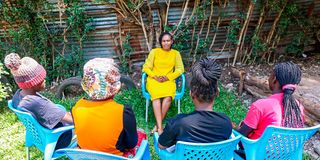
Truecare Newday Centre Founder and Director Ivy Mureithi speaking to some of the teen mothers at the centre in Nairobi on January 6, 2026.

What you need to know:
- Kenya's National Guidelines for School Re-Entry in Early Learning and Basic Education (2020) guarantee teen mothers and pregnant girls the continuity of learning.
- The policy allows a girl to re-enrol in a different school, with the head of the current school and the sub-county director of Education required to support her in securing a placement.
Amani Safari*, a 16-year-old girl from Kakamega County, sits quietly in the shade of a tree, her eyes fixed on the ground. The warm midday sun and a gentle breeze do little to lift her spirits. She is a child in distress, carrying a burden far heavier than her years.
Getting Amani to open up takes patience and gentle humour. Jokes about dancing off-beat or wearing a dress inside out draw brief, polite smiles, but they do not cut through the sadness she carries. Still, she clings to a fragile dream: becoming a television journalist.
Amani Safiri*,a 16-year-old teen mother, during the interview at Truecare Newday Centre in Nairobi on January 6, 2026.


"I want to be on TV," she says softly. "I like English and Kiswahili. I was doing well in school."
Distant dream
But that dream feels painfully distant. Though she should be joining Grade 10, Amani is living through compounded trauma: defiled by a paternal uncle, she became pregnant, was rejected by her family, and pushed out of school.
The abuse happened one evening around 7pm as she walked home after being sent on an errand by her mother. When her pregnancy became visible, questions followed. That is when she told her mother what had happened.
Also read: From teen mum to crusader of hope: The woman returning thousands of vulnerable youth to school
"She changed," Amani says, her voice barely audible. "She didn't talk to me like before. She blamed me. She told me to get an abortion."
Friends echoed the same advice, but Amani refused.
"I was afraid," she says. "I knew if I did an abortion, either I would die or the baby would die. I didn't want that."
Her father, who lived far away, cut off contact after being informed. There were no calls, no money for food, and no support.
What followed was rejection beyond words. Her mother refused to provide food or shelter, forcing Amani to rely on neighbours for a place to sleep. Under the Children Act (2022), such neglect and ill-treatment of a child is a criminal offence, punishable by a jail term of up to five years, a fine of up to Sh2 million, or both — but for Amani, the law offered little immediate comfort.
"I was hungry. I was tired," she says. Eventually, Amani sought help from the Children's Department. She was placed in a shelter, where she now lives with her baby.
"I don't want to return home. I can't imagine forgiving my parents for what they did to me. ‘Mum’ welcomed me with the love I truly needed," she says.
The mum Amani refers to is the woman who runs the shelter — a caregiver who has given her safety and stability.
While she has found protection and someone to help care for her son, one question continues to trouble her: who will take her back to school? Her parents have abandoned her, and the ‘mum’ at the shelter is already struggling to raise money to support the children in her care, let alone pay school fees.
Return-to-school policy
Kenya's National Guidelines for School Re-Entry in Early Learning and Basic Education (2020) guarantee teen mothers and pregnant girls the continuity of learning. The policy allows a girl to re-enrol in a different school, with the head of the current school and the sub-county director of Education required to support her in securing a placement.

Baraka Tajiri*, a 17-year-old teen mother, during the interview at Truecare Newday Centre in Nairobi on January 6, 2026.
The policy even accounts for repeat pregnancies: "In case a learner becomes pregnant more than once, she shall be allowed re-entry into a learning institution as long as she is within the mandatory schooling age," it states.
It further directs that learners who have attained the age of 18 years should be advised to enrol in Adult and Continuing Education or vocational training centres to complete their schooling.
However, without addressing the unique challenges teenage mothers must overcome to benefit from the policy, these guidelines often remain out of reach for child mothers like Amani.
In 2021, Elizabeth Mueni, then director of the Social Sector Policy and Strategy Unit at the Office of the President, noted that adolescent mothers from low-income households require additional support to resume studies after giving birth.
"If you're in a slum, you have to work because there is nobody to take care of the child," she said, referring to teenage mothers.
"We should do a strategic impact analysis of a policy because there are people who will need you to do other things to ensure they benefit from that policy," she added.
In a previous interview, Joseph Muthuri, an advocate of the High Court and a policy analyst, similarly observed that the re-entry guidelines are ineffective in their current form because they fail to account for the specific needs of teenage mothers, including who will care for their new-borns.
Without addressing these gaps, he warned, many girls will continue to fall through the cracks, defeating the spirit and purpose of the policy meant to protect their right to education.
Number of school-going teenage mothers
The exact number of school-going teenagers who have fallen through the education cracks after becoming pregnant is not publicly available. However, data from the Kenya National Bureau of Statistics economic surveys offers a glimpse into the scale of the problem.
An analysis of the 2024 and 2025 Economic Surveys shows that Nairobi, Bungoma, Kakamega and Narok counties contribute the highest numbers nationally of adolescents presenting with pregnancy at their first antenatal care visit.
In 2024, the number of adolescents aged 10–19 years presenting with pregnancy at their first antenatal visit stood at 253,300 — a 1.9 per cent decline from the previous period. Among those aged 10–14 years, the decline was sharper at 9.5 per cent, bringing the figure to 11,831.
By 2025, the total number had decreased by a further 4.8 per cent to 241,228. Despite the decline, the same counties still topped the list.
Interventions
The country is aware of the challenges child mothers face in resuming education, and some responses have included the establishment of schools that specifically enrol teenage mothers and accommodate their children. One such example is Greenland Girls School in Kajiado County.
Heri Njia*, a 16-year-old teen mother, during the interview at Truecare Newday Centre in Nairobi on January 6, 2026.
The school has since expanded its reach, opening branches in Meru, Kilifi and Makueni counties. Across all these branches, childcare centres have been established to look after the children of teenage mothers.
The school's management told the Gender Desk that the childcare centres were set up after it became clear that the girls' academic performance was suffering due to anxiety over their children's wellbeing. Once the babies were brought closer, performance improved significantly.
However, for girls who became mothers through defilement and were turned into outcasts by their own parents — chased away and abandoned — many remain invisible to such interventions.
As a result, the burden of care for both the girls and their children often falls on individuals and organisations willing to offer what their parents denied them, despite protections under child law. Central to that support is access to education — a key pathway to empowerment.
Strained goodwill
Yet even this goodwill is increasingly strained. The hands that give are slowly drawing back as economic hardships, struggling businesses and the rising cost of living take their toll.
"Years before, we used to receive surplus support that allowed us to help more girls. But last year was very difficult. There was a deficit," says Ivy Mureithi, who has supported more than 100 teenage mothers to return to school since 2021 with help from individual well-wishers.
While bursaries from the Constituency Development Fund, the National Government Affirmative Action Fund, or county bursary schemes could help bridge the gap, applications require the involvement of parents or guardians.
"These bursaries are highly politicised," Ivy explains. "I tried to secure bursaries for some of the girls, but my influence is limited. Each application requires identity cards from parents or guardians, and that becomes the biggest headache when the girls have been abandoned."
Government action
During the tenure of late Prof George Magoha as Cabinet Secretary for Education and Dr Fred Matiang'i as Interior Cabinet Secretary, there was a deliberate effort to return teenage mothers to school once they were ready to resume learning. However, even then, little consideration was given to those whose parents or guardians had completely discarded them.
Dr Matiang'i ordered chiefs and assistant chiefs to go door-to-door to ensure that all children, and specifically those who had become mothers, returned to school. Prof Magoha reinforced this directive, urging teachers to be supportive of teenage mothers — a call he also extended to parents.
The push was further strengthened by then President Uhuru Kenyatta. In his 2020 Jamhuri Day address, delivered during the Covid-19 period when thousands of girls had been impregnated, he ordered that teenage mothers be allowed to return to school.
"The Ministry of Education shall re-issue and publicise the Education Policy on School Re-Entry so as to facilitate the re-admission of all those who may not be able to report back due to pregnancy," he directed.
An official who served at the Ministry of Education during Prof Magoha's tenure said chiefs and assistant chiefs were, at the time, on high alert, combing villages to ensure that all children, including teenage mothers, returned to school.
However, the official noted that the ministry neither has the mandate to conduct return-to-school operations nor to provide childcare for the infants of teenage mothers.
"The ministry works with local administrators, boards of management and national parents' associations to carry out these operations. But the ministry has no mandate over children who are not of school-going age," the official said.
The official added that there was once a proposal for a bursary specifically tailored for teenage mothers, but concerns were raised that it could unintentionally encourage pregnancies as a means of accessing financial support.
Basic Education Principal Secretary, Prof Julius Bitok, who was referred to respond to these queries, had not responded by the time of publication.
The constant reality
For child mothers, whether during Prof Magoha's tenure or beyond, during Covid-19 or otherwise, their reality remains constant: they need education and care for themselves and their children to have the peace of mind required to learn.
That reality is evident in the case of Alfajiri Imara*, a 15-year-old girl from Nairobi County who dreams of becoming a lawyer but is grappling with trauma and the stress of finding sponsorship to join a boarding school far from the city.
She gave birth in April 2025 and lost her son to illness in November. She was in Grade Seven and is set to join Grade Eight. Her life changed when a man who had dropped out of school defiled her.
Her mother, a domestic worker, and her father, whom she describes as habitually drunk, became hostile after discovering she was pregnant. Alfajiri says they beat and insulted her, calling her a prostitute. When her father came home drunk, he would chase her out of the house, forcing her to sleep outside.
The weight of these experiences has overwhelmed her, leaving her desperate to be far away from Nairobi.
"I don't want to hear a child crying near me. It makes me feel so bad," she says.
"I don't want to be reminded of my parents either. I just want to be in a boarding school, as far as Nyeri or anywhere far away. Please, I need someone to come to my aid," she pleads, her voice fading as she breaks down in tears.
In the world of 16-year-old Heri Njia* from Siaya County, who is set to join Grade 10, everything feels dark. But when she imagines herself on television as a news anchor like Lulu Hassan, her heart warms.
Until December last year, Heri's maternal uncle was paying her school fees. But when her mother's boyfriend defiled her and her pregnancy was discovered, the adults around her declared that she was now an adult who should fend for herself or get married.
"My mother worked in a bar and she was always drunk," she says tearfully.
"We were three children and we didn't have a father. She would leave Sh50 and only come back home once a week — sometimes not for an entire week. We slept hungry for days, and sometimes neighbours would help us."
When Heri informed her mother that her boyfriend had impregnated her, the mother beat her, accusing her of making up the claims. Her uncle also withdrew his support, saying he could no longer educate a girl who had "decided to become an adult and a prostitute”.
Her mother chased her away. She sought refuge at a Catholic nun's home, who referred her to the Children's Department. From there, she was transferred to a shelter.
"Yes, I am pregnant, but I really want to go back to school," she says through tears. "I don't have any complications with the pregnancy. I just want to be in school."
Despite her strong desire to resume learning, Heri faces the harsh reality that her guardian is no longer willing to support her education, and the shelter's management lacks the resources to meet her school needs.
The same pain weighs heavily on 17-year-old Baraka Tajiri*, who dreams of becoming a paediatrician and is also set to join Grade 10. Her mother, who had been parenting her alone, abandoned her after she refused to terminate a pregnancy resulting from defilement by a hotel owner.
"Sometimes I sit and ask myself why my life had to turn out this way," Baraka says. "I really wanted to complete school and uplift my family, but now I fear becoming a nobody. How did it come to this? Please tell me there is hope for me to return to school."
Seeing these girls every day, their faces drawn with worry as others prepare to return to school this January, has left the shelter's founder sleepless.
"I have taken these girls in as my own children. Their pain is my pain," says the shelter's founder, who cannot be named for safety and privacy reasons related to the teenage mothers in her care.
"Day and night, my mind keeps racing as I try to figure out where I will get help to take them back to school. You will find me sitting quietly, but inside I am extremely stressed, wondering what I am going to do, because empowering these girls is my main mission."
A hope that refuses to fade
As the shelter's founder struggles to find solutions, the girls remain invisible to the Ministry of Education. In the eyes of their parents — the very people the law assigns responsibility for their care — their right to education has been cut off despite the fact that they are eligible for, and guaranteed re-entry under the return-to-school
policy.
But the question remains: who will take them back to school?
"I don't want to give up hope, and I can't," Baraka says firmly. "But I want to be assured that I will return to school, become a paediatrician, and build a better life for my daughter."