From domestic worker to IT equipment supplier: How Ivy is lighting the way for teen mothers
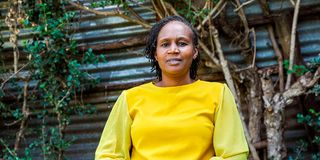
True Care New Day Centre Founder and Director Ivy Mureithi during the interview at the centre in Nairobi on January 6, 2026.

What you need to know:
- At 12, her stepfather in Kirinyaga attempted to defile her.
- Her mother fled with her, seeking safety, and Ivy began working as a domestic worker for an Indian family in Nairobi.
- What could have been a story of lost opportunity became one of change.
The midday sun shines over a serene, protected compound on the slopes of an outskirt village in Nairobi County, where sugarcane and avocado trees sway gently in the breeze.
Children run across a green lawn, their laughter mingling with the rhythmic thud of a football. Inside and around a large stone house, teenage mothers move busily - preparing for school, doing laundry, cooking - while others cradle their infants tenderly in the sitting room.
The gentle hum of daily life here unfolds in moving juxtaposition to the trauma that brought these girls to this place. This is the True Care New Day Centre, a sanctuary where hope is carefully rebuilt, one young life at a time.


At the helm of this haven started in 2021 is Ivy Mureithi, a woman whose own past mirrors the struggles of the girls she now empowers. At 12, her stepfather in Kirinyaga attempted to defile her. Her mother fled with her, seeking safety, and Ivy began working as a domestic worker for an Indian family in Nairobi. What could have been a story of lost opportunity became one of change.
“The family I worked for did not see me as a house help. They saw beyond that,” Ivy recalls.
“I told them my story, my fears, my vision. They took me back to school.” Enrolled in Grade Six, Ivy progressed steadily through her studies, eventually earning a degree in Information Technology (IT) from Jomo Kenyatta University of Agriculture and Technology.
Today, she supplies IT equipment to multinational companies, a success she credits to her former employers and lifelong mentors, who continue to support her work at the centre.
Ivy’s experiences fuel every decision she makes at the shelter. The centre currently supports 24 teenage girls, all of whom have survived sexual and gender-based violence and pregnancies.
“When these girls come here, most arrive with trauma. The first step is stabilising their minds through counselling. We provide prenatal care, pay hospital bills, and once they deliver, we continue supporting both mother and child,” she explains.
Education is central to the shelter’s mission. Girls return to school at the level they left off, whether primary or high school. Some attend boarding schools; others go to day schools, with childcare provided by the centre.
“We make sure they get the same start in life as any other child,” Ivy says.
Yet challenges abound. Space and funding limit how many girls can be accommodated.
“Our capacity is 26 girls, but in a week, up to 10 more may seek our help, and we cannot take them in,” Ivy says.
She and her family personally cover school fees and other expenses, with occasional support from well-wishers. Government bursaries, she notes, are largely inaccessible.
“Bursaries are political; if you’re not registered in the area, you are denied help,” she explains.
Despite these obstacles, Ivy remains determined. “We live each day at a time and keep our hopes high,” she says.
She believes schools and communities must also play a role in supporting teen mothers.
“Teachers need awareness. Churches and communities need awareness. These girls have scars but with the right support, encouragement, and love, they can turn into beautiful stars,” she says.
“Someone saw a star in me when I could not see it myself. That is why I am able to help these girls today. Watching them return to school in uniform, smiling and confident, is a source of profound joy.”
The shelter’s growth has been organic. It began with a single girl in a small rental house. During Christmas, Ivy invited all teenage mothers in the community - expecting or with babies -to share a meal.
She had budgeted for only 30 girls, but 98 girls turned up. “That’s when I realised the scale of the need,” she recalls. Today, the centre continues to provide a safe space for healing, and education.
“The girls I work with now remind me of myself,” Ivy reflects.
“If someone had not seen a star in me, I would not be here today. These girls deserve the same chance. They deserve to shine.”