Why are more Kenyan boys dropping out of school?
Boys are increasingly viewed as "premature providers," lured away from school by the miraa trade, fishing, and boda boda business to support struggling families.

Have you ever been approached on the street by a boy who looks about 10 years old, begging you to buy sweets, chewing gum or bananas while schools are in session?
Have you ever paused to ask why he is not in school?
Kenya is facing a serious education crisis. While there are fewer males in the country's population, more boys than girls are out of school.


According to the 2019 census, of Kenya's 47.6 million people, males make up 49.5 per cent and females 50.5 per cent, with less than 0.01 per cent identifying as intersex.
A report on the state of gender equality in basic education by Usawa Agenda, "What is the State of Gender Equality in Our Basic Education?", released on Tuesday, shows that more boys (five in every 100) than girls (four in every 100) of school-going age are out of school in Kenya.
Worse still, boys are more likely to be out of school than girls in both female-headed households (5.7 per cent) and male-headed households (4.5 per cent).
Women head 34 per cent of Kenyan households, according to the Kenya National Bureau of Statistics. These households are also poorer than male-headed ones, with 30.2 per cent of female-headed households classified as poor, compared with 26 per cent of male-headed households.
There is, however, one exception to the trend. In households headed by people with a university degree, a post-secondary certificate, or who dropped out of secondary school, more girls than boys are out of school.
In Kenya, about 19 per cent of women aged above 25 have attained post-secondary education — university or middle-level colleges — while around 18 per cent have completed secondary education.
Usawa Agenda executive director Dr Emmanuel Manyasa described it as a puzzle worth further research: there are fewer boys in the population, yet more boys are out of school.
"Actually, some of the issues that have come up are in themselves research questions. We need to go back and find out why it is that we are increasingly seeing more boys out of school," he said.
"It is a research question that we have not fully explored. However, going by the patterns of where you find more boys out of school, these are, for instance, fishing communities. And you can tell."

A bundle of miraa on display at Argyle Grand Hotel Nairobi during the forum on the Narcotic Drugs and Psychotropic Substance Control Amendments Bill, 2024 on May 24, 2024.
The profit motive
He singled out Meru as an area where many boys are dropping out because they believe the miraa (khat) trade is more profitable than school.
"So we need to look at those social pressures that are forcing boys to start seeing themselves as providers long before they are ready, leading them to drop out of school because they think they need to make money," he said.
"And we saw these trends during Covid-19. Part of it is that during the lockdowns, many boys became boda boda riders. When schools reopened, they did not see the value of going back to school when they were already making Sh100 or Sh200 a day."
Even as more boys drop out, the learning environment still favours them.
The study shows that nearly two-thirds of boys' senior schools (62.1 per cent) offer at least 12 examinable subjects, compared with 58.5 per cent of girls' senior schools — giving boys an upper hand in career choices and limiting opportunities for girls.
Boys' schools are also more likely to have playgrounds (95.7 per cent) and libraries (65.4 per cent) than girls' schools.
Margaret Koech, founder of the Chalan Foundation, which offers scholarships to both boys and girls, said this year's baseline survey by the foundation revealed different barriers for the two groups.
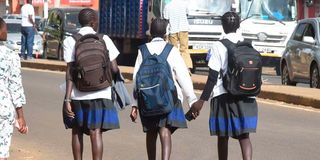
Secondary school students head home for the April holidays on March 27, 2026.
For girls, she said, the main challenges in accessing education were early pregnancy and child marriage. For boys, early dropout was driven mainly by economic pressure — many lacked school fees, and some went into business to raise fees and support their families.
She cited an example of how gender-transformative interventions can also benefit boys.
"One of the boys that we supported in the past had dropped out of school so that he could fend for his siblings," she said.
"And over the years, he worked. Then, at the age of 27, he returned to school. We supported him, he completed his education, went to college, and now he is working."
She added that exposure to drugs and crime, child labour and mental health challenges are also denying boys equal access to education. Other factors include a lack of mentorship and positive role models, pressure to become providers at an early age, violence, homelessness and incarceration.
"Let us protect girls where barriers exist, but do not ignore vulnerable boys who are also struggling. Strong societies need both educated women and educated men," she said.

Mandera South MP Haro Abdul Ebrahim.
Mandera South Member of Parliament Abdul Haro, a member of the Parliamentary Committee on Education, said the country can no longer assume gender gaps in education are closing simply because enrolment numbers have improved.
"This report shows us where progress has been made and where systemic inequalities persist," he said.
"For example, the report has shown that girls' enrolment rates in primary school are higher than those of boys. Yet significant learning resource gaps still favour boys' schools over girls' schools."
The country, he said, has no option but to adopt a gender-responsive education system that goes beyond achieving equal enrolment for girls and boys.
"Gender transformation requires us to examine what happens inside schools, around schools, and beyond schools," he said.
"A gender-transformative education system ensures that every learner, girl or boy, can access school safely, remain in school consistently, and learn effectively without discrimination."


