Why boys have fallen behind in Asal counties where more girls sat KJSEA
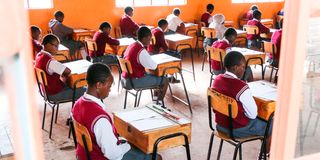
Grade 9 students at St Mary’s Girls Comprehensive and Junior School in Nakuru County sit for their Kenya Junior School Education Assessment (KJSEA) on October 27, 2025.

What you need to know:
- Stakeholders warn that the heavy focus on girls is beginning to sideline boys – pushing them out of school, into drugs, or into pastoral duties during drought seasons.
- Nairobi, the country’s largest cosmopolitan county, registered the highest number of candidates at 71,022, with girls comprising 50.99 percent (36,215).
Six counties recorded more girls than boys undertaking the Kenya Junior School Education Assessment (KJSEA) this year.
Of these, four are in Kenya’s arid and semi-arid lands (Asals) regions with some of the lowest population densities according to the 2019 census. They are also among the 22 hotspot counties where girls as young as pre-adolescents are prepared for child marriage through female genital mutilation.
Yet despite girls outnumbering boys in candidature in these Asal counties, their absolute numbers remain a fraction of those seen in urban counties such as Nairobi and Mombasa, where girls also led.


Nairobi, the country’s largest cosmopolitan county, registered the highest number of candidates at 71,022, with girls comprising 50.99 percent (36,215). Mombasa, the second most cosmopolitan county, had 20,745 candidates, and recorded the narrowest gender gap nationally, with girls surpassing boys by only one (10,373 girls).
But in Asal counties, where girls also outnumbered boys, the total numbers remain the lowest in the country.
In Marsabit, girls formed 50.48 percent of 6,351 candidates. In Isiolo, they made up 50.92 percent of 3,979. In Samburu, girls accounted for 50.45 percent of 5,372, while in West Pokot, they represented 50.63 percent of 14,856 candidates.
Despite these pockets of progress, boys still dominated nationally.
A total of 578,691 boys and 551,829 girls were assessed. This marks a drop in transition from Kenya Primary School Education Assessment to KJSEA to 88.17 percent, down from 97.77 percent during the earlier transition from the Kenya Early Years Assessment.
Although the Ministry of Education recommends that KJSEA candidates be aged between 12 and 14, those aged 13 and below made up only 3.12 per cent of the 1,130,587 candidates. On the other end, candidates aged 18 and above accounted for 3.33 percent.
Stakeholders say the increase in girls’ participation in Asal regions is the result of years of grassroots campaigns advocating for girls’ education and protection.
No initiatives for boys
However, they warn that the heavy focus on girls is beginning to sideline boys – pushing them out of school, into drugs, or into pastoral duties during drought seasons.
“I have not seen any initiative here that solely focuses on boys. The focus is on the girls,” said John Leparsanti, a gender-equality advocate in Samburu County.
“We have seen in remote areas such as Wamba and Serolipi that parents are not taking their boys to school. When there is drought, the boys are pulled out to take care of the cattle.”
In Isiolo, campaigners say the economic and social empowerment of women has fuelled rising enrolment among girls.
“Nowadays, women have been empowered. When they see husbands prioritising the sons, they know what to do to send their daughters to school,” says Grace Lolim, the executive director of Isiolo Gender Watch.
“They have joined Village Savings and Loan Associations, where they access funds to educate their daughters. We are even seeing a trend where girls are becoming brighter than boys.”
She notes, however, that the growing attention on girls is producing unintended consequences for boys, who are increasingly demoralised and turning to drugs.
To address this, her organisation has launched a sexual and reproductive health and rights mentorship programme in four primary and two secondary schools, involving 12 boys and 24 girls in each institution.
“Through these mentorship sessions, they learn about the importance of education and how to avoid factors that can derail their schooling,” she explains.
Each mentee is expected to reach 100 peers per term - 50 in school and 50 out of school - including those who dropped out due to teenage pregnancy, drug use, or other challenges, encouraging them to return to class.
Follow our WhatsApp channel for breaking news updates and more stories like this.


