Why teen mothers are still paying for 'free' delivery services
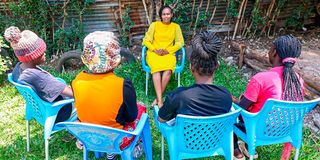
Ivy Mureithi speaks with teen mothers at the shelter in Nairobi on January 6, 2026. The facility cares for vulnerable pregnant adolescents, many of whom struggle to access the documentation and health insurance needed to benefit from the government's free maternity care programme.

What you need to know:
- The government promised free delivery services for teenage mothers under SHA.
- An investigation found many still face bureaucratic, financial and documentation barriers to accessing care.
- As a result, some of Kenya's most vulnerable girls continue to pay for services meant to be free.
In November last year, Emily* was 16 when her mother took her for her first antenatal care (ANC) visit at Korogocho Health Centre, a facility located in Nairobi County’s informal settlement.
The Ministry of Health classifies the centre as Level 3, with eight maternity beds.
This was just two months after Cabinet Secretary Aden Duale made a major pronouncement on how teenage mothers would access delivery services under the Social Health Authority (SHA).


On 30 September 2025, while speaking at Umma University in Kajiado County during the launch of the institution’s Phase II Education Complex and unveiling of its Phase III Development Plan, he announced that all teenage mothers in Kenya would give birth free of charge under SHA.
However, neither SHA, CS Aden, nor the Health Ministry has clearly defined who qualifies as a teenage mother under the programme, leaving ordinary Kenyans, many of whom are unfamiliar with policy language, uncertain.
Official health documents, such as the National Adolescent Sexual and Reproductive Health Policy and the World Health Organisation define adolescents as persons aged 10 to 19. In contrast, the Kenyan Constitution considers anyone aged 18 and above an adult.
Emily falls squarely within the bracket of intended beneficiaries of the free delivery programme. Yet she says she and her mother were never informed of its existence.
“I’m only hearing that from you now; that there are free delivery services,” she says.
She delivered last May at the same hospital, but there was nothing “free” about it.
“The first time we went to the clinic, my mother had to register for the Social Health Insurance Fund (SHIF) and paid Sh500. She was told to register me as her dependent so I could use her card when I came to deliver, but I don’t have a birth certificate. She doesn’t have one for me,” Emily explains.
Her mother could not make monthly contributions to SHIF due to lack of funds. She is solely raising five children and now a grandchild, surviving on casual jobs such as laundry and house cleaning in Eastleigh - often dubbed ‘Little Mogadishu’ as it is one of East Africa’s largest wholesale and retail marketplaces.
When Emily returned to give birth, she says she was told she must pay Sh5,000 before being discharged.
“I remember my mother had only Sh20,” she recalls. “I looked at her and started crying. In my head, I was asking myself, ‘The man who made me pregnant and then abandoned me, shouldn’t he be the one carrying this burden?’ But my mother was stoic. She called her friends, and they came through for us.”
Extreme poverty has shaped Emily’s life. Her mother only managed to educate her up to Form Two. After dropping out, Emily began doing domestic jobs. When an older man professed love, she accepted, only for him to turn against her when she became pregnant.
“He denied even knowing me,” she says.
Burden of teenage pregnancy
The burden of teenage pregnancy in Kenya is overwhelming, and the cycle is heavy. Interviews I conducted in Mathare, Korogocho, and Kibra - areas leading in teenage pregnancies in Nairobi- reveal that many adolescent mothers are themselves children of teen mothers.
Some later turned to commercial sex work. Most lack birth certificates, the key document needed to obtain a national identification card. These documents are also required to register for the state-run health insurance under the universal health coverage agenda.
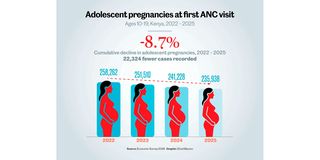
The number of adolescents aged 10–19 presenting with pregnancy at their first antenatal clinic visit declined slightly between 2022 and 2025, according to the Kenya National Bureau of Statistics' Economic Survey (2026). Yet the numbers remain high – over 200,000.
Teen mothers can register for health coverage through multiple channels, within health facilities and at designated service points across the country.
Registration process
Responding to Gender Desk’s queries, SHA chief executive officer Dr Mercy Mwangangi said registration is integrated into maternal health services, beginning when adolescent mothers seek antenatal care (ANC). Teen mothers can be registered during ANC visits at health facilities as part of routine healthcare delivery, she said.
Beyond health facilities, she explained, SHA has deployed community health promoters (CHPs), each responsible for about 100 households, to identify eligible pregnant adolescents during household visits. The CHPs then assist them with the registration process, she said.
The same services, she said, are available at SHA county offices and service points in all 47 counties. In addition, registration can be done at Huduma Centres across Kenya, where SHA has established service desks to support assisted enrolment.
For pregnant adolescent girls, she noted, registration requires proof of pregnancy, such as an ANC card or medical confirmation from a health facility. Alongside a proof of identity and age, provided through a birth certificate or national identification card.
But, as Emily’s case shows, not all have these crucial identification documents.
“Where formal identification is not available, SHA issues a temporary SHA ID to ensure immediate enrolment and access to services,” Dr Mercy said.
However, as explained by a nurse at Kianda 42 Level Hospital in Nairobi’s Kibra Sub-County, this temporary ID automatically expires once the holder turns 18. Even then, creating the temporary ID requires a birth certificate. Staff advised that a pregnant teen could return to her school to request a copy of her birth certificate, since schools keep records for enrolment and national examination registration.
Dr Mercy further noted that the programme goes beyond free delivery services, providing comprehensive cover for both the teenage mother and the new-born child for one year.
Benefits package
“During this period, beneficiaries are entitled to access the full SHA benefits package at empanelled and contracted healthcare providers across the country. This includes primary healthcare services such as routine check-ups, immunisation for the child, and postnatal care for the mother,” she said.
“They also include SHIF benefits, covering essential outpatient and inpatient healthcare services, and Emergency, Chronic, and Critical Illness Fund benefits, which support access to emergency, chronic, and critical illness care where required.”
Yet, since December last year, we have been unable to find a single teen mother who has fully benefited from the programme, despite reaching out to CHPs - who SHA says are tasked with identifying eligible pregnant adolescents during household visits and registering them, as well as conducting follow-ups. From Nairobi to Murang’a, Meru, Kisii, Homa Bay, and Kajiado, none could identify any.
As of 25 May 2026, however, SHA reported that 65,968 teen mothers had benefited from the programme.
Accessibility
Dr Mercy said teen mothers can access services at government health facilities at Level 2, Level 3, and selected Level 4 facilities that provide maternal and child healthcare.
SHA says these services are available in over 5,000 contracted primary health facilities nationwide. But when asked to clarify which facilities these are, neither SHA nor CS Aden responded. An official at SHA, however, indicated that the programme is limited to public and faith-based health facilities.
A random call to a faith-based facility in Embakasi East, listed by SHA, yielded a surprising response.
“I have no clue what you’re asking about,” the administrator said. “What I know is that they have to be registered under their parents as dependants, and their parents must be active, paid-up members. They must contribute monthly. Otherwise, they have to pay in cash.”
So, what exactly is “free?”
So, what exactly is “free” access to delivery services?
Services at primary health facilities, mainly Level 2 and 3, are financed through the government’s budgetary allocation. Patients are therefore not required to pay for the services they receive at these facilities.
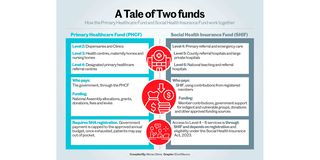
Care at Level 4, Level 5, and Level 6 facilities is accessed through SHIF, which is funded by contributions from registered members.
But to access primary healthcare, one must be registered with SHIF.
Kenya’s universal health coverage is delivered under two separate funds: the Primary Healthcare Fund (PHCF) and SHIF.
According to the Social Health Insurance Act (2023), SHA uses PHCF to purchase primary healthcare services from registered facilities. These include Level 2 (dispensaries and clinics), Level 3 (health centres, maternity homes, and nursing homes), and selected Level 4 (sub‑county and medium‑sized private hospitals) designated as primary healthcare referral centres.
The fund is financed through monies appropriated by the National Assembly, grants, donations, and fees or levies collected. In principle, services offered at these facilities are paid for by the government.
However, the Act stipulates that expenditure from the fund is limited to the annual budget estimates prepared by SHA at the start of each financial year. This means that once the allocated budget is depleted, users may be forced to pay for services out‑of‑pocket.
SHIF, on the other hand, applies to higher‑level facilities, from Level 4 to Level 6. Level 5 includes county referral hospitals and large private hospitals, while Level 6 refers to national teaching and referral hospitals.
SHIF is financed through contributions from registered individuals, allocations from the National Assembly for indigent and vulnerable groups, as well as donations and other innovative funding mechanisms.
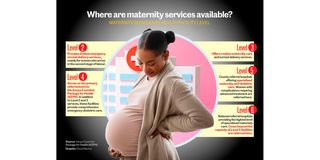
While SHA says adolescent mothers can access free delivery services at Level 2 facilities (dispensaries and clinics), the Ministry of Health’s Norms and Standards for Health Service Delivery is categorical about the circumstances under which this is possible.
It specifies that Level 2 facilities provide “limited (emergency) normal delivery services (clients found in stage 2).” In other words, they do not offer full maternity or labour management services but can conduct an emergency normal delivery for women who arrive when the cervix is fully dilated, and the baby is about to be born.
This is what happened to Irene*, who rushed to Ngomongo Dispensary in December last year, aged 18, when she went into labour.
“I used to go to Mathare North Hospital for the clinics, but the labour pains started so suddenly that I thought I’d give birth at Ngomongo Dispensary. When I got there, they told me to go to Mathare North Hospital. They said it was safer to give birth there,” she recalls.
From the Health Ministry’s website, Ngomongo Dispensary is a Level 2 facility in Ruaraka Sub‑County and has no maternity beds. Mathare North Hospital, by contrast, is a Level 4 facility in the same sub‑county and has 24 maternity beds.
She did not register for SHIF. She says she has neither a birth certificate nor a national identification card and has no idea where they might be. An orphan, she has been living on her own since the age of 14. She was also impregnated by a man who later denied ever knowing her.
“A good Samaritan paid my hospital bill after I gave birth. I honestly don’t know how much it cost, but she covered the expenses and took care of me and my twins for six months,” says Irene, who survives on domestic work.
So far, she is unaware of where or how to register her children for birth certificates.
Painful reality
The painful reality of girls being violated, impregnated, and rejected by their families is all too common in Kenya. When they end up in shelters, surviving on the kindness of well‑wishers, even registering for SHIF becomes impossible.
It is a harsh situation that Ivy Mureithi, who runs a Nairobi-based True Care New Day Centre, a sanctuary where hope is carefully rebuilt, one young life at a time, faces daily. She takes in pregnant adolescents from across Kenya, ensures they have safe births, and cares for them and their children. While well‑wishers are willing to cover their health insurance, enrolling them remains out of reach.
“What we have done is negotiate with a private facility that allows us to have the girls give birth at a fee of Sh6,000,” she explains.
A gazette notice issued on 8 May 2026 by CS Aden amended the Schedule to the Tariffs for Healthcare Services, indicating that normal delivery and essential newborn care cost Sh10,000, while caesarean section and essential new-born care cost Sh30,000.
It stated that all registered beneficiaries would access free delivery services at Level 2 and 3 primary healthcare facilities, financed through budgetary allocations.
However, a nurse at a health centre in Homa Bay paints a clearer picture: “First of all, you must have SHIF and have paid for it; not just registered. Registered and paid,” the health professional explained.
“Secondly, our health centre used to be classified as Level 3 but was downgraded to Level 2 because we were not equipped to offer delivery services. We do not have beds, and you cannot deliver a mother and send her home immediately. You must observe her for 72 hours post‑delivery.”
This observation period, the health professional said, is critical to ensure the mother is safe from complications such as postpartum haemorrhage – the excessive bleeding following childbirth.
Structural barriers
Yet even where services exist, experts say structural barriers continue to lock vulnerable adolescents out of care.
Martin Onyango, Associate Director of Legal Strategies for Africa at the Centre for Reproductive Rights, says the promise of universal healthcare often fails to reflect the realities facing teenage mothers, particularly those without parental support or official documentation.
“The universal care and social health insurance presuppose that everybody can access care universally provided in registered or qualified institutions, but that is not the reality,” he says.
According to Martin, one of the biggest obstacles begins with registration. Many adolescents, especially those heading child‑led households, lack the documents required to enrol in the system.
“The assumption is that all families are made up of father, mother, and children,” he explains.
“But there are child‑led households, where only the adolescent heads the family. They have no national ID card, no birth certificate. They cannot register into this system. So how can they access care?”
Even for those who manage to obtain the required documents, cost remains a barrier.
Martin says adolescents are often expected to register and make contributions before they can benefit from healthcare services, despite government commitments to universal access.
“You must make your contribution, otherwise you are ineligible,” he argues, adding that the system has failed to adequately accommodate young people who cannot afford to pay.
Beyond registration and cost
Beyond registration and cost, Martin points to another obstacle: healthcare workers who continue to demand parental consent before providing reproductive health services to adolescents.
For teenagers from unstable family backgrounds or child‑headed households, this requirement becomes an insurmountable barrier.
The consequences, he warns, extend far beyond delayed treatment.
“The long‑term impact is that we still record high rates of maternal mortality and morbidities,” he says.
“When people cannot access healthcare at the earliest opportunity, at the lowest level possible, they show up only when there are high‑risk cases. They are about to die.”
For Martin, improving outcomes for teenage mothers requires more than expanding services. It means dismantling the bureaucratic, financial, and social barriers that prevent adolescents from accessing care in the first place.
“We have created structural barriers that prevent young people from accessing the supposed universal healthcare service,” he says.
“Before we address those bottlenecks, we can talk, we can pontificate, but universal access will not be possible.”
Legal invisibility
Unmarried and teenage mothers are also less likely to register the births of their children, a gap whose impact on their sons and daughters lasts a lifetime.
This finding was among the presentations highlighting the legal invisibility resulting from inadequate civil registration, shared during the 4th Global Civil Registration and Vital Statistics and Gender Symposium held from 15–17 October 2025 in Nairobi. The Kenyan government hosted the symposium in collaboration with multiple partners.
“Among the barriers contributing to low registration rates is the long distance people must travel to registration facilities, which is costly and unaffordable for many,” noted Patrick Kaburi, Deputy Director at the Children’s Investment Fund Foundation.
This lack of registration strips girls and boys of their legal identities and locks them out of essential services such as education.
Patrick recommended that, with the expansion of healthcare coverage through community health promoters, civil registration services could be integrated at the community level to eliminate the barrier of high access costs.
To address the challenges of registering births, vital statistics stakeholders, who convened to share best practices for achieving universal registration and documenting all life events from birth through adulthood, proposed adopting a unique lifetime identifier for every citizen.
The struggle continues
For adolescent mothers like Emily and those cared for in Ivy’s shelter, health insurance is more than access to “free” maternity services; it is a struggle against the bureaucratic and social walls that block their path to care.
“I hope I’ll get a birth certificate for my daughter. Will they allow me if I don’t have a national identification card, or can I use my mother’s?” asks Emily*, posing a question that leaves many more unanswered.
Emily and Irene are pseudonyms to protect their identities.
This work was produced as a result of a grant provided by the Wits Centre for Journalism at the University of the Witwatersrand. The opinions held are of the author(s).