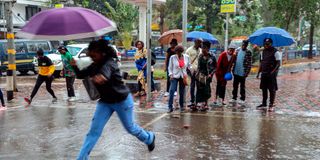
Heavy rainfall exceeding 20mm is expected to affect several parts of the country from Thursday, increasing the risk of flooding, landslides, and widespread damage.
The Kenya Meteorological Department (KMD) has warned of dangerous conditions across multiple regions from March 18 to 24, raising concerns about potential flooding, landslides, and disruptions to daily life.
In the advisory released on Wednesday, March 18, KMD forecasts that several parts of the country will experience rainfall exceeding 20mm within 24 hours, beginning Thursday, March 19. Rainfall intensity is expected to peak between March 20 and 23, then gradually decrease on March 24.
According to the forecast, the rains will affect a wide geographical stretch, including areas around Lake Victoria Basin, the Rift Valley, as well as the Highlands both east and west of the Rift Valley, including Nairobi.
Counties such as Kisumu, Kakamega, Nakuru, Kiambu and Narok are among those listed as high-risk zones.
“Residents of areas mentioned are advised to be on the lookout for potential floods, flash floods and poor visibility,” KMD warns.
Residents in affected areas have been advised to remain alert and take precautionary measures. Authorities have also warned that flooding and landslides may occur even in areas that have not received heavy local rainfall, due to upstream runoff.
In landslide-prone regions such as Elgeyo Marakwet, especially those with steep slopes and saturated soils, communities are encouraged to monitor ground movement and report any early warning signs such as cracks or unusual water seepage.
“People in landslides prone areas, especially over the slopes of the Aberdare ranges, Mt Kenya and other hilly areas should be vigilant,” KMD warns.
This latest advisory comes amid growing concern over increasingly erratic weather patterns linked to climate change. Kenya, like many countries in East Africa, has experienced a rise in extreme weather events in recent years, including prolonged droughts and sudden, intense rainfall.
Vehicles on a flooded road in Nairobi after heavy rains on March 6, 2026.
Photo credit: Nation Media Group
Kenya experienced heavy downpours during last year’s ‘October–November–December rains,’ which triggered deadly landslides in some parts of the country, such as Elgeyo Marakwet County in the Rift Valley. The disaster claimed the lives of at least 30 people, displaced families, destroyed homes, farms and critical infrastructure.
The disaster, which unfolded across the country’s fragile highland regions, exposed the deadly intersection of saturated soils, steep terrain and human settlement in high-risk zones
According to experts, the crisis was driven by changing rainfall patterns linked to climate change, environmental degradation, and land-use pressures, factors that continue to heighten Kenya’s vulnerability to recurring landslides and floods.
A man rummages through a flooded section of Sai Road in Nairobi’s Industrial Area on March 9, 2026 following heavy rains in the city.
Photo credit: Bonface Bogita | Nation Media Group
KMD cautioned people against attempting to cross flooded roads or rivers, noting that fast-moving water can be deceptively powerful.
Additionally, people are urged to avoid sheltering under trees or in open fields during thunderstorms due to the risk of lightning strikes.
“People are advised to avoid driving through or walking in moving water or open fields and not to shelter under trees or near grilled windows,” KMD cautioned, “to minimise exposure of lightning strikes.”
In a recent interview with the Nation , David Koros, the Assistant Director of Forecasting Services at KMD, explained why standing under trees is extremely dangerous.
Trees are at high risk of falling, which could claim people’s lives if they are sheltering under them. Moreover, during thunderstorms and lightning, they are among the most frequently struck objects.
“If lightning strikes a tree, the following can occur,” Koros said, “the electrical current can jump to nearby people or the tree can split or explode or the ground current can spread through the soil. This makes standing under trees extremely dangerous,” Koros added.
Government agencies, including disaster management teams and humanitarian organisations, have been placed on alert. Coordination efforts are expected to focus on early warning dissemination, evacuation planning, and emergency response readiness.
Urban areas, particularly Nairobi, face additional risks due to poor drainage systems and rapid urbanisation. Flooding in informal settlements and low-lying neighborhoods remains a recurring challenge during heavy rains.
For now, residents are urged to stay informed, follow official updates, and prioritise safety as the country braces for several days of potentially heavy rainfall.