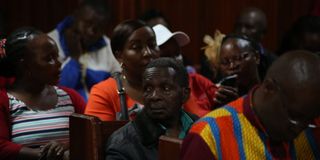
Victims of the 1998 US Embassy terror attack, which left over 200 people dead, among them 12 Americans, walked out of a Milimani High Court, heartbroken after their long-awaited compensation case was dismissed, 28 years after the blast.
Following the rejection of their petition, the over 1,500 victims will now seek further redress of their plight at the Court of Appeal and also at the International Criminal Court of Justice (ICCJ).
At the ICCJ, the victims will be seeking orders to compel foreign countries whose banks financed Al Qaeda terrorist activities to compensate them.
The judgment was rendered two days after a lead petitioner, Rev Evanson Ndung’u Gitu, died, while another victim, George Ngigi Njoroge, said he has cancer, which is at stage four. Mr Njoroge alleged the cancer resulted from the injuries he suffered during the terrorist attack.
Rev Gitu was instrumental in the collection of volumes of evidence presented to the court by Kituo cha Sheria lawyers John Mwariri, Nicholas Muinde and Dr John Khaminwa.
“We are dissatisfied with the judgement and we have instructions to move to the Court of Appeal and ICCJ,” Mr Mwariri told the trial judge.
“This is injustice. Whom do we turn to if the Government cannot protect and defend its own people?” Mr Njoroge wondered. “If any of the ruling class was a victim, we would have been compensated but now we are left at the mercy of God.”
Victims and survivors of the 1998 US Embassy bomb blast in a pensive mood at the Milimani High Court as the high court dismissed a petition seeking their compensation.
Photo credit: Billy Ogada| Nation Media Group
The US Government has already compensated relatives of US nationals who perished or were injured in the blast in excess of $5 billion (Sh640 billion).
Dismissing the petition, the High Court said the applicants failed to prove the State neglected its duty to prevent the attack. It was observed that the petition lacked merit and did not establish liability on the part of the government.
The judge said the petitioners had alleged that the State ignored repeated early warnings and failed to act to prevent the attack, including securing Kenya’s borders, despite the threat being made known or ought to have been known.
Victims and survivors of the 1998 US Embassy bomb blast in a pensive mood at the Milimani High Court as the high court dismissed a petition seeking their compensation.
Photo credit: Billy Ogada| Nation Media Group
A former US Ambassador to Kenya, Prudence Bushnell, was meeting Kenyan Cabinet Minister Joseph Kamotho when the attackers blew up the Embassy. They both survived with injuries.
The judge held that it was the obligation of the petitioners to prove claims that the government was negligent.
“The obligation placed on the State is clear. The State must take positive steps to prevent violations of the right to life,” the judge said, while quoting constitutional principles and international human rights standards.
Victims and survivors of the 1998 US Embassy bomb blast in a pensive mood at the Milimani High Court as the high court dismissed a petition seeking their compensation.
Photo credit: Billy Ogada| Nation Media Group
He, however, noted that under the Evidence Act, “the burden of proof lies on the person who desires the court to believe in the existence of facts.”
He went on to add: “the petitioners were required to demonstrate, on a balance of probability, that specific intelligence existed and that the government failed to act on it.”
On the question of delay, the government had argued that the petition was filed more than two decades after the attack, contending that the lapse of time had caused prejudice to the State.
Kituo cha Sheria advocate John Mwariri (right) at the High Court in Milimani on January 28, 2026, after victims of the 1998 US Embassy attack lost a compensation case over injuries suffered.
Photo credit: Richard Munguti | Nation Media Group
The petitioners countered the argument, saying they had been engaging the relevant government agencies over the years and were repeatedly given assurances that compensation was under consideration, adding that constitutional claims are not strictly limited by time.
“I find the explanation given by the petitioners for the delay in filing this petition satisfactory,” the judge said, adding that the State had failed to clearly demonstrate the prejudice they alleged.
“The claim of prejudice was made, but it was not articulated," the judge observed.
Justice Lawrence Mugambi dismissed a petition by the 1998 bomb blast victims seeking compensation.
Photo credit: Billy Ogada| Nation Media Group
The judge also addressed reliance on foreign court decisions, noting that the petitioners had cited judgments from the United States, which were not binding on the Kenyan Court.
“I have gone through the files, and I did not find any finding by American courts attributing neglect to the Kenyan government,” he said, adding that such material could not be relied upon to establish liability.
The judge further observed that no affidavits had been sworn by the authors of the reports relied upon, and that no demonstrable evidence had been produced to show that Kenya received prior intelligence and failed to act on it.
“Without evidence of failure on the part of the respondents, the averments by the petitioners remain hollow,” he said. “There is no basis upon which liability can be imposed.”
Victims of the 1998 US Embassy bomb last at the Milimani high court on January 28, 2026.
Photo credit: Billy Ogada| Nation Media Group
On the prayers seeking a declaration of State culpability and an order compelling the President to establish a commission of inquiry, the court declined, holding that such decisions fall within the discretion of the Executive.
“To grant this prayer would amount to meddling with the independence of another independent office,” stated the judge.
The court similarly rejected prayers directing the Attorney General to present a report on steps taken to obtain reparations from foreign states, noting that such actions could have serious foreign relations implications beyond the Attorney General’s constitutional mandate.
“Having found that the petitioners have failed to prove that their rights were violated, I find that the petition lacks merit and is hereby dismissed,” the judge ruled.