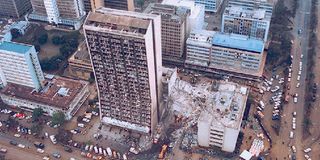
A trove of documents belonging to US’s Federal Bureau of Investigation(FBI) offer insights into the grilling of Mohammad Al-Owhali, one of the masterminds of the 1998 Nairobi terrorist attack, which claimed the lives of over 224 people and injured over 4000.
The interview which was conducted two weeks after the attack and over a four-day period at the CID headquarters in Nairobi was attended by two Kenyan CID officers, and two American detectives namely Mr Gaudin of the FBI and Mr Parola of the New York City Police both of whom were members of the joint Terrorist Task Force based in New York.
Also present during certain segments of the interview was Patrick Fitzgerald, the Assistant United States Attorney in the Southern District of New York who also doubled up as the Chief of the Organised Crime-Terrorism Unit.
“Throughout these interviews, the subject appeared to be in good health, well rested and in good spirits. The subject was examined by medical personnel from the FBI on several occasions and received treatment for the wounds he had obtained during the bombing of the embassy,” the document reads in part.
One of the many faces of Fazul Abdullah Mohammed aka Haroun Fazul, a key operative in the August 7th Nairobi bomb blast.
Although Born on January 18, 1977, in Liverpool England in 1977, Owhali had a Yemeni and a Saudi passport. He arrived in Kenya a week before the bombing, and on August 4, carried out a reconnaissance of the embassy in the company of Fazul Abdullah who was the head of Al-Qaeda cell in Kenya.
On that same day a meeting that brought together al-Qaeda operatives in Kenya was held at Fazul’s rented home in Runda followed by another one at Hill top Hotel on August 5. During both meetings Fazul warned that those who were not planning to die in the blast on August 7 should leave Kenya, on August 6 a day before the blast.
On the day of the bombing two trucks left a villa in Runda rented by Fazul and drove towards the US Embassy in Nairobi. Fazul drove a white Datsun pickup that led the way while Owhali was a passenger in a Toyota Cargo truck carrying the bomb and driven by Azam. Owhali had in possession a handgun, four stun grenades. The tun grenades were to be used to draw people inside the building towards the window in order to inflict heavy casualties.
He was also to manually detonate the bomb in case the detonation device malfunctioned. For this reason, he had a key to the compartment containing the bomb behind the truck. The truck approached the embassy’s rear access area but was blocked by another vehicle coming out of the underground garage.
At this point Owhali got out of the vehicle to force the guard to give them access. He had forgotten his pistol in the truck and was only carrying the stun grenades. Although it was a suicide mission, he threw the grenade in the direction of the security guard and fled on foot. He went to MP Shah Hospital in Nairobi for treatment after suffering some injuries during the attack but was later tracked by CID officers who arrested him on August 12.
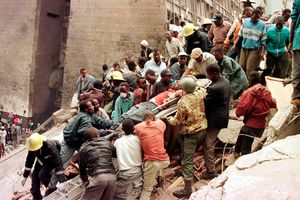
In this photo taken on August 8, 1998 firefighters and members of the public retrieve bodies after a bomb exploded near the US embassy and a bank in Nairobi, killing at least 60 people.
Photo credit: File | Nation Media Group
At first he identified himself to the police using the fake name Khalid Salim Saleh Bin Rashed and stated that he was from Yemen. Found in his possession were $800, some Kenyan money and a hospital report showing that he had received treatment at MP Shah. He was then taken to CID headquarters for questioning by Kenyan detectives who were joined by their American counterparts
The interview started in English but because of communication difficulty, it was decided that an Arabic translator should be brought in. Consequently, an interpreter working for a US agency was brought in but worked for only three days before he was replaced by an FBI Language Specialist. As part of identification, the CID conducted an identification parade whereby witnesses were asked to identify him. Fortunately, one witness was able to point him out. The following day the FBI fingerprinted al-Owhali for the first time since his arrest. But he was still evasive about his identity and his involvement in the bombing.
After being confronted by new evidence and perhaps because of torture which an interpreter later claimed to have witnessed, Owhali eventually agreed to talk. Almost immediately Fitzgerald the Assistant Attorney handed him a Miranda rights waiver form to sign. Miranda rights are a set of warnings that police in the United States are required to give to a person in custody before questioning them. It informs them of their constitutional rights, including the right to remain silent and the right to have a lawyer. However, a person can waive his Miranda rights allowing him to be questioned by law enforcement officers.
Owhali refused to sign the waiver form insisting that he could only do so if he was given a guarantee that he would be tried in the US and not Kenya. Fitzgerald tried to tell Owhali that although he could not promise a trial in the US, he would make recommendations to the Attorney General for him to stand trial in the US. It was only after he received reasonable assurance that he would be indeed tried in the US, that he revealed his true identity by giving his real name, nationality and proceeded over the next four days to inculcate himself in the bombings.
“It should be noted that during these interviews the subject received food and water on a regular basis as well as snacks when he requested them. The subject also made frequent requests to pray and was given every opportunity to do so. Before the interrogation upon being presented with this form, Owhali signed it and agreed to waive his Maranda rights and tell all he knew about the bombing in Nairobi on 7 Aug 1998,” read an FBI report.
“At the beginning of each separate interview, subject was presented with the form explaining his Miranda rights and each time subject agreed to waive these rights.”
The interrogation focused on five parts, mainly his background information, training in Afghanistan, planning and preparation, day of the bombing and additional information. He informed the investigators that he joined Al-Qaeda in the mid-1990s and thereafter received training in explosives, hijacking, kidnapping assassination and intelligence techniques in Afghanistan. In 1966 he met with Osama Bin Laden and accompanied him to meetings and conferences.
About his role in the August 7 bombing, Owhali told the detectives at CID headquarters that he travelled from Pakistan to Kenya a week before the bombing and on August 4 in the company of another terrorist conducted a reconnaissance of the American embassy. A decision was eventually reached to park the truck as close as possible to the rear of the building instead of driving it into the embassy’s underground garage or a place in front of the building.
A file photo taken on August 8, 1998 shows police workers removing the remains of the car-bomb used to destroy the US embassy in Nairobi, that killed 280 Kenyans and 12 Americans.
Photo credit: Alexander Joe | AFP
Travelling with an associate in the bomb truck, they drove to the embassy from Runda where he threw a grenade at the guard and fled even though the operation was to be that of martyrdom. He revealed that after fleeing, he headed to MP Shah hospital where he discarded in the hospital’s bathroom three bullets and two keys for the padlock of the rear door of the bomb truck. The keys and the bullets were later recovered at the hospital following this revelation.
In another interview transcript Owhali narrated to FBI agents in a later proffer session how Osama decided to send some members of Al-Qaeda to Kenya after scanning a map of Kenya which had been presented to him by one of his lieutenants. The first person he sent to Kenya was a member of the Shura Council, which was responsible for security within Al-Qaeda. He was followed by two other Al-Qaeda members who joined him in Mombasa.
The reason why Osama instructed them to settle in Mombasa was because their physical appearances were similar to those of inhabitants of the coastal part of Kenya. He encouraged them to integrate with the locals by marrying their girls and starting businesses.
Although names of these terrorists sent to Mombasa are redacted on the documents, Mohammed Saddiq Odeh was likely to be one of them. He moved to Mombasa and set up a fish business using capital provided by Mohammed Atef. He fled to Pakistan on the day of the bombing but was arrested for using a forged passport and repatriated to Kenya where he was handed to the CID. Just like Owhali, he was interrogated at CID headquarters by Kenyan and US detectives in the presence of Tim O'Neill, Assistant United States Attorney.
Following the interrogation, it was decided that both Owhali and Odeh should be flown to the US to stand trial. However, there was fear that the decision could trigger anger among Kenyan citizens who wanted them to be tried locally. For this reason a decision was reached to transfer Owhali first to the US on August 26, 1998, while Odeh remained in the custody of GSU . This was to allow the Kenyan government to gauge the reaction of the public. With no reaction from the Kenyan public, Odeh was flown to the US the following day aboard a US Air Force plane. Both Owhali and Odeh were sentenced to life imprisonment and are imprisoned at USP Florence Colorado and Penitentiary Coleman Florida respectively.