The High Court has softly redrawn the rules governing multi-billion-shilling public projects, signalling that a lack of transparency alone can be enough to halt construction, even at advanced stages.
In the Ngong–Riruta railway case, the court last week stopped a Sh11.5 billion project and ordered disclosure of critical documents, finding that the State had been “at best evasive” in responding to requests for information.
The court rejected blanket confidentiality claims in public procurement, elevating Article 35 of the Constitution on access to information into an enforceable compliance duty, even in big-ticket projects.
“Privileged communications and genuinely confidential materials remain exempt, but vague assertions of confidentiality do not suffice to displace the constitutional right to information,” said the court.
The ruling goes beyond the railway dispute, raising deeper questions about how major infrastructure projects are financed, approved and executed, and whether billions in public funds are being committed outside clear constitutional and statutory frameworks.
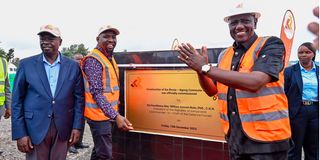
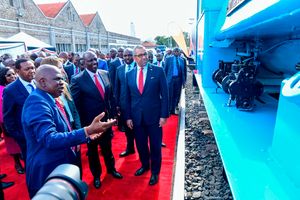
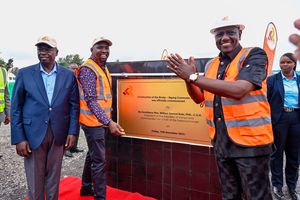
The project was commissioned in December 2023 by President William Ruto, before construction began in early 2024. China Road and Bridge Corporation (CRBC) was hired as the contractor, while The APEC Consortium Co. Ltd was engaged as the consultant.
President William Ruto launches the Riruta-Ngong railway in December 2023. Looking on are then-Deputy President Rigathi Gachagua and then-Roads CS Kipchumba Murkomen (on Dr Ruto's left).
Photo credit: File | Nation Media Group
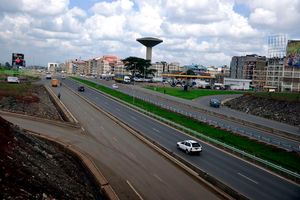
The project was intended to provide last-mile commuter rail connectivity between Riruta, in Nairobi and Ngong, in Kajiado, decongest Ngong Road, and enhance integration with the existing railway network.
Construction had already reached about 40.5 per cent when the court intervened, issuing interim orders halting further works pending the determination of the case.
Despite the advanced stage, the court declined to allow the project to proceed, warning that continued spending risked entrenching constitutional violations.
“The dissipation of public funds is perhaps the most acute form of irreparable harm in constitutional litigation. Any attempt at recovery would require further expenditure of public resources and would likely be met with legal obstacles, including the principle of restitution in favour of bona fide contractors who have performed work in good faith,” the court ruled.
At the centre of the dispute is the use of the Railway Development Levy Fund to finance the project.
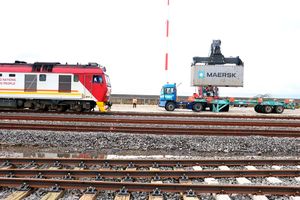
The law limits the fund to the construction and operation of a standard-gauge railway network, yet the project is a metre-gauge commuter line.
The court found that this raised a serious constitutional question requiring a full hearing, rejecting the State’s arguments that the project was merely a feeder to the standard gauge railway.
Equally significant were concerns over public finance approvals. Evidence presented showed that no funds were allocated to the project in the 2023/24 financial year, even as construction was ongoing.
But the court rejected that position, stressing that Parliament retains exclusive authority over public expenditure.
“Appropriations-in-Aid are a budgetary mechanism, not a device to override the specific purpose limitation,” the court said.
The procurement process also came under scrutiny. The project contractor and consultant were allegedly single-sourced, raising questions about compliance with constitutional requirements for fairness, equity and competitiveness.
The State argued that the contractor and consultant were directly procured on grounds of “standardisation and compatibility” with existing railway infrastructure and prior works. The State counsels claimed the firms had handled related railway projects such as the SGR-linked works and were therefore best placed to deliver the project seamlessly.
However, the court noted that no tender evaluations or market analysis had been provided to justify the approach.
On access to information, the court was unequivocal, finding that repeated requests for key documents, including feasibility studies and contracts, were ignored or inadequately addressed.
“The Respondents’ engagement was at best evasive, and at worst wholly non-compliant with both constitutional and statutory obligations,” the court said.
The court ordered immediate disclosure of the documents, including feasibility studies, procurement records, financing agreements and environmental approvals, stating that access to information is a constitutional right, not a discretionary privilege.
“Any limitation must satisfy the test of necessity and proportionality in an open and democratic society,” the court added in a ruling that points to a shift in how courts approach major public projects.
Traditionally, courts have been asked by the State not to halt large infrastructure works once substantial funds have been committed.
This ruling departs from that approach, holding that transparency failures alone can justify intervention. It also highlights the growing role of public interest litigation in shaping governance.
“No amount of expenditure can sanitize an unconstitutional action,” Justice Bahati Mwamuye warned. “The doctrine of legality requires that all state action, including expenditure of public funds, must conform to the Constitution from inception to completion,” he added.
The judgment places Kenya’s mega infrastructure projects, such as the Standard Gauge Railway, the Arror and Kimwarer dams, and more recent investment deals, under renewed scrutiny.
“There can be no greater public interest than upholding the Constitution and the law,” the court held.
The case will proceed to full hearing, where the court will determine the legality of the project and the use of public funds.