Kenya’s public debt rose to Sh12.29 trillion in the six months between June 1 and December 31, 2025, according to a new report by the Controller of Budget Margaret Nyakang’o.
As of December 31, 2025, the public debt stock stood at Sh12.29 trillion, representing a four percent increase from Sh11.80 trillion in June 2025.
The amount includes Sh6.82 trillion borrowed from domestic lenders and Sh5.46 trillion borrowed from external lenders.
As of December 31, 2025, the public debt stock stood at Sh12.29 trillion, representing a four per cent increase from Sh11.80 trillion in June 2025.
Photo credit: Shutterstock
Dr Nyakang’o explained that the increase in the first six months of the 2025/2026 financial year amounted to 67.8 percent of the national GDP, exceeding Parliament’s approved threshold of 55 percent.
The total public debt and publicly guaranteed debt has continued to rise over the years due to the national government borrowing to finance budget deficits and to pay interest accumulated on unpaid debts from previous years.
Domestic borrowing was largely sourced from Treasury bills and bonds with the Central Bank contributing a small portion. During the first half of the 2025/2026 financial year, the government reduced borrowing from external lenders.
While domestic borrowing contributes positively to the development of the local debt market, the CoB cautioned that increased borrowing leads to higher interest rates, which in turn reduce investment due to the high cost of borrowing, thereby crowding out private sector investment.
An analysis of domestic debt based on its holders shows that financial institutions, such as commercial banks and insurance companies, held the largest share.
The national government budget for the 2025/2026 financial year was Sh4.69 trillion, compared to Sh4.37 trillion for the 2024/2025 financial year.
“The Education sector received the highest budget allocation of Sh703.07 billion, followed by Energy, Infrastructure, and Information Communication Technology, which received Sh534.63 billion, reflecting their key role in the economy,” stated Dr Nyakang’o.
To finance the budget, the CoB explained that the government, through the National Treasury, targeted funds from various revenue sources, including tax and non-tax revenue, borrowing (both external and domestic), grants, other domestic financing and ministerial Appropriations-in-Aid (A-IA).
To effectively manage high domestic borrowing and the associated interest rates, the CoB urged the government to implement measures to reduce budget deficits in the medium term, in line with the 2025 Budget Policy Statement (BPS).
During the first six months of the 2025/2026 financial year, the national government spent Sh2.18 trillion, compared to Sh1.76 trillion during the same period in the 2024/2025 financial year.
The CoB highlighted several challenges affecting budget implementation including incomplete automation of procurement and exchequer processes for national government entities and low absorption of the development budget.
According to the CoB, the increased use of Article 223 during the first six months was mainly directed toward other operating expenses and the buyback of an international sovereign bond.
Article 223 allows the National government allows the National Treasury to spend on emergencies without the approval of parliament. The law demands that Treasury seek approval from parliament within two months after the withdrawal of funds from the consolidated fund.
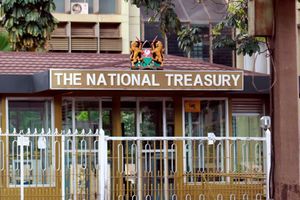
The National Treasury Building in Nairobi.
Photo credit: Pool
The Controller of Budget approved Sh115.11 billion, comprising Sh8.66 billion for development expenditure and Sh106.44 billion for recurrent expenditure, representing two percent of the gross estimates.
Of the total exchequer issues under Article 223, Sh86.29 billion (75 percent of the total requests) was allocated to the issuance of an international sovereign bond for liability management operations during the 2025/2026 financial year.
To address the challenges, the CoB recommended collaboration among all stakeholders in implementing the Electronic Government Procurement System, including its integration with Ifmis, training of users (both staff and suppliers), and technical support to accelerate the procurement of planned activities.