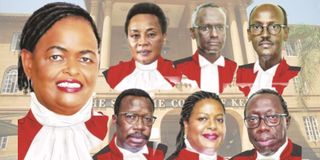
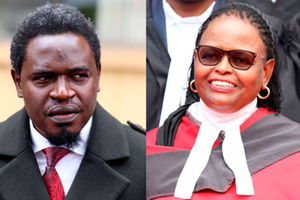
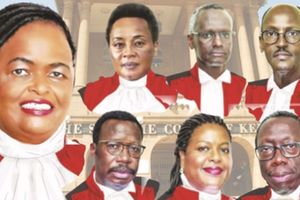
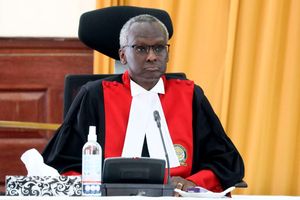
A tense constitutional battle dominated Kenya’s legal landscape in 2025 as the Supreme Court judges, including Chief Justice Martha Koome, fought off an unprecedented disciplinary trial and push by three petitioners to remove them from office.
What began with years of sustained social media firestorms by lawyer Ahmednasir Abdullahi and contentious litigation involving the auction of politician Raphael Tuju’s properties morphed into one of the most explosive institutional standoffs in the country’s recent history.
Lawyer Ahmednasir Abdullahi.
Photo credit: File | Nation Media Group
The conflict’s immediate roots trace back to a series of denunciations on social media platforms by prominent lawyers, including senior counsels Ahmednasir Abdullahi and Nelson Havi.
Their posts targeting the top judges drew sharp rebukes from the Supreme Court and helped crystallise complaints that would fuel formal ouster efforts through the Judicial Service Commission (JSC).
In January 2024, the apex court judges barred Mr Ahmednasir and lawyers working at his law firm from appearing before the Supreme Court, citing an alleged campaign that sought to “scandalise, ridicule, and denigrate” the institution. His rallying cry, ‘jurispesa’, had gained prominence among the legal fraternity in the country.
The Judicial Service Commission (JSC), the constitutional body charged with enforcing discipline in the Judiciary and punishing errant behaviour, became the crucible for these disputes.
In January 2025, Mr Havi, together with former Cabinet Secretary Raphael Tuju and lawyer Christopher Rosana, filed petitions at the JSC arguing that Chief Justice Koome and her colleagues should be ousted.
These petitions alleged misconduct, misbehavior, and incompetence in their judicial roles. In February 2025, the JSC formally ordered the Supreme Court judges to respond to the removal petitions, signalling the start of an official disciplinary process.
Chief Justice Koome and the Supreme Court judges responded not in the JSC chambers, but in the High Court, challenging the very basis of the JSC’s authority.
Under Articles 171 and 172 of the Constitution, the JSC has the authority to investigate and recommend the removal of judicial officers for incapacity, incompetence, or gross misconduct.
Judges and lawyers aligned with the judiciary argued that the JSC was overstepping its mandate by scrutinising decisions made in the exercise of the Supreme Court’s constitutional duties.
CJ Koome and her colleagues turned to the High Court to halt the JSC proceedings, resulting in a series of conservatory orders that temporarily blocked the JSC from continuing its intended disciplinary process.
In her petition, Justice Koome argued that the Supreme Court has ultimate authority over the JSC on matters of removal of judges of superior courts, underscoring her legal position that the JSC lacked jurisdiction over judgments rendered in the lawful exercise of judicial power.
“The JSC does not, whether by virtue of the provisions of the Constitution or any other law, have the jurisdiction to deal with a petition or claim against the judges of the Supreme Court,” Justice Koome said in her court papers.
The proposed ouster also revealed a legal lacuna that many had not seen: Where does an entire bench of the Supreme Court file an appeal in case of removal from office?
According to Article 168 of the Constitution, a judge removed from office after a tribunal investigation has the right to appeal the decision directly to the Supreme Court within 10 days, allowing the apex court to review the tribunal’s findings and recommendation for removal.
“By admitting the petitions against all justices of the Supreme Court, the first respondent (JSC) has contrived a situation through which the petitioner (Justice Koome) is denied the right of a fair hearing as prescribed and enshrined in articles 25, 47, 50 and 1668(8).
Indeed, it further denies the right of appeal to any other Justice of the Supreme Court,” said Justice Koome in her petition. She is also the JSC chairperson.
The High Court’s intervention granted the judges reprieve. A February ruling in Narok issued a conservatory order preventing the JSC from compelling responses to removal petitions, stating the process should remain suspended pending a full hearing.
The political and legal implications were profound. Mr Tuju added fuel to the fire with a series of scathing letters to the Chief Justice, accusing the Supreme Court of bias and irresponsibility.
Former Cabinet Secretary Raphael Tuju.
Photo credit: File | Nation Media Group
In one letter, Mr Tuju complained that a panel of five Supreme Court judges had authorised the auction of his 27-acre Karen property in a dispute with the East African Development Bank.
“The law cannot be the foundation of morality… Morality is the foundation of good law,” he wrote, characterising the ruling as immoral and unprecedented.
Mr Tuju petitioned the JSC to take disciplinary action against the judges after five of them—Deputy Chief Justice Philomena Mwilu and Justices Mohammed Ibrahim, Smokin Wanjala, Njoki Ndung'u, and William Ouko—disqualified themselves from the case, allowing the auction to proceed.
In the complaint, Mr Tuju’s Dari Limited asked the JSC to remove the entire seven-judge bench over alleged misconduct and negligence, arguing that the Supreme Court was working on a predetermined outcome.
He was aggrieved that after the recusal of the five judges, the remaining two—CJ Koome and Isaac Lenaola—could not have an appropriate quorum to handle the case.
The Supreme Court of Kenya (Procedure) Rules and the Supreme Court Act both stipulate that all matters before the Supreme Court must be heard by an uneven number of judges. This is designed to ensure that in the event of a disagreement, a clear majority decision can always be reached.
Mr Tuju’s campaign also amplified public scrutiny of the Judiciary and dovetailed with the JSC’s broader disciplinary actions.
However, Justice Koome and her fellow judges firmly rejected the notion that they are above accountability, emphasising that the Constitution defines the scope of disciplinary oversight.
In their legal filings, they argued that no constitutional provision grants the JSC authority to probe decisions rendered by the Supreme Court in the legitimate exercise of judicial power.
They insisted that allowing the JSC to “entertain, hear, or determine” such petitions would undermine public confidence and constitute a mockery of justice.
Another key argument was that at the time the JSC asked them to respond to the proposed ouster petitions, the commission lacked regulations to guide the processing of petitions and complaints.
Interestingly, on December 1, 2025, members of the JSC engaged the judges of the Supreme Court on the Judicial Service (Processing of Petitions and Complaints Procedures) Regulations, 2025.
“The Regulations seek to establish clear, consistent and efficient procedures for the management and processing of petitions filed against judges, as well as complaints lodged against judicial officers and staff,” said the commission.
Former Law Society of Kenya president Nelson Havi.
Photo credit: File | Nation Media Group
The battle played out against a backdrop of intense legal filings and jurisdictional jockeying. In July, Mr Havi sought to have a three-judge bench hearing the removal petitions disqualified on grounds of conflict of interest, arguing that Justice Koome, who appointed the bench, should not preside over matters in which she is directly involved.
Meanwhile, the High Court in late 2025 upheld the composition of that bench, dismissing arguments that its members lacked independence.
The clash between the Supreme Court and the JSC revealed deep fissures over the interpretation of Articles 163 and 168 of the Constitution—particularly over which arm of the justice system has final say in disciplining and removal of judges.
Ms Koome’s camp cited Article 168(1) to stress that grounds for removal are narrowly defined and must be construed with respect for judicial independence.
Beyond the legal wrangling, the dispute laid bare tensions between judicial independence and accountability in a highly charged political environment.
Supporters of the Supreme Court judges lamented the online vilification of the judiciary, which the Kenya Magistrates and Judges Association decried as intimidation tactics undermining judicial functionaries.
By year’s end, the battle remained unresolved but had reshaped public discourse on the separation of powers. The judiciary had won crucial procedural victories, but the underlying questions about its accountability mechanisms linger.
As Justice Koome and her colleagues prepare for further hearings and possible escalations in 2026, the outcome will carry implications for Kenya’s rule of law and institutional balance of power.