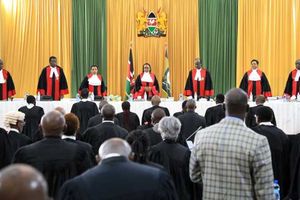
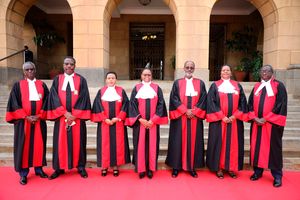
The Judicial Service Commission (JSC) has dismissed a series of petitions seeking the removal of six judges, including Chief Justice Martha Koome, ruling that the applications failed to meet the constitutional threshold required for ouster.
Among those cleared were Supreme Court judge Isaac Lenaola, Court of Appeal judges Asike Makhandia and Kathurima M’Inoti, and High Court judge Alfred Mabeya.
High Court Judge Alfred Mabeya.
Photo credit: File | Nation Media Group
The complaints were filed separately by former Law Society of Kenya (LSK) president Nelson Havi, businessman Edwin Dande, Ms Victoria Naishorua, as well as two companies —Benjoh Amalgamated and Muiri Coffee Estate, which are associated with Captain (Rtd) Kung’u Muigai.
Mr Havi had petitioned for the removal of Chief Justice Koome, accusing her of misconduct for empanelling a three-judge bench to hear a case she and other Supreme Court judges had lodged against the JSC.
He argued that she should have delegated the empanelment, alleging a conflict of interest.
However, the Commission ruled that empanelment of benches under Article 165(4) of the Constitution is an exclusive prerogative of the Chief Justice.
The JSC cited a recent Court of Appeal judgment that affirmed this interpretation, concluding that Chief Justice Koome had acted out of what it termed “constitutional necessity.”
“The petition was tabled before the Commission at its meeting of July 30, 2025, and upon deliberation, the Commission concluded that it did not meet the threshold for removal of a judge under Article 168 of the Constitution,” JSC Secretary Winfridah Mokaya said.
The JSC also dismissed claims that the Chief Justice had deliberately selected junior judges loyal to her. It noted that judicial appointments are a collective responsibility of the Commission and cannot be attributed to individual influence.
“Judicial appointments are made collectively by the Judicial Service Commission and cannot be construed as creating undue personal loyalty to any one individual. The fact that some empanelled judges were appointed during the Chief Justice’s tenure as Chairperson does not in itself compromise their independence or impartiality,” the Commission stated.
In another petition, Ms Naishorua challenged Justice Lenaola’s role as executor of the estate of the late politician John Keen.
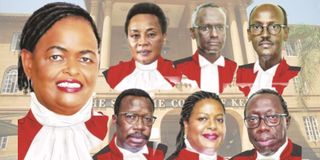
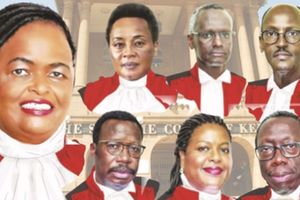
Supreme Court judges (from left) Isaac Lenaola, Dr Smokin Wanjala, Philomena Mwilu, Chief Justice Martha Koome, the late Mohamed Ibrahim, Njoki Ndung'u and William Ouko.
Photo credit: File | Nation Media Group
The JSC declined to consider the matter, citing the sub judice rule since the case is already pending before the High Court in Succession Cause No. 123 of 2017.
“The Commission, therefore, observed that delving into a petition of such a nature is outside its mandate. This is therefore to convey to you the above decision of the Commission disallowing your petition against Justice Isaac Lenaola,” the JSC told Ms Naishorua’s lawyers, Murgor & Murgor Advocates.
Two complaints against Justice Mabeya—filed by Mr Havi and Mr Dande—were also rejected. Mr Havi had contested the judge’s ruling in a land dispute between the Pumwani Riyadha Mosque Committee and Gikomba Business Limited.
The JSC found that, while the complaint appeared to meet the threshold, the case had already been heard on appeal and determined by the Court of Appeal.
“The Commission observed that delving into such a petition would be tantamount to sitting on appeal or reviewing a court’s decision, a mandate that lies outside its jurisdiction,” Ms Mokaya explained.
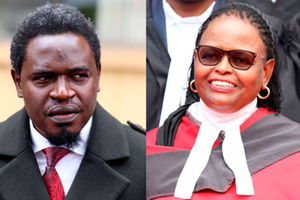
Former LSK president Nelson Havi.
Photo credit: File | Nation Media Group
Mr Dande, for his part, accused Justice Mabeya of mishandling two Cytonn Investments insolvency cases.
The JSC dismissed the claims, stating that the rulings and orders were issued in the course of judicial authority and discretion. Any dissatisfaction, the Commission said, should be pursued through appeal or review.
“In arriving at this decision, the Commission noted that the substance of your allegations pertained to the manner in which the judge handled the two matters. The Commission observed that the issuance of the orders, rulings and directions complained of were done in the exercise of judicial authority and discretion in the course of hearing and determining the matters before him,” Ms Mokaya said.
Additional allegations that Justice Mabeya had colluded with unnamed lawyers were dismissed as vague and unsubstantiated.
In another petition, Benjoh Amalgamated and Muiri Coffee Estate accused Justices Makhandia and M’Inoti of upholding a “non-existent consent judgment” dating back to 1992, which they claimed had led to the auction of their property.
The JSC rejected the complaint, finding that the judges acted within the scope of their judicial authority.
“The Commission found that the judges acted within the scope of their judicial authority and exercised judicial discretion in rendering the judgment. Dissatisfaction with the outcome of the case, therefore, falls outside the mandate of the Commission,” Ms Mokaya said.
In all rulings, the Commission underscored the limited scope of its role under the Constitution, stressing that judicial discretion, once exercised, cannot be grounds for removal unless there is clear evidence of misconduct.